
[ad_1]
 How much attention do you pay to…well, attention? Attention is one of those many brain functions that you don’t notice or think about when it is working fine, but can become debilitating if it is impaired in any way, and we notice when it is stressed to the point of failure. Otherwise we don’t have much reason to contemplate the incredibly demanding and complex neurological process of managing attention. Recently neuroscientists have added one more piece to the puzzle of what we call the neuroanatomical correlates of attention – which parts of the brain are doing what.
To review, attention is a critical neurological function the primary purpose of which is to allocate limited brain resources for processing external stimuli and internal thoughts. When you attend to something you process more information about that thing more robustly while simultaneously actively suppressing other (distracting) information. There are basically two types of attention – a top-down goal oriented attention and a bottom-up stimulus response attention. So, when reading a book, for example, you are focused on the page and processing the squiggles into words and the words into meaning. If a loud noise occurs, that will involuntarily grab your attention.
It has long been know that the frontal lobes are critical to attention, particularly goal-oriented attention. But attention is also widely distributed throughout the brain, particular in the frontoparietal attention networks. Frontal lobe executive function is a sot of master control, directing attention and focus, and critical for switching tasks. Attention has wide-ranging effects throughout the brain, however, which makes sense given it can affect so many functions.
It has also been known that the superior colliculus is a critical attention hub. This is a primitive subcortical structure that initially was thought to only be involved in vision and eye movements. However, we now know it also overlays information from auditory and visuospatial centers of the brain. These overlapping maps of the world allow the superior colliculus to focus attention on one thing and then actively suppress all other sensory information. This is partly why phenomena like inattentional blindness can be so profound – when focusing your attention on one thing, you can entirely miss even large objects in your visual field (see here for a classic demonstration). You literally become blind to such things because at a basic neural level the information is being suppressed.
You can also see this in various optical illusions, like the vanishing dots. Stare at the center dot and the peripheral dots will disappear. Here, the rotating red grid is deemed “high priority” by your brain’s attention system. The peripheral static yellow dots are deemed low priority and suppressed, and literally vanish.
There is at least one layer deeper here – how does the brain determine the demarcation between high and low priority objects? The vanishing dots illusion is specifically constructed to maximize the difference between high and low priority objects, but the real world is a continuum of fuzziness. This brings us to the current study.
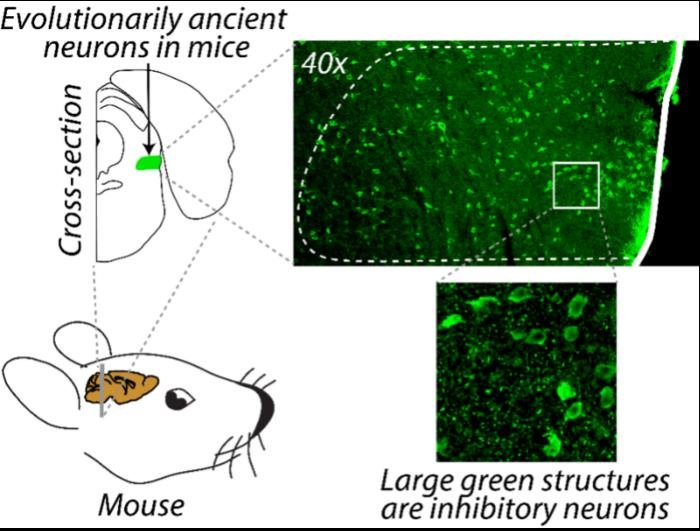
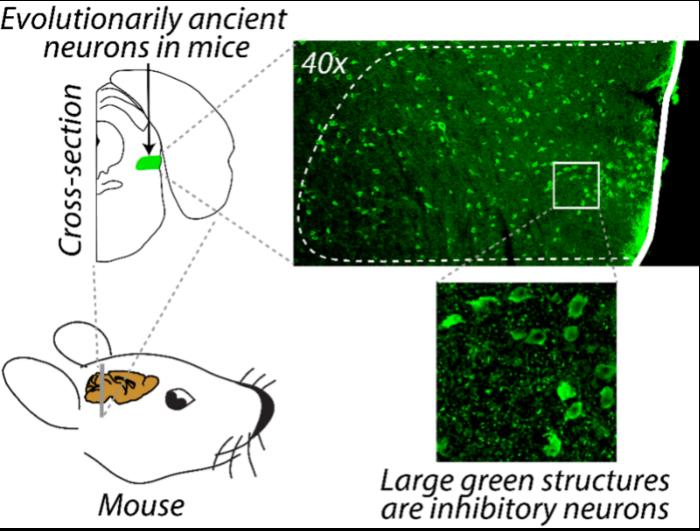
The researchers looked at mice, who they trained on an attentional task – they had to focus straight ahead and wait for the proper trigger, then touch their nose to the screen to receive a reward. Meanwhile, distracting objects were shown in their periphery. The mice quickly became good at focusing on the task and ignoring the distractions. Then, however, the researchers suppressed a specific structure in the brainstem, the PLTi. This brainstem region contains inhibitory neurons that connect to the superior colliculus, so it was a likely candidate for such a function. They found that when PLTi was inhibited the mice became highly distractable, and could not maintain their focus on the task. When the PLTi was active again, they resumed their prior good task performance. The researchers found that the PLTi’s main function was to improve the “accuracy and categorical precision of the decision boundary separating the target from lower-priority distractors.”
Because this network is in such an evolutionarily ancient part of the vertebrate brain, it is possible and even likely that the PLTi is common to all vertebrate brains, including humans. That, of course, is an obvious next stem – confirm that the PLTi has the same function in humans as in the mice in this study. It is possible that higher frontal lobe functions in humans may have diminished the role of the PLTi, but I would bet that it has the exact same function as in mice. If so it is then possible that dysfunction of the PLTi may be one potential cause for some types of attention deficit disorder (ADD).
For psychological and cognitive disorders, they are typically first identified and diagnosed as a cluster of signs and symptoms – a clinical syndrome. As they are studied further, subtypes may be identified. It may be much later that we start to unravel the
“neuroanatomical correlates” – the underlying brain circuits that are responsible for the neurological functions involved in the disorder. In the last couple of decades the technology for looking at brain circuits has improved significantly, and we have been making a lot of progress looking for those correlates. What this all means is that there are many neuropsychological syndromes that are basically clinical diagnoses, with several or even many underlying conditions being lumped together because they have similar or overlapping symptoms. This is very likely true of ADD.
It is therefore possible that some people with clinical ADD may have a decrease in executive function, while others may have decreased function in their PLTi. Both could result in being highly distractable, but for entirely different neurological reasons. And of course this means that the most effective treatment may also be very different. For now the advanced tools we use to research brain function and the correlates of clinical syndromes are mainly limited to research. They are only now just starting to be used for clinical diagnosis (the threshold of utility are vastly different between research and clinical use). The hope is that as our information improves and these tools improve they will cross the threshold to being useful diagnostic tools. That will mean that they predict something useful, such as the probability of responding to various treatments.
What sometimes happens in the history of medicine, and what we hope to have happen, is that the categories of clinical subtypes of a disorder will be rearranged to align with specific neuroanatomical correlates (or underlying pathophysiology), which then determines which treatments are appropriate. Currently attention deficit has three different “clinical presentations” – inattentive type, hyperactive type, or combined. In the future we may instead diagnose a PLTi type vs a frontoparietal type vs some other specific neurological type, with completely different treatments. There is a lot of research between here and there, but it is always good to see such progress.
[ad_2]
Source link
