
[ad_1]
 The primary claim of the cryptoterrestrial hypothesis is that all the unidentified anomalous phenomena (UAP) sightings that were immensely popular in the media during the summer of 2023 do not come from above, they come from below—or to the side. The nonhuman intelligences are from Earth and represent a wide variety of different possible sources. This is according to an article published in the Journal of Philosophy and Cosmology (Lomas et al. 2024).
I want, right away, to establish the difference between what is possible and what is probable. I’m not going to give the deepest philosophical definition, but I want to say that something is possible if it is not necessary that it not be the case. Possibility means that there is no contradiction in it happening. It is not possible that a door can be both open and closed at the same time. It must be one or the other.
Probability is a very different creature. An idea has to be possible before it can be probable, but an idea does not have to be probable to be possible. Probability concerns the likelihood of an event. If we are to take an idea as possible, it means that there is no rational contradiction between the idea and itself or between the idea and the external world. In the case of the latter, it means that the flat-earth hypothesis is impossible. For it to be true would mean that there is a whole new natural world we must now define. The prime maleficent of the flat-earth conspiracy theory is the force of gravity, and gravity cannot exist on a flat earth. This is much different than the 9/11 Truther conspiracy theory, which claims that the United States government “let it happen on purpose,” because there would be no inherent contradiction or violation of the world were that theory true. This means that it is possible to be the case, but it does not mean that it is true or even likely to be the case.
This is a salient difference because what the cryptoterrestrial hypothesis claims is not that nonhuman intelligence exists and comes from underground or in some hidden society among us but that such a claim should not be dismissed out of hand. My contention, and the goal of this article, is to argue that the proponents of the theory do not make their case, and thus the cryptoterrestrial hypothesis does not need to be considered a tenable hypothesis. In short, we can reject this theory out of hand and still maintain epistemic honesty. To do this, I first give an overview of the debate within the philosophical study of conspiracy theories between the particularists and the generalists. Then I will point out that while the cryptoterrestrial hypothesis is not impossible, it is improbable to the point that it should be summarily dismissed. I will use the evidence that the proponents use in support of their position to explain that their position is not sustainable.
A Conspiracy Theory?
Why are we discussing two camps within the conspiracy theory debate when talking about the cryptoterrestrial hypothesis? I want to make the assumption the cryptoterrestrial hypothesis is no less a conspiracy theory than the explanation that an alien spacecraft crashed in Roswell, New Mexico, on June 14, 1947. The cryptoterrestrial hypothesis’s allegation aligns much with Brian Keeley’s (1999) definition of a conspiracy theory. The cryptoterrestrial hypothesis is claiming an alternate explanation of an observed phenomenon (such as UAP) that is being hidden by a group of actors (various government agencies) for which the evidence is insufficient to support the claim (more on that below). Keeley offers the requirement that the goal must be nefarious, which I don’t think is met (but that is a discussion for a different time). I don’t require that a conspiracy theory have a malevolent motive as a necessary feature. Preventing widespread panic by concealing the truth can be a justifiable motive, but this is a matter of debate.
In the literature of the conspiracy theory world, there is a debate between two camps: the particularists and the generalists. The particularist position argues that any explanation, even if it is considered a “conspiracy theory,” ought to be taken on its own merits before being dismissed or accepted. The opposing camp, that of the generalists, take the stance that if an explanation of an event/phenomenon is considered a “conspiracy theory,” we should reject it out of hand. The latter position is taken by social scientists, who usually define “conspiracy theory” as something that is false, debunked, or disproven. The particularist camp is more generous, allowing that their explanations are usually not “false”; rather they are unsupported.
What the cryptoterrestrial hypothesis is asking is for us to accept that it is a possible assertion. That is, does it clear the bar set by the particularist position? This is difficult, because the great weakness of the particularist position is to judge every explanation on its own merits. Of course, this is only a weakness if one thinks that the evaluation of different ideas is a waste of time. I am not in this camp, but I do take an Aristotelian categorization approach to conspiracy theories in that I place theories into genera where I then evaluate them. The cryptoterrestrial hypothesis is not impossible, but it is improbable to the point where it touches that line. There is nothing within the claims of the cryptoterrestrial hypothesis that breaks known scientific laws; it is not necessarily internally contradictory, although it is an absurdity.
The Evidence
The first thing I considered was whether the cryptoterrestrial hypothesis is that absurd. It is unusual and has an air of David Icke’s lizard people. But is the prime factor of our knee-jerk reaction merely that we aren’t used to it? Since the 1950s, our movies and television shows have been about nonhuman intelligence from space. These plots and universes do not break our credulity because space is a big place, there’s a lot of it out there, and the possibilities are nearly endless. Whereas on Earth, the common conception is that we’ve seen all there is. Sure, we are discovering new species still, but those new species tend to be more like a grasshopper with a slightly more expressed flexor tibiae muscle than a species of intelligent lizard people.
The best and only significant advantage that the cryptoterrestrial hypothesis has is that it solves the “how did they get here” problem. If you believe, as many do, that an alien spacecraft crashed on a ranch in Roswell, New Mexico, the most difficult problem is that craft’s origin. Without a new physics, faster than light travel isn’t possible, so where and when did they come from? The cryptoterrestrial hypothesis has this prime advantage: the UAP don’t need faster than light travel or some new science; they just come from “over there.” Yet therein lies the main problem: if they come from “over there” or “under here,” lightspeed travel as a problem now seems quaint.
Tim Lomas and colleagues (2024) put the probability of the cryptoterrestrial hypothesis being true at 10 percent but failed, almost grotesquely, to justify this number in any manner. The paper utterly lacks any kind of evidence for the cryptoterrestrial hypothesis and indeed any reason for us to accept the cryptoterrestrial hypothesis as a possibility. The evidence presented comes from the most credulous of sources in the UFOlogy world, and they seem to offer no skepticism or reticence in acceptance of the kinds of individuals we would see as guests in conspiracy theory podcasts.
That wouldn’t be bad necessarily. I would guess that there are some contributors to this magazine who have used a guest from Joe Rogan’s or Kerrie Cassidy’s podcasts as a launching point for an article. The difference is in how that source is being treated. In the case of the cryptoterrestrial hypothesis paper, the authors seem to commit the conspiracist fallacy of treating anything that argues in favor of the conspiracy as being credible, no matter how tenuous the link between the original claim and the cryptoterrestrial hypothesis.
The most glaring attempt is when the authors point out the discovery at Göbekli Tepe in modern-day Turkey. This is a site where the remains of a temple and surrounding structure date to at least 11,000 years old. This is an important find because it indicates that Homo sapiens were building stone structures several thousand years earlier than we had thought. The authors use this to further the claim that an ancient advanced race of beings might exist and have escaped our detection; “the general point is that if another intelligent species had inhabited Earth (or Mars) long before Homo sapiens, it is possible that we could have no idea” (Lomas et al. 2024, 9). The authors make a valid, if fantastic, point: it certainly is possible that we lack this knowledge, but it is a reach to say that Göbekli Tepe’s existence is indicative of nonhuman intelligence. Instead, what should impress us is how much earlier human ingenuity developed into physical artifacts.

The authors also hold on to the Face of Mars, a phenomenon that even UFOlogists have abandoned at this point. They rightly warn about the tendency to dismiss such things as pareidolia, “as doing so would equally be a cognitive bias that hinders us from studying evidence with due openness and objectivity” (Lomas et al. 2024, 8). They then make a reference to “Corlotto 1997” (which they misspell in the article; the correct spelling is Carlotto). According to Lomas and colleagues, Mark Carlotto argues that the face and surrounding phenomenon are evidence that Göbekli Tepe is an artificial construction. While Carlotto’s (1997) paper makes an interesting case, it does so based on a series of assumptions about the surrounding area in the original image acquired from the Viking satellite image in 1976. Carlotto assumes that a figure in the original image can be nothing other than an artificial pyramid. We can forgive Carlotto for the claim about the face, because he published his article in 1997. In 1998 and again in 2001, NASA’s Mars Global Surveyor surveyed the site with a higher resolution image, and it turns out that it was just a mountain the whole time. It’s quite strange that Lomas and colleagues missed this fact; even a shallow dive into “the face” reveals its true identity, and three other high-resolution images all show what looks like a natural formation.
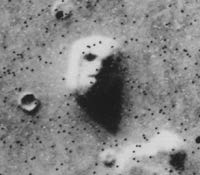 This is because it is not just that the cryptoterrestrial hypothesis posits the possibility of an intelligent lifeform on this planet that has remained hidden but that such a lifeform is advanced beyond us. The bait-and-switch of the authors is the most egregious crime the paper commits. It sets up the idea that our current civilization could have missed the existence of an ancient one. I don’t think that this is an uncontroversial claim. Of course, we could have and indeed have. It’s not just Göbekli Tepe either; without the monoliths on Easter Island, there would be no trace that it was ever inhabited. Keeping in mind Machu Picchu, which had been swallowed by the Peruvian jungle, and even the remnants of the city of Troy, the odds that there is something missing from the story of human civilization is likely. However, these are civilizations that fit with a timeline. Ancient Greek writers Herodotus and Xenophon both mentioned ruins that predated the Bronze Age world as the Persian and Greek armies (respectively) marched on their journeys.
The problem, though, is that these civilizations would not only still be present but also invisible to us and have the facilities to produce the craft that are claimed to be responsible for UAP. This strains credulity to the point of what I would call the Arthur C. Clarke threshold: it is no longer an advanced technology but literal magic.
This is because the cryptoterrestrial hypothesis solves the problem of interspace travel, but it then creates a new problem—infrastructure, a problem that the extraterrestrial hypothesis does not have to contend with. The prime strength of the cryptoterrestrial hypothesis is its most apparent weakness. Science fiction universes, especially now, make references to how their spaceships are built and where. These include the Eridani Shipyards (Star Trek), the Coruscant facility (Star Wars), and the former shipyards of the Planet Reach (Halo), all massive facilities that require hundreds of people to build single ships. The amount of time and material to build one of the in-universe ships would lend itself to detection. However, Star Trek’s Enterprise is a large ship, something like a modern-day aircraft carrier; the UAP would clearly be more akin to the Galactic Empire’s Tie-Fighter—a point I will happily concede, but there is still the problem of what it takes to put one of those planes in the sky. I’ll ignore fuel and material cost for now and focus primarily on the logistics needed to operate one of these crafts. A modern human aircraft, an F-16 for example, requires maintenance facilities to service the plane. While it’s easy to claim that the underground lizard people can just hide a plane in a cave, it’s much more difficult to claim that there exists an entire hangar and crew to maintain the planes in working order.
Now we can return to the material constraints: Where do they get their fuel and the material to repair them? One might be tempted to claim that such an advanced civilization would not have the same requirements as we have in our contemporary civilizations, but then we’re making an argument from ignorance. We don’t know, so therefore we are to conclude it must be advanced technology (or magic). Committing these fallacies is how we got to the suggestion of a 10 percent probability for the cryptoterrestrial hypothesis in the first place.
The paper points out the “Silurian” hypothesis—which makes the claim that there exists the possibility of detecting a civilization through the waste products of its fuel expenditures. The Silurian hypothesis was argued as a thought experiment to raise “useful questions related to both astrobiology and to Anthropocene studies” (Schmidt and Frank 2018, 148). It was not as the authors mischaracterize to argue that an “intelligence or even industrialized species might have long pre-dated human existence on Earth but vanished without leaving a discernible paleontological trace” (Lomas et al. 2024, 8).
Conclusion
The question that remains for us is the one ostensibly posed by Lomas and colleagues: Do we need to accept the cryptoterrestrial hypothesis as a viable explanation for UAP? While I concede that the cryptoterrestrial hypothesis is a possibility, I do so on the same leather that I would concede anything that does not possess an inherent logical contradiction. There is no reason to think it is logically impossible, but under any other criteria the authors have not made the case.
Their argument rests on logical fallacy. Most notably their claims seem founded on the appeal to ignorance that says: “Well, we don’t really know what happened in the past so therefore underground nonhuman intelligence is responsible.” It’s such an absurd position to take that I would have thought it would have been confined to guests on conspiracy theory shows such as Coast-to-Coast AM. While the cryptoterrestrial hypothesis resolves the problems of the extraterrestrial hypothesis, it contains too many endemic problems to compel our consideration. What standard of evidence, or even possibility of evidence, would count against the cryptoterrestrial hypothesis? The authors accept the most credulous explanations as evidence for their position without considering the sources. The entire article is filled with cherry picking.
The other problem is that the UAP sighting they are seeking to explain with the cryptoterrestrial hypothesis isn’t, itself, unknowable. While three very popular videos were spread through the internet as “proof” that an advanced intelligence was visiting Earth, the videos are explainable. The Go Fast video is claimed by advocates of UAP as being either extraterrestrial or cryptoterrestrial and as being a low flying ultra-fast craft, but the data presented by Mick West and others indicates that it is a high-altitude slow-moving craft. It only seems fast because of a phenomenon known as the “parallax view,” which is the difference between something close moving against a far background, a technique used by Super Nintendo to create the illusion of motion in the original Mario Kart. The other two videos, “FLIR” and “GIMBAL,” are explained by the motion of the cameras on the jets (Gault 2020).
I’m not discounting the existence of nonhuman intelligence, but the cryptoterrestrial hypothesis isn’t justified by anything Lomas and colleagues have presented. It remains not an unproven hypothesis but one we ought not spend much consideration on.
References
Carlotto, M. 1997. Evidence in support of the hypothesis that certain objects on Mars are artificial in origin. Journal of Scientific Exploration 11:123–145.
Gault, M. 2020. The skeptic’s guide to the Pentagon’s UFO videos. Vice (May 6). Online at https://www.vice.com/en/article/the-skeptics-guide-to-the-pentagons-ufo-videos/.
Keeley, B.L. 1999. Of conspiracy theories. The Journal of Philosophy 96(3) (March): 109–126.
Lomas, T., B. Case, and M.P. Masters. 2024. The cryptoterrestrial hypothesis: A case for scientific openness to a concealed earthly explanation for unidentified anomlous phenomena. Philosophy and Cosmology 33.
Schmidt, G.A., and A. Frank. 2018. The Silurian hypothesis: Would it be possible to detect an industrial civilization in the geological record? International Journal of Astrobiology (April 16).
[ad_2]
Source link
