

[ad_1]
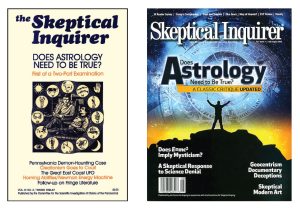
In 1986, I joined colleagues in a long two-part look in Skeptical Inquirer about an early concern of the Committee for the Scientific Investigation of Claims of the Paranormal (CSICOP): the serious astrology of consulting rooms. We asked an unusual question: Does serious astrology need to be true? The answer seemed to be no.
Astrologers laughed at us. Our clients are always satisfied, they said, so nuts to you! But clients had always been satisfied—even when the wrong birth data had been used by mistake. Clients could not tell the difference. Astrology was just patterned wallpaper for the mind.
In due course, computers made testing easier, which led to our thirty-year update in SI (published in 2016). Serious astrology was still practiced by one person in 10,000 but had no clear need to be true. This outcome is confirmed today by a thousand empirical studies (see Dean et al. 2022; Kelly and Saklofske 2024) and by numerous critical website articles—all with no discernible effect on astrology’s popularity.
Why Is Science Not More Effective?
Most astrologers and their clients find that serious astrology meets needs not met by science––a spiritual framework for understanding the world, a language that speaks to the soul, a tool for uncovering meaning and purpose. Telling them the perils of illusion and the benefits of science is a waste of time because they question the science, not their experience. And it’s at that point that the metaphorical butterfly starts to flap its wings.
At a 1972 meeting of the American Association for the Advancement of Science, meteorology professor Edward Lorenz gave a paper subtitled “Does the Flap of a Butterfly’s Wing in Brazil Set Off a Tornado in Texas?” He reported how an apparently trivial rounding of a climate variable from .506127 to .506 had completely changed the computer-calculated outcome. His “butterfly effect” became part of modern chaos theory and a pop culture metaphor for changes too small to seem important but that had a disproportionate effect on later events. A butterfly effect also presents a fundamental problem for astrologers.
Controls That Do Not Control
Controls in astrology are usually formed by shuffling birth data between subjects to break any links with birth charts. But it has no effect on a person’s knowledge of astrology, which stays in place ready to bias self-reports in favor of astrology.
Ask Sagittarians––said to be sociable and outgoing––a question related to extroversion, such as “Do you like going to parties?,” and knowledge of their sun sign might shift their answer in favor of yes rather than no. The shift will not be affected by shuffling birth data, which will therefore not control prior knowledge (hence the “fundamental problem”).
Ask the Right Questions
To test astrology, we should avoid the questions suggested by astrologers, such as “is astrology true?” (what is truth?) or “does it work?” (what are you talking about?). Instead, we should ask about effect size, the extent to which one thing is associated with another, such as waistlines and consumption of sugar.
One common measure of effect size is correlation r (for regression), ranging from +1.0 (perfect) through 0.0 (no correlation) to -1.0 (perfect inverse). Astrologers and others typically ignore effect size in favor of the p-value, the probability downward through 0.5 (chance) of your result given no real effect, so a small p (≤ .05) is desirable. But p is not correctable for sampling error and therefore does not tell you what you want to know: the probability of your result given your data. Relying on p alone has led to wrong conclusions and calls for this to be replaced by effect sizes and confidence limits.
Before we can look at effect sizes in more detail, we need to know more about astrology’s butterfly effect.
Butterflies and Prior Knowledge
The effect of prior knowledge in astrology was first demonstrated over fifty years ago by J.G. Delaney and H.D. Woodyard (1974). They created two sets of traditional sun sign descriptions: one in which items related to Dominance (domineering–unassertive) and Change (changeable–steadfast) were left unchanged, and the other in which low or high items were reversed. They then gave one of the two sets at random to forty-five Canadian high school students aged sixteen to nineteen.
Each student read the description for their sun sign and completed personality tests, including tests measuring dominance and change. The change in descriptions affected how they saw themselves. The differences between high and low student groups were surprisingly large with low p-values (r = .34, p = .01 for Dominance and r = .30, p = .03 for Change). The authors concluded that “the astrological descriptions did influence self-report as predicted.” Their work had introduced the world to astrology’s butterfly effect. It did not go unnoticed.
Attracting the Interest of Scientists
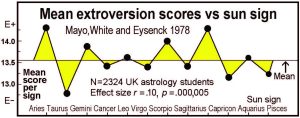
Two years later, a U.K. group led by Professor Hans Eysenck calculated the extroversion scores of 2,324 astrology students. Astrologers claim that odd-numbered signs starting at Aries are extroverted (E+) and the rest are introverted (E–). The results (Figure 1) varied in sawtooth fashion exactly as claimed. It seemed like clear support for astrology, which attracted the interest of scientists and eventually a meta-analysis.
About Meta-Analysis
Meta-analysis takes a cloud of effect sizes and weights them by their sample sizes to allow correction for sampling errors (something not possible with a single effect size), then checks the mean statistically to see if there is a real effect (Hunter and Schmidt 1990). Since the 1970s this ability to sort out clouds of data has revolutionized research in the sciences and humanities, and by 2015 about 10,000 meta-analyses had appeared in PsycINFO, a scholarly online database in psychology and related fields.
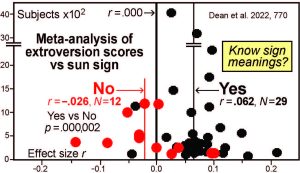
When sun sign studies were meta-analyzed, they showed that a link with astrology did exist but only when subjects were familiar with sun sign meanings (Figure 2). The link was not so much with astrology as with knowledge of astrology, which led subjects to give themselves qualities supposedly indicated by their birth chart, a process called self-attribution.
From Artifact to Permanent Confound
In the United States, Canada, and the United Kingdom, most adults know their sun sign and typically about 25 percent believe that astrology affects their lives (Alcock 2018, 499), all based on their experience. This popularity makes knowledge of astrology a permanent confound in every population used to test it (Kelly and Saklofske 2024, 41). But demonstrating its absence is not easy because serious astrology involves complex interactions between planets, signs, houses, aspects, midpoints, and other factors (and this is just for starters). Denying we have knowledge of astrology is unconvincing, because it can operate subconsciously to cue our behavior (Bargh 2017).
Indeed, given the increasing availability of free birth chart calculation services on websites and apps, and because “There is no area of human existence to which astrology cannot be applied” (Parker and Parker 1975, 81), we can reasonably expect to see positive astrological effect sizes rather than zero effect sizes in all areas of human life. Appeals to hard evidence have taken on a new meaning.
Effect Sizes Are Useless If Too Small
If astrologers’ clients are to receive answers better than chance––better than tossing coins––for x percent of their yes/no questions, effect size r has to be at least (x/50)–1 (Dean et al. 2022, 758). For example, if x = 80 percent, r has to be at least (80/50)–1 = .60. But for 708 published studies in psychology, the median r was .21, and a large r was typically .30 (Gignac and Szdoria 2016). Could astrology really deliver r = .60?
Exploring the Butterfly Effect
The nominal range of effect sizes for prior knowledge is shown in Figure 3, where the .05 limit is conservatively based on the .062 of Figure 2, itself hugely more conservative than the .34 and .30 of Delaney and Woodyard. The red circles are effect sizes for recent tests of birth chart factors (such as planetary aspects, Moon’s nodes, and chart rulers) by research astrologers using huge samples. All are statistically significant, and most involve Gauquelin data known to show the effects of prior knowledge (Dean et al. 2022, 165–194). All are in the area nominally explained by prior knowledge; without evidence of its absence, they fail to support genuine astrology.
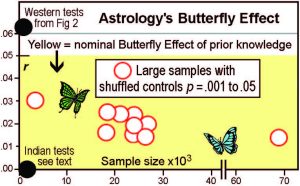
At the lower black dot, an Indian team led by physicist Nagesh Rajopadhye tested four sets of timed Western births (with a mean sample size of 820 subjects), each involving opposite human afflictions. They were testing Indian methods said to tell the difference, and the opposites are among the most extreme known to humans, namely cancer/no cancer, divorced/long-married, intellectually disabled/intelligent, and unknown/famous.
Indian astrology uses a non-Western zodiac, treats the two Moon’s nodes as planets, and ignores planets beyond Saturn. Many methods have no Western equivalent. So prior knowledge by Western subjects is unlikely. Testing took ten years (see Dean et al. 2022, 749–752). The differences between extreme opposites ranged from r = –.007 to +.008, mean –.000, p =.49, which means that neither astrology nor prior knowledge could be detected.
Matching Tests Use Controls
Similar tests have yet to be conducted in Western astrology. But an effective equivalent involves astrologers (not researchers) choosing which of several birth charts best matches the subject’s occupation, personality, or case history. Because several charts (not one) are involved and the astrologer (not the subject) is being tested, prior knowledge is controlled.
Matching tests are the most common test in serious Western astrology. Results involving more than 2,400 birth charts and 1,000 astrologers form an inverted funnel around a mean not significantly different from zero (Figure 4, red dots, p = .79). Our r = .60 now seems unattainable. This bad news is made worse by the study shown as black dots.
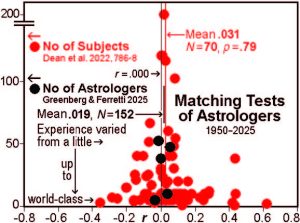
The black dots are from a 2024 online matching test organized by mathematician Spencer Greenberg for his social enterprise Clearer Thinking (see Greenberg and Ferretti 2025). He had 152 astrologers—from beginners to world-class experts—complete twelve tests, each requiring them to match one of five birth charts to a subject described by gender, education level, marital status, and typically 1,000 words in response to standard questions chosen by six other astrologers to maximize success. The black dots are the observed effect sizes ranked by self-rated experience.
The most experienced astrologers performed no better than the least experienced, and by t-test none were significantly different from the red dots (p = .41). World-class astrologers (N = 5, agreement r = .10) agreed slightly better than the rest but not usefully. Thus the observed test-retest agreement for standard psychological and ability tests is at least .80 (Meyer et al. 2001).
On average each astrologer was familiar with 3.5 chart-reading techniques out of a total of thirty. In decreasing popularity, the top four were: Western, traditional, psychological, and Hellenistic; the bottom four were Egyptian, cosmobiology, Uranian, and Mayan. When corrected for the number of techniques, none were better than chance. Tossing coins would have been just as good.
Time Twins Are Another Forgotten Effect
Time twins are people born close enough in time and geography to have closely similar birth charts, for which astrology predicts closely similar lives. Tests have the unique advantage of not needing birth charts, only subjects. “Thus a time-twin study [is] a simple, straight-forward, definitive and universal test for the scientific basis of astrology” (Komath 2009, 1571). Many tests have been made without finding the predicted similarities (see Dean 2016, 43, updated in Dean et al. 2022, 795–809). As the bad news accumulates, how do astrologers react?
Reactions by Astrologers
The most common reaction by astrologers to bad news is to ignore it. Or they appeal to fashionable new factors such as asteroids (over 10,000 to choose from) or to untested philosophical arguments. They rarely run a controlled experiment that targets the problem. Robert Currey (2025), editor of the astrology research journal Correlation, is at first sight an exception as shown in Figure 5.
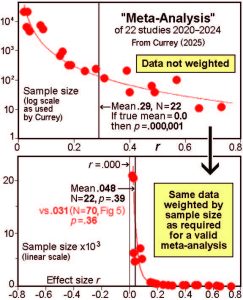
Currey’s “meta-analysis” of twenty-two studies has an extremely low p-value (p < .001), which suggests significant results. The scare quotes are because he omits relevant tests published elsewhere and the required weighting by sample size. When at bottom the required weighting is applied, the significance disappears (p = .39). Moral: Why bother with science if it fails to give the results you want and your journal needs?
Based on everyday artifacts that can look and feel like astrology, Ivan Kelly and Don Saklofske (2024, 95) conclude, “we can predict that modern astrology will be characterized by (1) disagreement on almost everything, (2) agreement that it works, and (3) failure to work when artifacts are prevented. Which is exactly what is observed.”
Conclusion
Astrology’s forgotten butterfly effect of prior knowledge leads to a tornado of fake positive outcomes often with high statistical significance. All are a legacy from antiquity with no connection to reality and no claims that need be true, leaving astrologers conjuring make-believe from patterned wallpaper.
Even so, whatever we may think, astrology continues to appeal to many people. In terms of longevity, it beats many other popular beliefs. Despite the efforts of skeptics, astrology seems unlikely to go away. For any student of pseudoscience, astrology would seem to be a good place to start.
Acknowledgments
My thanks to Wout Heukelom (The Netherlands), Ivan Kelly (Canada), Arthur Mather (Scotland), David Nias (England), and Rudolf Smit (The Netherlands) for insightful comments and unfailing help during forty years of collaborative research.
References
Alcock, J.E. 2018. Belief: What It Means to Believe and Why Our Convictions Are So Compelling. Amherst, NY: Prometheus Books.
Bargh, J. 2017. Before You Know It: The Unconscious Reasons We Do What We Do. New York, NY: Touchstone.
Currey, R. 2025. Introduction to statistics. Talk given at the Kepler Day astrology research conference, London, January 25.
Dean, G. 2016. Does astrology need to be true? A thirty-year update. Skeptical Inquirer 40(4): 38–45.
Dean, G., A. Mather, D. Nias, and R.Smit. 2022. Understanding Astrology: A Critical Review of a Thousand Empirical Studies 1900–2020 with a 2026 update. Available only from the publisher. Amsterdam, NL: AinO Publications.
Delaney, J.G., and H.D. Woodyard. 1974. Effects of reading an astrological description on responding to a personality inventory. Psychological Reports 34: 1214.
Gignac, G.E., and E.T. Szodorai. 2016. Effect size guidelines for individual difference researchers. Personality and Individual Differences 102: 74–78.
Greenberg, S., and A. Ferretti 2025. Can astrologers truly gain insights about people from entire astrological charts? Online at www.clearerthinking.org/post/does astrology work? (select for “more details” to access the article).
Hunter, J.W., and F.L. Schmidt. 1990. Methods of Meta-Analysis: Correcting Error and Bias in Research Findings. Thousand Oaks, CA: Sage Publications.
Kelly, I.W., and D.H. Saklofske. 2024. An in-depth philosophical critique of contemporary Western astrology. Online at https://www.astrology-and-science.com/PhilCritiqueAstrol.pdf.
Komath, M. 2009. Testing astrology. Current Science 96(12): 1568–1572.
Mayo, J., O. White, and H.J. Eysenck. 1978. An empirical study of the relation between astrological factors and personality. Journal of Social Psychology 105(2): 229–236.
Meyer, G.J., et al. 2001. Psychological testing and psychological assessment: A review of evidence and issues. American Psychologist 56(2): 128–165.
Parker, J., and D. Parker. 1975. The Compleat Astrologer. London, UK: Mitchell Beazley.
[ad_2]
Source link
