
[ad_1]
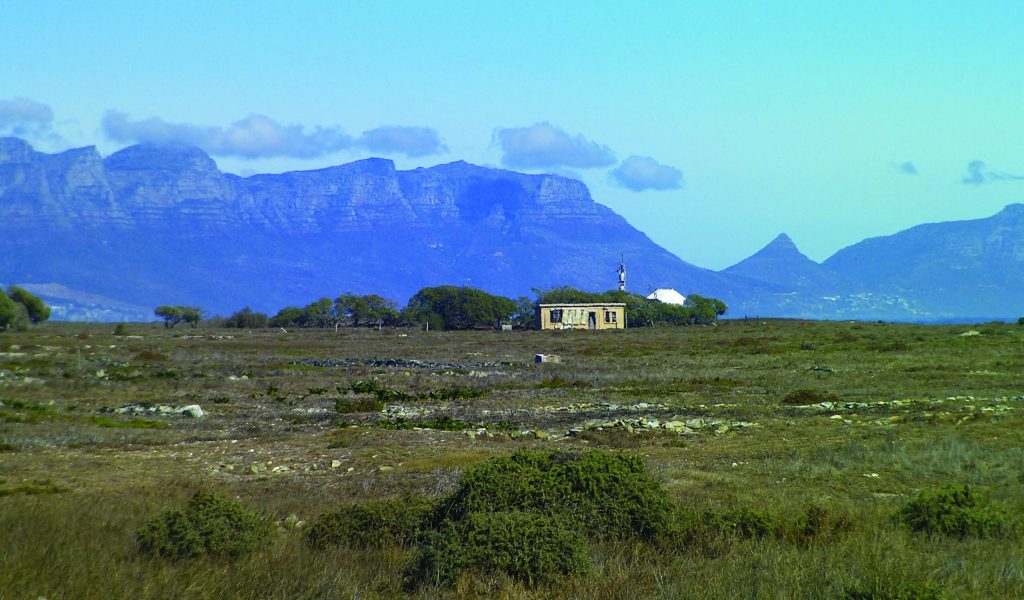
Imagine an eerie abandoned island complete with dilapidated prison buildings and half-open graves. Empty war-carved pillboxes that were dug deep into the soil but never saw any use are now occupied by the bones of dead steenboks and mole snakes. The lone human inhabitants are a group of eager scientists intently following the nesting habits of penguins. I found myself in this exact scenario at the historical goldmine that is Robben Island when I worked with the South African Penguin Project, a scientific research mission and rescue effort hoping to save the South African penguin from extinction. What I didn’t expect, however, was for a scientific project to become so caught up in the ghosts of the past.
As I grabbed a taxi from the Cape Town airport, the driver exclaimed, “What’s on Robben Island for you? There’s nothing there but ghosts of the past. You will be cursed!” When I replied that I would be working with penguins, he quickly interrupted, “There are penguins on Boulders Beach. It’s much less haunted.” Alas, this wasn’t the first time someone had warned me about the “dangers” of Robben Island. But where I was worried about getting tetanus from old military structures (or by being bit by mole snakes), the people I encountered in South Africa on my way to Robben Island were worried about ghosts and curses. While I surely love intrigue and was interested to explore the claims of hauntings on one of the most iconic land masses in history, I didn’t quite understand why so many people thought this famous island was haunted … until I first stepped foot on it myself. Indeed, it felt as if the ghosts of the past were rising up to greet me.
Setting the Scene: The Surreal Landscape
As I scattered my luggage onboard a small ship that took me forty-five minutes off the coast of Cape Town to the small strange clump of land I would soon call home, I saw the supposed ghost-infested landmass looming off in the distance. Upon departing the ship, what I saw both excited and frightened me. I was enthralled by the bizarre biodiversity of the landscape. As someone who studied anthropology with a specialization in folklore and the occult, the legends of ghosts and curses on the island only intrigued me more. As I met up with my research team and put my bags on the back of the bakkie (the project’s truck), we decided to walk around the island.
The area closest to the docks was the only part that was well-kept, because it sees regular tourists by the boatloads. We immediately saw the “new” prison buildings, built in the 1960s by prisoners staying in the “old” prison building. The prison buildings see regular tours. After all, this is the prison that famously housed Nelson Mandela, so it brings in plenty of interested tourists. It was here in the new prison where Idris Elba spent the night in preparation for his role in Mandela: Long Walk to Freedom. Upon spending the night on the island, Elba told BET, “I slept for about an hour in total. There were ghosts there—of course there were!—because people had died there. I woke in the night and a massive cold thing hit my face, almost like cold water … it was obviously a spirit” (BET staff 2013). Locals also believe that the disgruntled prisoners who were forced to work in the quarry had cursed the land, which is why the civilization on Robben Island has become nonexistent in recent years; the school and store on the island closed a few years ago.
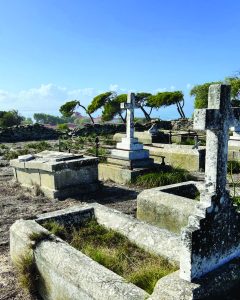
The further you move out across the coast of the island, the stranger and more haunting the landscape becomes. We walked by a seemingly beautiful stone church structure that held a graveyard on its property. The graveyard showcased some of Robben Island’s darkest history. Many who died of leprosy were buried there. The most presentable graves were shoddily thrown together behind the walls of a fence for the tourists on buses to see. The less sightly graves were scattered around the outskirts of the quickly added fence. We conducted penguin nest rounds on that day, and I would be remiss to leave out the fact that another researcher and I fell into the crumbling graves on more than one occasion. When we attended an island bus tour on one of our days off, the tour guide speculated that the whole island was haunted by the buried bodies of those who had died of leprosy, forced here against their will via the Leprosy Repression Act in 1891 (Robben Island Museum staff 2022). It was tempting to believe his tale, because the crumbling graves painted a vivid picture.
We walked through the remains of a now almost fully abandoned town and found the school, pool, and general store still sitting as they were a couple of decades ago when they were in use. Seeing these abandoned facades immediately added a level of unease. It was here you could admire the beautifully crafted Irish cemetery left behind from the settlement in the early 1900s. As we moved around through the other side of the island, past the old, towering lighthouse, we found the most picturesque setting, complete with steenbok, springbok, and fallow deer. The tall grass and caribou-like silhouettes reminded us that we were, in fact, in Africa, despite the rest of the island feeling largely separated from that continent. Knowing that there were mole snakes scattered around the tall grass only added to the folklore of the island; snakes represent both good and evil in South African culture and are usually seen as messengers sent by ancestral spirits. The presence of snakes usually dictates the presence of spirits in many centuries-old South African belief systems.
After walking down Lovers Lane, a street that goes through the Serengeti, we passed by several large shipwrecks that not only looked hauntingly majestic but also reminded us that the swell around the island is extreme and dangerous. One of the locals onboard our ship into the island told me, “At night, the sailors who died in the sweltering waves off the coast come out and walk the shores, looking for a way off the island. Do not get in their way.”
Then, we passed the empty canon housing, war-time structures built on the island during World War II, and pillboxes dug deep into the ground. Overgrown and falling apart, these structures added an extra layer of forebodingness to the landscape. As I opened one of the World War II buildings, I found the fully intact skeleton of a steenbok strewn over an old toilet like a James Ensor painting. Because they have no predators on the island, all the caribou-like species died of old age or natural complications, so their lifeless bodies were regularly found strewn about and intact.
It was only after we passed all these strange and unsettling sights that we saw the penguin colony, something humorously out-of-place in the setting of Robben Island.
The South African Penguin Project
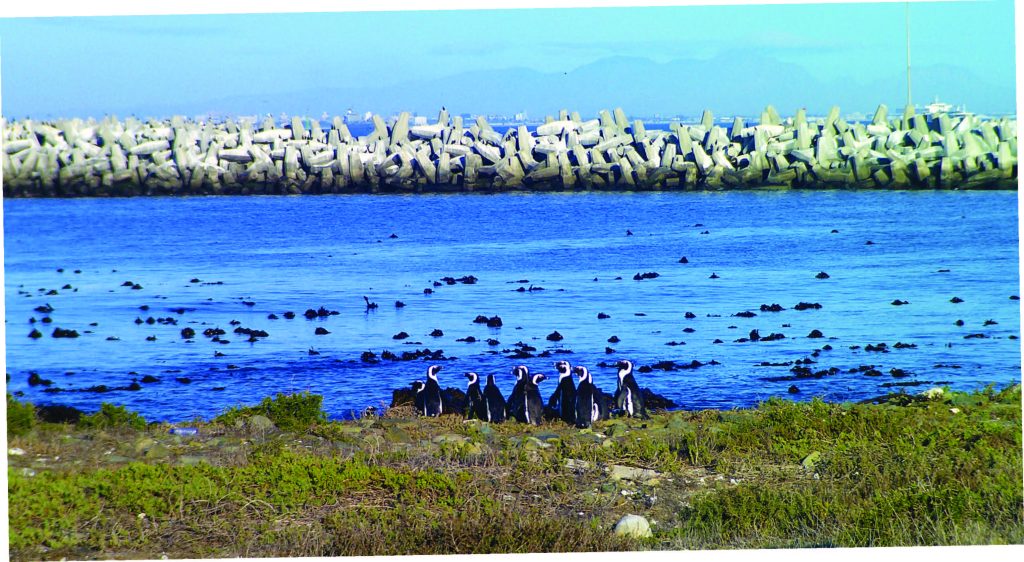
The penguins offered a quick reprieve from the supposed ghosts dancing across our peripheries on the island. They were why I was here on Robben Island, after all. As an investigative journalist and member of the Explorers Club, I regularly get recruited to work and report on a variety of research expeditions and conservation research studies by friends and fellow explorers. Because I’ve volunteered and covered several warm-weather penguin expeditions in my recent experiences, I was lucky enough to be brought onto the island to participate in these studies. While accounts of specific numbers vary, it is commonly agreed upon by penguin biologists that there are just over 10,000 mating pairs of South African penguins left in the world (Sherley 2020, 7949–8528). They were classified as endangered in 2010 and are acknowledged by most professionals to be on their way to extinction in the not-too-distant future. It has been calculated that the African penguin has lost roughly 97 percent of its total population, leaving only 3 percent of its historical population in the wild today. After years of research, scientists have attributed most of the penguin decline on Robben Island to the increase in anchovy and sardine habits of human beings, because these penguins are finding their food sources rapidly unavailable to them (Sherley 2013, 89–95). Seeing photos of how many penguins used to be on the island in the 1920s, it appears that humans may not be the only ghosts inhabiting Robben Island.
The South African Penguin Project is working to monitor and record the mating and nesting habits of these penguins on the island. Penguin nests within the project are regularly monitored by scientists checking their nests for eggs, monitoring the health of their babies, and recording where tagged penguins are nesting on the island. Working around the graves, shipwrecks, and abandoned buildings, scientists document all data as a way to keep record of the population on Robben Island while also serving as a means to send off any penguin chicks that may be underweight for rehabilitation and closely monitored care.
The research on Robben Island found the penguins in this colony move out to sea daily, leaving in the morning on the penguin highway to return at night to their nests. The penguins here switch on and off on daily rotations with the male of a mating pair leaving to hunt one day and his female counterpart switching out the next day. Knowing the basic nesting habits of each colony can help scientists better develop certain tactics. For instance, knowing the schedule of the mating pair is crucial for deploying loggers on birds to collect the GPS data of their fishing habits (Sherley 2013, 291–301).
While the South African Penguin Project is monitoring and collecting data on the African penguin population found on Robben Island, the project has seemed to take on a much more important goal. It also serves as a penguin rescue mission. With the population so close to extinction, the question quickly becomes, “How can we keep these penguins from going extinct?”
In the case of Robben Island and the South African Penguin Project, a fishing ban is one of the main plans to try and keep the penguins from becoming extinct. The project has worked with the South African government to put a three-year ban on fishing on Robben that moves around to two other neighboring islands. While the data being collected on the results is fairly new, we do understand that if the food conditions of a penguin colony are poor, the parents generally fledge their babies much earlier than they would if the conditions were good (Sherley 2013, 291–301). During my time on Robben Island, there were many fat chicks, leaving us to believe that the ban on the island is working. Much more research is needed, however, to officially validate this claim.
The other way in which the project is helping the penguin population is in the form of an actual rescue mission. If any injured birds or unwell babies are found, they are sent off to the SANCCOB organization to undergo hands-on care and rehabilitation (Sherley 2013, 89–95).
Despite being completely engaged and excited to help in attempts to save the African Penguin, I just couldn’t get my mind off all the ghost stories. I even sometimes seemed to see a ghost-like face staring out at me from an abandoned pillbox, only to disappear when I went to investigate. I was getting caught up in the claims of ghost stories even when focused on seabirds. I was in a constant state of unease. And I wasn’t the only one. Many of the scientists and researchers on the project seemed to be on the same page. How could the ghosts of long ago be affecting our scientific minds in such an impactful way?
From Scientific Investigation to Paranormal Conversation
My team and I had a conversation about how those most familiar with the island become uneasy throughout the night there. Perhaps it’s because there’s very little artificial light and therefore minimal visibility on the island. Perhaps it’s because those of us staying on the island know its history—the abuse suffered at the political prison, the horrifying deaths from leprosy, and the soldiers preparing for war. Most of its rich past has been unfortunate, painting a dark picture across the canvas of the island’s great history. And the setting itself, complete with steenbok skeletons, is a recipe for unease. As we began this conversation one night, we concluded that it’s likely due to the stressors of the island creating an overwhelming lack of control. These stressors mixed with a fear of losing control can lead to extreme paranoia and even hallucinations in the most stalwart of people, igniting our fear of the unknown.
According to evidence found in clinical studies and neuroimaging work published in Trends in Cognitive Sciences (Leotti et al. 2010, 457–463), our mental health is in a much better place when we have control over our immediate environment. This is why, as logical thinkers, our first thought on this project was to span out and become familiar with the entirety of the island. The more we knew about the island, the more we understood its landscape, the more control we had, the safer we felt. And while understanding the basic layout of Robben Island is helpful to feel a bit of control, the overall unruly, wild, and unique biodiversity tells the logical thinkers that there is not much control to be gained over the island. The factors such as shipwrecks, abandoned dilapidated buildings, gravestones, and other elements regularly found in ghost stories also provide immediate unease, which means immediate stress. There were also many other factors at play that could and would make us unsafe: poachers, heavy swell, daunting winds, and the fact that we were stuck on the island most of the time, with boats only coming some days when the weather permitted. Much of our life on Robben Island was out of our control. This surely played into our fear of the unknown, despite the fact that we had a base understanding of the island. And a fear of the unknown is one of the biggest stressors we face as humans.
This natural instinct to protect ourselves makes us fear the unknown and keeps us from getting comfortable until we are truly and completely familiar with our environments. So, we frankly never got fully comfortable on the island. According to a post at the NIH provided by Sara Hunter (2021), our brain can also oversimplify or lead to cognitive distortions as a fear response when we face unknown factors. This is why an eerily diverse and uncontrollable location such as Robben Island can be so frightening. The daunting picture painted, the tragic history, and the lack of environmental control together make the perfect recipe to see ghosts.
According to research conducted by James Houran and Brian Laythe for Frontiers in Psychology (2022), the more stressed and uneasy we become, perhaps by alarming tales of ghosts or uncontrollable natural elements, the more likely we may be to hallucinate or see ghosts in our periphery, especially if we’ve been hearing about them regularly. When we feel there may be a threat, we begin to look for more dangers, and our base instincts can kick in and trick us into seeing threats where they don’t exist. So, given enough fear and stress, we can begin to hallucinate, or at least see threats where they are nonexistent. This became clear to me throughout my experiences. To say that I was paranoid on Robben Island is an understatement.
With no logical evidence of any kind, I was convinced I’d wake up and see a face looking into my window as I was sleeping. I knew I had no control over the environment, and my base instincts became more powerful than my logical mind.
Even still, we found that despite its eerie past and jarring landscape, the fear of the unknown on Robben Island went away, albeit briefly, when we were able to sit back and watch the sunset color the bodies of the penguins waddling down the penguin highway each evening. That daily respite helped to make Robben Island feel a little less daunting as it faded into the evening hours. Even so, the surreal landscape mixed with the powerful research made Robben Island one of my most compelling and memorable explorations to date.
References
BET staff. 2013. Idris Elba spent a night on haunted Robben Island. BET (September 13). Online at https://www.bet.com/article/bjhsr5/idris-elba-spent-a-night-on-haunted-robben-island.
Houran, James, and Brian Laythe. 2022. Case study of recognition patterns in haunted people syndrome. Frontiers in Psychology 13: 1–20. Online at https://www.ncbi.nlm.nih.gov/pmc/articles/PMC9216229/.
Hunter, Sara. 2021. Dealing with uncertainty. NIH (November 15). Online at https://oitecareersblog.od.nih.gov/2021/11/15/dealing-with-uncertainty.
Leotti, Lauren A., Sheena S. Iyengar, and Kevin N. Ochsner. 2010. Born to choose: The origins and value of the need for control. Trends in Cognitive Science 14(10): 457–463. Online at https://www.ncbi.nlm.nih.gov/pmc/articles/PMC2944661/.
Robben Island Museum staff. 2022. Infirmary 1890–1931. Robben Island Museum. Online at https://www.robben-island.org.za/infirmary-1890-1931/.
Sherley, Richard. 2013. The initial journey of an endangered penguin: Implications for seabird conservation. Endangered Species Research 21: 89–95. Online at https://www.researchgate.net/publication/246546176_The_initial_journey_of_an_Endangered_penguin_implications_for_seabird_conservation.
———. 2020. The conservation status and population decline of the African Penguin deconstructed in space and time. Ecology and Evolution 10(15): 7949–8528. Online at https://onlinelibrary.wiley.com/doi/epdf/10.1002/ece3.6554.
[ad_2]
Source link
