
A recent study represents a confluence of technological advances that is pretty interesting. The specific problem being addressed – chemotherapy for bladder cancer – is very promising, but the technology itself can potential have many applications.
Let’s start with the problem, delivering chemotherapy to bladder tumors. The trick with chemotherapy is to create the highest levels of toxicity possible for cancer cells while limiting the toxicity for healthy cells. There are several ways to achieve this, with the primary method being finding drugs that are inherently more toxic tumor cells than non-tumor cells. The classic feature that has been targeted is the fact that tumor cells are rapidly reproducing and have a high metabolic rate, so drugs that target such cells are used. This still has an effect on healthy cells, especially those that rapidly reproduce, like hair cells, which is why many chemotherapies cause hair loss. Essentially we push the toxicity of these drugs to the limit of tolerability, to kill the cancer cells as much as possible.
Another strategy is to get these drugs to the tumor in higher concentrations than the rest of the body. You can accomplish this by intralesional injecting (injecting chemotherapy directly into a tumor), by injecting into the body compartment that contains the cancer, or by directing the chemotherapy specifically to the cancer using advanced techniques (such as lipid nanoparticles). For some types of bladder cancer the strategy has been to fill the bladder with chemotherapy and keep it in there for as long as tolerated. This works to some extent, increasing the dose of chemotherapy to the tumor while limiting systemic effects. However, there is limited penetration of the drug into the tumor because of the nature of the bladder lining.
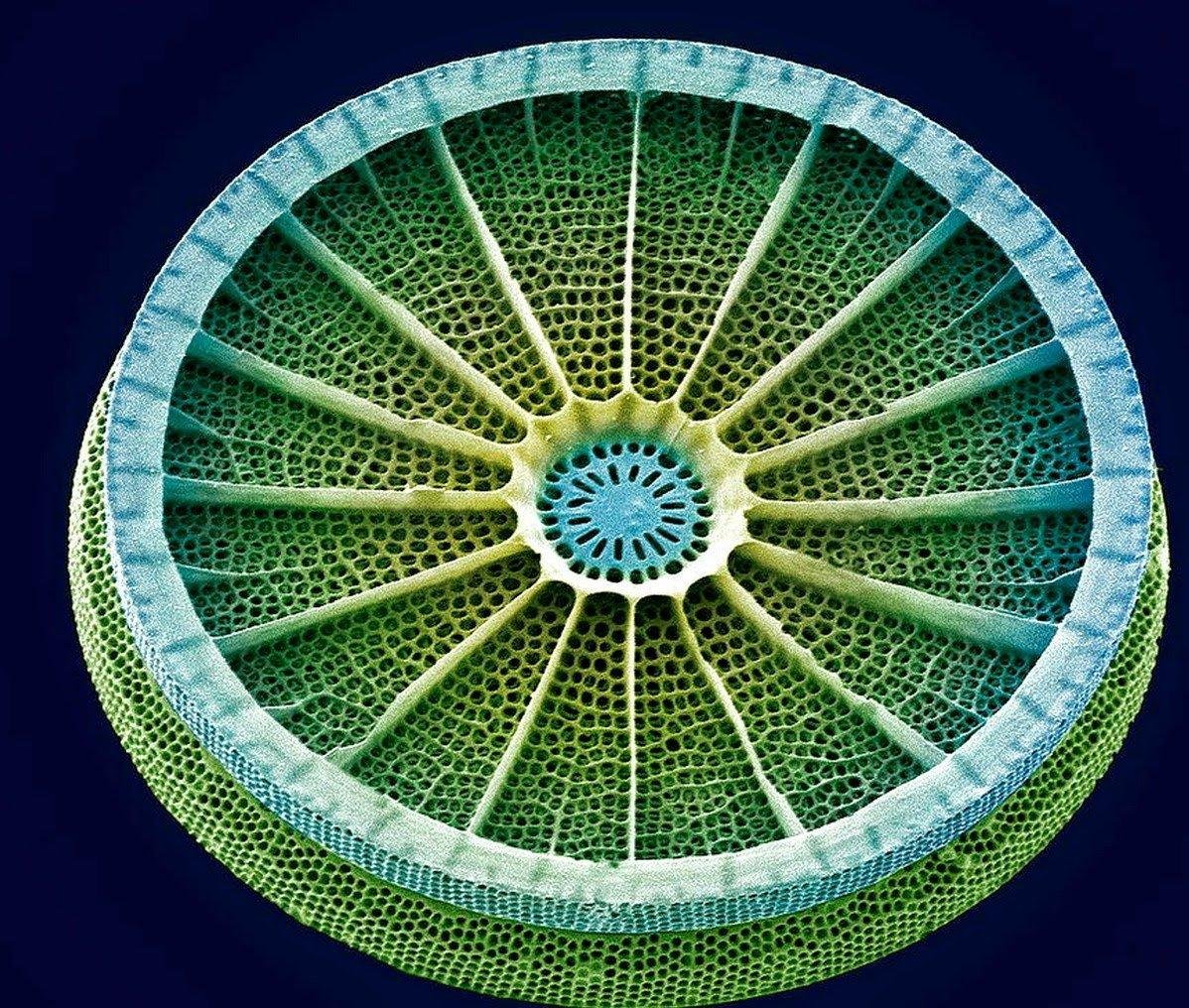
The researchers therefore developed a hybrid algae robot to delivery chemotherapy for bladder cancer. They started with the silica shell of a diatom algae, specifically Coscinodiscus granii. The shell is called a frustule, which you can think of as a tiny glass wiffle ball. They chose G. granii because it has a multilayered porous shell with different sized pores, including a network of nanopores. They cleaned it of all the living algae parts so just the frustule was left. Essentially they are using the algae as nanofactories, mass producing these finely structured rigid shells that are also biodegradable. Nature so far is much better at creating things at the nanoscale than our technology. They then coated the frustules with magnetite and filled them with a chemotherapeutic drug, doxorubicin.
They were able to control these algebots with an external magnetic field. They studied them both in vitro and also in mice with bladder cancer. There were two control modes, the first being to swarm the algebots to the tumor. They used ultrasound to track them and AI to interpret the signals, distinguish the swarm from the surrounding fluid, plan the path to the tumor, and close the loop between imaging and magnetic control. The second control mode, once the algebots were in position, caused the algebots to rapidly spin. This caused two things – the release of the drug through the pores, and also the generation of a vortex that pushed the drug deeper into the tumor.
In short, this strategy appeared to work. Penetration depth of the drug increased by about 150 μm, with a tenfold increase in overall drug penetration into the tumor. Tumor burden was reduced to less than 3% of the control group, which was treated with the standard method. The researchers estimate that this technique was 40 times as effective as the standard technique. Pretty impressive.
Of course, the usual caveats apply. This was a single study and we need replication by other groups. This was a short duration study in mice and so we need to progress to clinical trials in humans. We are still likely years away from using this technology in the clinic, if everything works out. But the results of this study are very encouraging.
Perhaps even more encouraging than this one narrow application is the technology itself. I love the idea of using complex nanoscale structures that you can simply grow using something like algae. Nature has already accomplished, through billions of years of tinkering, some incredible engineering, and we might as well take advantage of it. We have also been using living things as factories (mostly for drugs) for decades, and this is a nice extension of that technology. We can them make hybrid robots or nanomachines by then modifying the structures so that they are fit for purpose. It’s also easy to imagine in the future using AI-guided genetic engineering to modify frustules or other living structures for various applications. We are also slowly advancing our ability to control things at the nanoscale – in this case using magnetic fields, ultrasound imaging, and AI guidance to move and spin the tiny algebots.
The idea of nanotechnology is decades old – the term was coined in 1974 by Japanese scientist Norio Taniguchi. Since then one of the debates has been whether nanotechnology will essentially be biologically based or machine based. This study may be providing a glimpse into the likely answer – it may be a hybrid of both (at least in some applications). Perhaps eventually our genetic engineering will be advanced enough to simply grow nanobots fully formed and functional, but until then the hybrid approach seems to have the most potential.
Nanomedicine in particular has been advancing nicely, with applications in targeted drug deliver, imaging, and antimicrobial treatments. So far I have been seeing many applications using the lipid nanoparticles (essentially engineered bubbles of fat). The frustule approach seems like a nice addition, and I expect to see a lot more of it going forward.
