
[ad_1]
Three-year-old Yu, from the southwestern Japanese island of Kyushu, worried his mother, Kimi. He suffered from nightmares and anxiously searched everywhere for smoke detectors and fire extinguishers. One day he told Kimi that he remembered himself on the hundredth floor of a skyscraper, beside another skyscraper that looked similar. “I spoke English and worked with a computer,” the toddler continued. “Then something terrible happened in the neighboring building. The firefighters arrived, but too late. I also tried to escape, but — boom! There was a tremendous collision, and I died.”
Today Yu is 12 years old. In a shared video call with him and his mother, he appears as a sweet boy wearing a buttoned shirt and large glasses. He is happy to speak English. “I always preferred this language,” he says, adding that he still remembers the two towers, and how he tried to escape and go down the stairs, but it was impossible. “I was shocked—it was all so strange,” Kimi says of hearing the story for the first time. “I couldn’t tell whether he was inventing it, and the story itself was horrifying, but he was so serious.”
Two years ago Yu and Kimi flew to New York, accompanied by Professor Masayuki Ohkado, a researcher of past-life memories from Chubu University in Japan. “The surroundings there felt more familiar to me than the neighborhood where I live today,” Yu says about New York.
The three visited the 9/11 Memorial Museum, where Yu claimed he recognized the person he once was. Later they met that person’s sister. Yu has an unusual fondness for classical music and also collects toy Volkswagen Beetles. It turned out that the “previous personality” listened to classical music and drove a Beetle. He, too, wore large glasses. “I was very moved to discover who I had been,” Yu says. “It calmed some part of my soul that had been restless. I had a strong feeling that everything was finally settled.”
In four apartments inside a residential building in Charlottesville, Virginia, research is taking place that may be unparalleled in its significance for human existence—and equally unmatched in the criticism and ridicule it provokes. The rooms house a research group with a rather dry name: the Division of Perceptual Studies (DOPS). Although the division is part of the University of Virginia School of Medicine, its offices are located several kilometers from the main campus. Once you hear what the department’s dozen or so members actually do, it becomes easier to understand why: they search for empirical evidence of extraordinary human experiences and abilities. And they mean extraordinary. Among the phenomena they investigate are near-death experiences, out-of-body experiences, and abilities such as telepathy or precognition. Not exactly the sort of thing mainstream science tends to focus on.
The centerpiece is the line of research pursued by the division’s founder, established in 1967. Professor Ian Stevenson was a renowned psychiatrist who, at a certain point, decided to devote his career to investigating children’s “memories” of “past lives.”
Nearly sixty years later, DOPS remains more or less unique in the academic world. Surprisingly, the division is thriving. Psychologist Professor Philip Cozzolino continues Stevenson’s pioneering work there. “It’s hard to believe how far we’ve come,” he says in a video interview with Haaretz magazine. “We have the largest team we’ve ever had, a biography of Stevenson has just been published, HBO is making a documentary about us. And all of this started with one person. You would expect the opposite to happen—that people would only mock us. Of course that exists, but we’ve grown, and we continue to attract attention, for all the right reasons.”
DOPS is a fully academic research group. When Cozzolino speaks of “the right reasons,” he does not mean that it is difficult to imagine anything more fascinating, bizarre, and emotionally stirring than the thousands of stories of children claiming to remember past lives, all cataloged in the division’s library. Rather, as he puts it, those “right reasons” are that “we continue to investigate as scientists without an agenda, taking the subject seriously.”
It turns out that the study of reincarnation has itself been reborn. Stevenson focused on locating as many children as possible who spoke about what sounded like previous lives, mentioning details such as names, places of residence, professions, and causes of death. If the information was detailed enough, he tried to determine whether it matched a person who had actually lived, while also ruling out natural explanations for the child’s knowledge, such as having heard the story from a relative. Today the researchers are no longer focused on collecting additional stories, but rather on examining the phenomenon in the laboratory. “We accumulated this body of evidence, and now we are trying to move beyond it, to understand the process,” says Cozzolino’s research partner, Professor Marietta Pehlivanova.
Previous studies have shown that the brain functions differently when remembering and when imagining. Among other things, the researchers want to examine the brain activity of children who claim to remember past lives in three situations: when recalling something experienced in their present lives, when recalling something “experienced” in a past life, and when imagining something—in order to determine whether the brain activity associated with past-life memories resembles that of memory or imagination. In addition, the researchers compare these findings to brain scans of children without past-life memories, with similar demographic backgrounds, who were asked to remember something they had experienced, imagine something, and imagine having experienced something in another life.
Reincarnation! There is perhaps no subject in which the danger of deception—and self-deception—is greater.
Another line of research focuses on trauma. “Many children remember lives that ended violently or in some kind of accident,” Pehlivanova explains. “That is a central feature of past-life memories.” Using imaging devices, the researchers examine whether these children show evidence of trauma exposure even in the absence of trauma in their current lives.
Psychiatrist Professor Bruce Greyson, who succeeded Stevenson as director of DOPS in 2002 and served in the role for twelve years, says that most of the cases studied by his predecessor involved children from cultures that already believed in reincarnation, which weakened their evidential force. “It was difficult to find cases in the West at that time,” the researcher explains. Today, thanks to the internet and social media, DOPS receives an average of about 125 inquiries a year, almost all from American parents.
One particularly interesting case investigated by the division, Greyson says, involved a four-year-old boy named Ryan Hammons from Oklahoma. One night Ryan told his mother, Cindy, “I think I used to be someone else.” He told her that he remembered himself dancing, that he had wanted to become an actor in Hollywood but failed and instead became an agent. Not exactly the typical story.
Ryan would not let the matter go, and Cindy began researching the subject online, and tried to calm the distressed boy with books about Hollywood. One day, while flipping through a book about 1930s cinema, Ryan pointed to a figure standing behind the leading actor. “That’s me, Mom,” he said. “I found myself!” The mother contacted DOPS, and the division’s director at the time, Professor Jim Tucker, tracked down the actor’s name in a film archive. It turned out that the man had been a Broadway dancer who dreamed of becoming an actor but received only minor roles before eventually becoming a successful agent.
Cozzolino notes that one of the most intriguing details in the story is that Ryan repeatedly said he had died at the age of 61, even though the medical file listed the man’s age at death as 59, which was also what his family believed. Tucker’s investigation uncovered a document showing that he had in fact been 61 when he died.
“This is not proof of reincarnation,” Greyson emphasizes. “First of all, this is not part of an experiment. Beyond that, we don’t know where the child got the information. Maybe there are fields around us from which information can be accessed, rather than from a previous incarnation? But he had information he should not have had access to, so it can’t simply be dismissed as fraud. And there are many such cases.”
“I don’t feel any need to change people’s minds,” says Cozzolino. “I want to ask questions that can be examined scientifically and report the answers. The people who mock us usually have no idea what we actually do. Precisely because of its nature, our field is more difficult and rigorous than many other areas of research.”
Writing about this field is also more difficult than usual. Reincarnation! There is perhaps no subject in which the danger of deception—and self-deception—is greater. But there is also no subject with greater potential to transform the way we understand our lives and our deaths. Almost bizarrely, although there is probably no culture in human history that has not engaged with the subject, no one thought to investigate it systematically and scientifically—until Ian Stevenson arrived.
Perhaps consciousness is a fundamental phenomenon of existence and of the universe, rather than merely a byproduct of brain activity.
Lekh Pal Jatav, the sixth of eight children in a family from the village of Nagla Devi in northern India, was born without fingers on his right hand. X-rays revealed that there were no bones there at all. Such a condition, in which all the fingers are absent from one hand, is extraordinarily rare and had been documented only once before in the medical literature—more than a hundred years before Lekh Pal’s birth. But that was nothing compared to what happened when the toddler finally began to speak (only at the age of four). He told his older sister that he had been with “Chacha” when his fingers were caught in a machine and cut off, and asked her to go home to “Tal” to visit his real mother. Several months later, a guest from the village of Nagla Tal, about ten kilometers away, arrived at a wedding in Nagla Devi. She told Lekh Pal’s mother that, strangely enough, there had been a boy in her village named Hukum Singh whose fingers had been severed at the age of three when he tried to help his father while he was operating a fodder cutter. Hukum died about a year after the accident, only a few months before Lekh Pal was born. When Lekh Pal was five years old, he visited Hukum’s family and, according to those present, recognized the family members, including the father—Chacha.
This astonishing story, alongside an astonishing photograph of Lekh Pal’s hand itself, appears in one of the dullest, most unreadable, and most subversive books in the history of science—Reincarnation and Biology. Spanning 2,226 pages, the book painstakingly documents hundreds of cases of children born with birthmarks, scars, moles, and various physical deformities who, at a young age, claimed to remember previous lives that included events capable of explaining these physical anomalies.
The book is Stevenson’s magnum opus, and he is widely regarded as the most prominent researcher ever to investigate the possibility of life after death through reincarnation. Stevenson did not fit the common image of a paranormal investigator. He was quiet and introverted, an outstanding physician who published dozens of studies in the most prestigious scientific journals. For many years he chaired the Department of Neurology and Psychiatry at the University of Virginia, which during his tenure (and still today) was ranked among the ten best public universities in the United States.
Alongside his respectable identity as a psychiatrist and academic, Stevenson possessed an immense curiosity about the greatest mystery of all: what happens to us after death? Some would say science answered that question long ago: nothing. We die, and then there is no one left for anything to “happen” to. Stevenson believed that given the possibility—however remote—that this might not be the case, the subject deserved serious investigation. He devoted roughly fifty years of his life to this research and secured substantial funding for it.
By the time of his death in 2007, Stevenson had documented around 2,500 cases of children who claimed to remember previous lives. A new biography by Jesse Bering now presents, in unprecedented detail, both the man and his research, reviving once again the question: could it be that death is not the absolute end?
Ironically, Stevenson was born on Halloween, October 31, 1918. His father, John, was a well-known political journalist. His mother, Ruth, was interested in the occult. He studied at the medical school of McGill University and graduated at the top of his class. He specialized in psychiatry and later trained as a psychoanalyst.
Stevenson published numerous articles as well as an influential book on the medical interview. “The psychiatrist should notice changes in the pitch and timbre of the patient’s voice as he talks,” he noted. “[W]atch for the play of emotion in the patient’s face, in the posture of his body, and in his movements and gestures.” In the not-so-distant future, his skills as an interviewer would prove critical in assessing the credibility of stories told by children and families about memories of past lives.
Although Stevenson never claimed to have proven that reincarnation actually exists, he pointed out what he saw as a problem with the materialist position—namely, the idea that consciousness and mind are merely products of the brain.
In the 1950s Stevenson conducted some of the earliest studies on psychedelic drugs. He also experimented on himself with substances such as LSD and mescaline on five different occasions. During one of these experiences, he later recounted, he had a powerful sensation of remembering an event from another life. In later years Stevenson was criticized on the grounds that his personal beliefs may have influenced his research. He replied that such beliefs had no relevance whatsoever to the evaluation of the evidence he uncovered.
At the age of 39 Stevenson was appointed department chair. Alongside his intense work as an administrator, researcher, and therapist, he began collecting newspaper reports about memories of previous lives. He also traveled to India, where he investigated several cases himself.
Stevenson’s wife, Octavia, did not approve of the direction he was taking. “Everything is going great for you, and you’re just ruining a promising career,” she reproached him. But Stevenson was unwilling to let go of the potentially revolutionary task. “This research may bring about a conceptual revolution that will make the Copernican revolution seem trivial in comparison,” he wrote early in his career as a reincarnation researcher.
Stevenson’s early studies attracted the attention of Chester Carlson, the inventor of the Xerox machine—one of the richest men in the world, who also had an interest in parapsychology. Over the years Carlson showered Stevenson with grants worth tens of millions of dollars. These funds enabled him to devote himself exclusively to the study of rebirth and even persuaded the administrators of the University of Virginia to approve the creation of a department dedicated to researching paranormal phenomena. This led to the publication of his first collection of cases in 1966, Twenty Cases Suggestive of Reincarnation. The use of the word “suggestive” was important. Stevenson never claimed to have proven the idea of reincarnation. Keep that in mind as we continue the narrative.
Over the years Stevenson refrained from publishing cases that included physiological manifestations in the child’s body corresponding to an injury or other biological feature in the body of the “previous personality.” This was his strongest card. Even the most impressive case, in which a child remembers numerous specific details (such as the case of Ryan Hammons, where researchers claimed that 55 specific statements about his previous life were verified), could theoretically be explained by information somehow obtained from family members—or even telepathically, a possibility impressive enough from a parapsychological perspective, but far less dramatic than the claim of rebirth. But how does one explain missing fingers?
Stevenson spent thirty years working on Reincarnation and Biology. The book’s two volumes contain hundreds of rather mundane cases discussing at length insignificant pigment marks. But they also include highly intriguing cases, such as a girl born without the lower part of her right leg who spoke about the life of a girl killed by a train; or a boy with a braided-rope pattern on his deformed wrists who said he had been tied up and thrown into a well in a previous life; or a girl born with dozens of large birthmarks covering her body who remembered many details from the life of a thirty-year-old woman who burned to death in an accident. There were also eighteen children who remembered lives ending in gunfire and bore two distinct birthmarks corresponding to the bullet’s entrance and exit wounds.
In sixty of the cases Stevenson managed to obtain documentation from the previous life—hospital records, police reports, and sometimes even postmortem photographs. This allowed him to compare the remembered events with the current bodily marks.
Most of the cases Stevenson investigated came from countries such as India or Burma. According to him, this was because parents in those countries tended to take their children’s memories seriously. Nevertheless, the last book he published, five years before his death, included a collection of cases from Western families.
One such case involved sisters Joanna (11) and Jacqueline (6) Pollock from northern England, who were killed by a car. About a year later their mother gave birth to identical twin girls—Gillian and Jennifer. The twins did not possess explicit memories of previous lives, yet their personalities and behavior resembled those of Joanna and Jacqueline. Such similarity could be explained by parental suggestion, but there were also several unexplained physical phenomena. Despite their identical genetic makeup, only one of the twins had two distinct birthmarks—in precisely the same locations where Jacqueline had had a scar and a birthmark.
Rare cases like these—involving identical twins raised in the same environment yet displaying striking differences in specific respects—offered some support for Stevenson’s hypothesis that, alongside genes and environment, there exists a “third factor” in the development of personality and bodily structure. “Heredity may account for resemblances between members of the same family,” he argued. “Reincarnation may account for some of the differences.”
In addition to reincarnation, Stevenson researched other areas of parapsychology. Among other things, he wrote a book about emotional and sensory telepathy—situations in which a person inexplicably experiences another person’s emotions or pain (for example, a woman suddenly feeling pain in her palm at the exact moment her daughter burned her hand in a chemistry-class accident at school). An article in which he documented how a well-known medium succeeded in guessing the images on face-down cards at rates exceeding statistical expectation, despite strict supervision, was published in the prestigious scientific journal Nature.
Nevertheless, Stevenson was highly skeptical of the very field to which he belonged. “You can get all the legitimate researchers in this field in a phone booth,” he once wrote. He was especially critical of studies of reincarnation based on hypnosis, arguing that when people are hypnotized and asked to “return” to previous lives, the process tends to evoke fictional material rather than genuine memories.
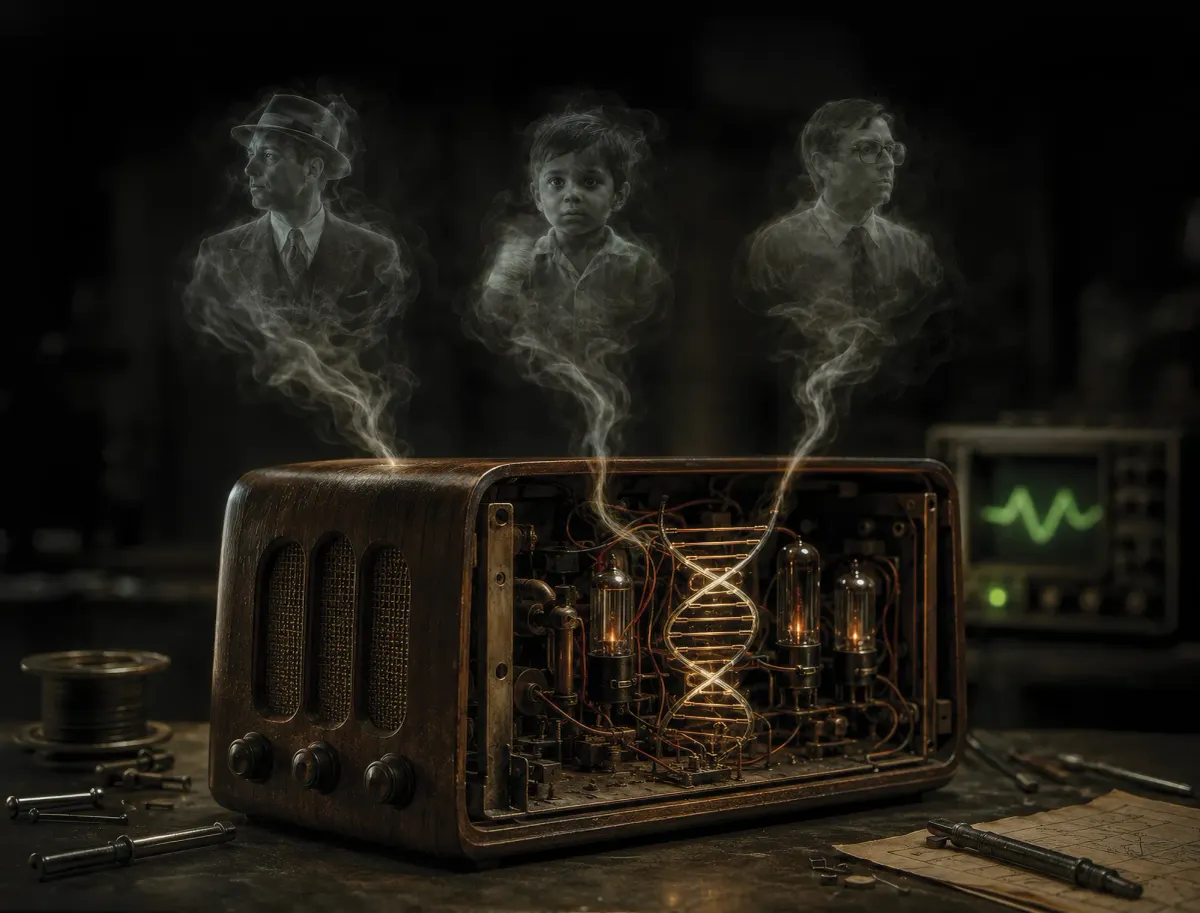
Although Stevenson never claimed to have proven that reincarnation actually exists, he pointed out what he saw as a problem with the materialist position—namely, the idea that consciousness and mind are merely products of the brain. “Certainly,” he wrote, “the mind expresses itself through the brain, and disturbances of the brain disturb the functions of the mind. Anyone can prove this to himself with an ounce or two of whisky.” But this fact, he argued, does not prove that consciousness is identical to brain activity. A common analogy for the idea is that of a radio receiver: if a radio breaks, the radio waves themselves remain unaffected.
Professor Emily Kelly of DOPS worked alongside Stevenson for thirty years, from 1978 until his death. “The great questions he tried to shed light on were ‘Who are we as human beings?’ and ‘Why are we who we are?’” she tells Haaretz magazine.
Professor Jesse Bering, a psychologist at the University of Otago, began his academic career working with chimpanzees in an attempt to understand what distinguishes them from us. His conclusion was that the ability to understand the psychological states of others—theory of mind—was uniquely human. Only humans, he argues, can think in a complicated way about what another person thinks or feels. Some animals possess an excellent sense of smell; others can fly. Human beings are the “psychologists” of the animal kingdom. “We are constantly thinking about how others think and feel.”
But theory of mind is rooted in us so deeply that even after someone dies, we continue imagining how that person thinks and feels. For twenty years Bering has studied this universal cognitive bias—the belief that consciousness continues after death. That is how he came across Stevenson. He began immersing himself in Stevenson’s writings, initially hoping to show that even the man regarded as the most serious researcher in the field had fallen prey to the same biases. “Contemporary research in social cognition shows how easily people detect meaning where none exists,” he says. “I thought that through these modern lenses I would be able to debunk Stevenson’s evidence, as one can do with most parapsychological research.”
Instead, Bering encountered an unexpected difficulty. “My theoretical framework cannot explain how a two-year-old child knows things about a dead person he never met,” he says. “That simply is not social cognition. My work focuses on how people think about dead minds, whereas Stevenson focused on how dead minds think.”
What about the argument that the brain is like a radio receiver that is needed to decode radio waves, but is not itself the waves?
Bering found himself drawn into Stevenson’s world. After nearly a decade of work, he published the first biography of Stevenson: The Incredible Afterlives of Dr. Stevenson. “I approached the subject completely certain that there is no such thing as reincarnation,” he says. “Even now I would not describe myself as a believer, but I am no longer quite as certain.” In an interview I asked Bering what caused this shift. “Mainly the fact that Stevenson was an extraordinarily knowledgeable and rigorous researcher who was fully aware of all the counterarguments and still found evidence that could not be explained.” He added: “Everything I say is true only if one accepts Stevenson’s word. I do accept it. After all these years of work, I feel that I know him better than many people I encounter in everyday life. He was an honest man who was not motivated by money or fame—quite the opposite, in fact. But he was genuinely obsessed with the subject, like an artist devoted to his craft. I came away convinced that he was ‘the real thing.’”
Rabih Abu Diab was born into a Druze family in Lebanon. He said that in a previous life he had been a famous soccer player and a successful pop star. One would have to be especially naïve to attribute any credibility to such memories. After all, many children dream of becoming soccer players or successful singers. Yet investigators later discovered that there really had been a man in Lebanon with golden feet and the voice of a nightingale named Saad Halawi, who died during the civil war. Yet, when the research team questioned Rabih about his memories, he was unable to recount anything that was not already widely known in Lebanon.
Rabih had already met some members of his “previous” family before the research team arrived, but he still had a half-sister he had never encountered. The team, led by Professor Christopher French, arranged such a meeting and documented it. “All that was missing was for the sister to write her name on her forehead,” French recalled the meeting. “She couldn’t have given him more hints—and he still didn’t recognize her.” French, who heads the Anomalistic Psychology Research Unit in the Department of Psychology at Goldsmiths, University of London, and who specializes in naturalistic explanations for experiences that appear paranormal, was not surprised. He noted that “The typical story goes like this. A toddler starts talking and says things that are open to interpretation. In the West, some of these statements are sometimes interpreted as descriptions of an ‘imaginary friend,’ while in cultures such as the Druze one they may be interpreted as descriptions of previous lives.”
According to French, even if a child knows details about a deceased person, this does not necessarily point to any hidden meaning. “Even Stevenson admitted that it is impossible to completely rule out every possible way in which the child might have acquired the information,” says French. “Parents, for example, may ask leading questions that unintentionally convey a great deal of information, resulting in the creation of false memories. We know that false memories are easy to implant and extremely common.”
What about cases involving marks on the body? Or cases in which the child remembers details for which no possible source of learning could be identified? “I assume they are not genuine, much as happens with charlatans or magicians who convincingly appear to possess powers they do not actually have,” French continued. “Even if there was no deliberate attempt to deceive, I suspect these memories are not real. It is simply a natural human tendency to believe in rebirth. I was not persuaded by Stevenson’s studies, and the most promising explanation in my view is that these are false memories.”
Another prominent skeptic is Professor Susan Blackmore of University of Plymouth, who originally began as a parapsychology researcher following a dramatic out-of-body experience. “I was out of my body for two hours,” she told Haaretz. “It was more vivid and real than ordinary life, and I wanted to understand how that could be. I was completely convinced of the existence of astral worlds and life after death.”
After twenty years of research that yielded no findings Blackmore became convinced she had been mistaken. “If you look at near-death experiences, for example, once we have neurological studies, the entire phenomenon is fully explained by heightened activity in certain areas of the brain.”
When I asked Blackmore how she explained cases like that of Lekh Pal Jatav, I was in for a surprise. The well-known researcher raised her hand to the camera and showed that she too suffers from a congenital defect that caused shortened fingers on one hand. “Is it rare?” she asked. “I don’t know, but probably not extremely. A doctor told me the umbilical cord likely wrapped around the fingers. Are there photographs of the man from the previous life whose fingers were cut off? That would have been more impressive.”
Blackmore pointed out that Stevenson traveled to India and relied on interpreters. “That’s unavoidable, but think about their motivation—to help, to produce good stories. And there is also the motivation of the children, who wanted to tell stories that would make them famous. There is a widespread cultural belief in reincarnation, so is it really surprising that there are so many such stories?”
One of Blackmore’s more surprising arguments actually comes from Buddhism. The researcher, who has practiced Zen for 45 years, recalls the Buddha’s teaching that the “self” is not a continuous entity. “In terms of modern science, I think he meant that the self is a sensation that appears and disappears, a product of a neural network. This allows rebirth to be understood differently. There is constant life and death—in our everyday experience. But there is no reincarnation of souls, because there is nothing there to reincarnate. It simply makes no sense.”
The historian of science Dr. Michael Shermer is perhaps the world’s most prominent skeptic today. In 1992 he founded the Skeptics Society, which he still directs, and the long-running Skeptic magazine. “There is no such thing as reincarnation,” he says bluntly. Research into past lives is riddled with problems, Shermer notes, such as the tendency to focus on unexplained anomalies. “What about all the children who have dreams and fantasies that never connect to anything? If you count only the ‘hits’ and ignore the ‘misses,’ that’s a statistical error. And when you examine, for example, birthmarks on children’s bodies—how similar do they have to be to the mark or wound on the previous person?”
Shermer invokes the “law of truly large numbers,” which states that given a sufficiently large number of events, even highly improbable occurrences are bound to happen. “When there are billions of people, of course there will also be very strange anomalies,” he says. “The whole thing is complete nonsense. There is no such thing as a soul, no separate consciousness—there is only brain activity.”
What about the argument that the brain is like a radio receiver that is needed to decode radio waves, but is not itself the waves? “I have a radio here” (he points to the cabinet behind him). “When it receives radio signals that are present in this room, I can go to the station and see where they are being produced. But where am I supposed to go when it comes to consciousness? Where was my consciousness before I was born? The answer is ‘nowhere.’ It did not exist.”
Toward the end of the interview, Shermer softens a bit, admitting, “It is true that there is something about human consciousness that is very strange. ‘What is consciousness?’ is a question science cannot answer. Perhaps theology, philosophy, or metaphysics will be able to do so.”
♦ ♦ ♦
In March 2005, the person closest to me on earth died. The depth of the rupture and grief is difficult to describe. Everything fell away—a total loss of grounding.
Three years later, in a corner of the basement floor of the Jerusalem Literary Gallery, I came across Twenty Cases. Naturally, I bought it, hoping to find some support, or at least a clue. I read the book over the course of more than a year. It is clearly not a light text, nor one intended to provide comfort. It seemed instead to offer a kind of medicine—but of an unexpected sort, mixing together ingredients that are difficult to swallow because they appear so foreign and contradictory.
In no scientific discipline can uncertainty be entirely eliminated, but it can be reduced.
Gardner Murphy was an extraordinary figure in the history of psychology. During the 1940s and 1950s he served both as president of the American Psychological Association and as president of the American Society for Psychical Research. Murphy wrote: “I saw, as no one but a psychologist can see, the massive ‘impossibility’ of personality without the body, of thought without cerebral cortex, of feeling without basic ganglia, of learning without the articulation of nerve cells … For all that, I saw the force of the evidence … for a genuine continuity.” That is what I felt after finishing the book. On the one hand, Stevenson operated according to the rules of the scientific world and presented astonishingly detailed evidence. On the other hand, that same evidence pointed toward something that sounds utterly absurd to anyone raised within the framework of Western scientific thinking. Reincarnation? As Blackmore put it so simply: no way.
Yet the unease would not let go. On the one hand, throughout all of recorded human history, despite an intense desire to prove the idea of reincarnation, not a single case compelling enough to settle the debate once and for all has been found. On the other hand, is there even anything that could truly count as “proof”? One could always argue that the case involves fraud, misunderstanding, information obtained by some ordinary means, or mere coincidence. “It would seem wiser to abandon this concept [of proof], which after all is virtually unknown anyway in other branches of science,” Stevenson once remarked. In no scientific discipline can uncertainty be entirely eliminated, but it can be reduced. To Stevenson’s credit, he accomplished that.
The dominant approach in Western science and philosophy for several centuries has been materialism—the idea that everything in the universe is entirely material. This includes consciousness, which according to this view is nothing more than electrical activity in the brain. But materialists tend to forget two important facts. The first is that consciousness is wholly “qualitative” in nature; its essence is subjectivity. Therefore, in principle, it cannot be described in the quantitative-objective language of science, nor can it be directly observed in experiments through measuring instruments.
The second fact is that, according to physics, what lies at the foundation of reality is not particles—that is, material entities—but rather fields and wave functions. In a lecture delivered late in life, the Nobel Prize–winning physicist Max Planck said: “As a man who has devoted his whole life to the most clear-headed science, the study of matter, I can tell you as a result of my research about atoms this much: there is no matter as such.”
If that is so, perhaps consciousness is a fundamental phenomenon of existence and of the universe, rather than merely a byproduct of brain activity. And if so, perhaps it does not cease with the death of the body, as materialism dictates? “I think a rational man, if he wants, can believe in reincarnation on the basis of the evidence I have collected,” Stevenson wrote, in a characteristic blend of modesty and self-confidence. Did he himself believe? It is not entirely clear.
About a year before his death, Stevenson wrote an article summing up his winding career. He concluded it with the words: “Let no one think that I know the answer. I am still seeking.” Perhaps that is his legacy to humanity: that we can, with clear thinking and without embarrassment, allow ourselves to think that perhaps there is something more—and to continue seeking.
This article is based on an article first published in Haaretz on May 28, 2026.
[ad_2]
Source link
