
[ad_1]

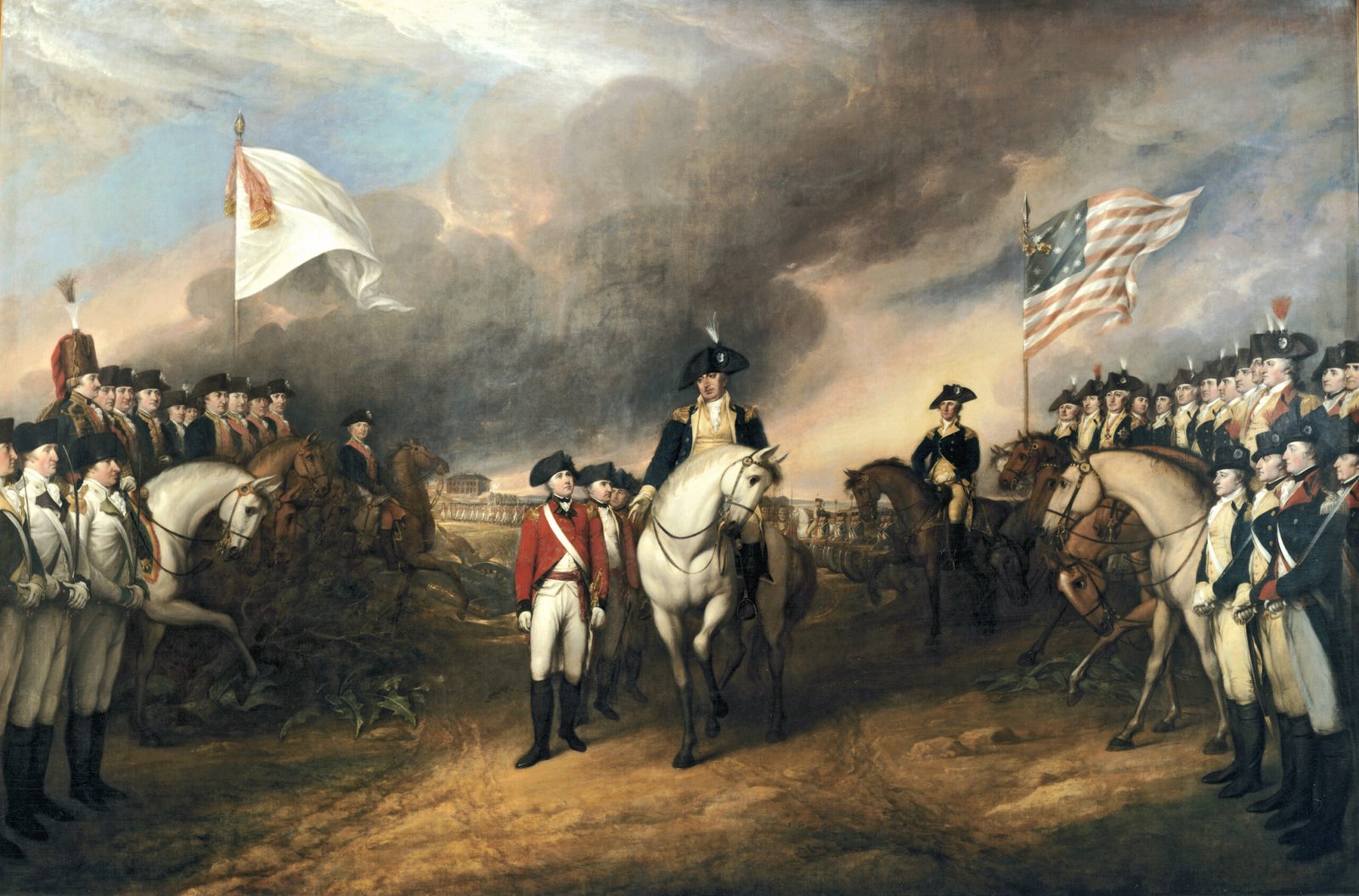
Surrender of Lord Cornwallis by John Trumbull – Public Domain
The American Revolution was undoubtedly revolutionary, but what exactly does this imply about our world today? To be sure, the Declaration of Independence articulated a universal idealism that helped establish the modern era and put a major nail in the coffin of the ancient regime. Applying Locke’s defense of the Glorious Revolution (e.g., the establishment of government based on consent with the threat of withdrawal, natural rights, and the invocation of universal — male and otherwise exclusionary — liberty and equality), 1776 was revolutionary insofar as it would have been unthinkable, and likely considered blasphemous, for someone like Jefferson to assert in the Middle Ages that he was the equal of a king. More concretely, after 1776 revolutionary ideas were exported, often via French officers who had aided the Revolution, back to Europe where they ultimately helped produce the French Revolution, which in turn helped inspire among other events the Haitian Revolution, the Revolutions of 1848, and the Egyptian and Ottoman reforms, which is not to mention the numerous U.S. reform movements that succeeded in part by calling the Declaration’s various bluffs.
How then are we to make sense of a revolution that invoked universal Enlightenment ideals yet whose foundational document excludes the majority of humanity and was authored by a slaveholder? The prevailing narrative is that the Declaration and the Constitution, in particular its Bill of Rights, planted seeds of universal equality and liberty whose growth was simply a matter of time and struggle. However, this is bad history, retroactive thinking that projects an imagined version of the present back onto the past. The historic reality is that slavery dramatically expanded, and became far more brutal, after the ratification of the Constitution and was only abolished due to a four-year civil war — that is, in spite rather than because of the Constitution. Following the end of Reconstruction, conditions again savagely deteriorated for African Americans, culminating in nearly a century of what has been termed “slavery by another name.” This is not to mention the 19th century expansion of racist immigration policies targeting the Chinese, the annexation of large parts of Mexico, Puerto Rico, Guam, and Hawaii, among other places, or the centuries-long genocide of the indigenous population.
In order to reconcile the revolution’s contradictions while simultaneously avoiding misleading teleologies, it is necessary to address the framers’ political project. After all, the revolution was not intended to simply eliminate colonial rule but rather to enable the colonists to establish an enterprise premised above all on securing the rights of private property. It is by looking at how they justified this enterprise that we can make sense of the framers’ particular relationship to freedom and equality, the ideological bedrocks of their project and our world today.
The freedom in question was of a decidedly negative variety, as the Declaration bitterly laments the Royal Proclamation of 1763’s prohibition against the colonists’ westward expansion following the Seven Years’ War. In condemning the king’s alleged support for the “merciless Indian savages,” the Declaration is clear that what it objects to is the restriction of the framers’ freedom to conquer the land and exterminate its inhabitants. In a similar vein, the Declaration complains that the king was interfering with the colonists’ freedom to control their private property, including in the form of slaves; the natural right to private property here meant little more than the freedom to dominate those whom property excludes.
The framers’ version of equality, while historically significant in comparing non-monarchical white men to a king, necessarily also takes its meaning from the context of the framers’ political project. Namely, the nation-state by definition bases its legitimacy on an imagined people that is defined in contrast to an outside (here the “unassimilable” indigenous population) as well as a subordinated inside (namely African Americans and in different ways women of all races). Paradoxically then, the revolution invoked equality but only within the confines of an intrinsically exclusionary and hierarchical nation-state. Here one is reminded of Anatole France’s observation that “The law, in its majestic equality, forbids rich and poor alike to sleep under bridges, to beg in the streets, and to steal their bread.” It is also no coincidence that this brand of equality anticipated and helped establish the ideological foundation for capitalism, which equalizes us insofar as it ceaselessly reduces all of our qualitative features into quantitative ones (i.e., our use values into exchange values), striving to make us fungible and commodifiable for the purposes of the market and ever more efficient capital accumulation.
We are very much living today in the world created by the American Revolution, a transformation designed above all to create a political, legal, and ideological system suitable to the needs of private property. We can experience this system’s liberty in our freedom to work or starve; to buy a home (or if you’re Elon Musk, the world’s first trillionaire, to buy 2.5 million homes) or go homeless; or to shop for all manner of goods, assuming you have the money. And we likewise live under its equality, a formal equality that is used to alternately disguise or justify the deeper divisions within our society and the world, on one hand, and to ensure that our human diversity is homogenized in order to be rendered legible to the demands of the market, on the other.
While the dominant narrative asserts that the U.S. has been inexorably advancing “toward a more perfect union” since 1776, critics frequently complain that the U.S. has failed to live up to its lofty ideals. It is possible, however, that both sides are wrong.
[ad_2]
Source link
