
[ad_1]

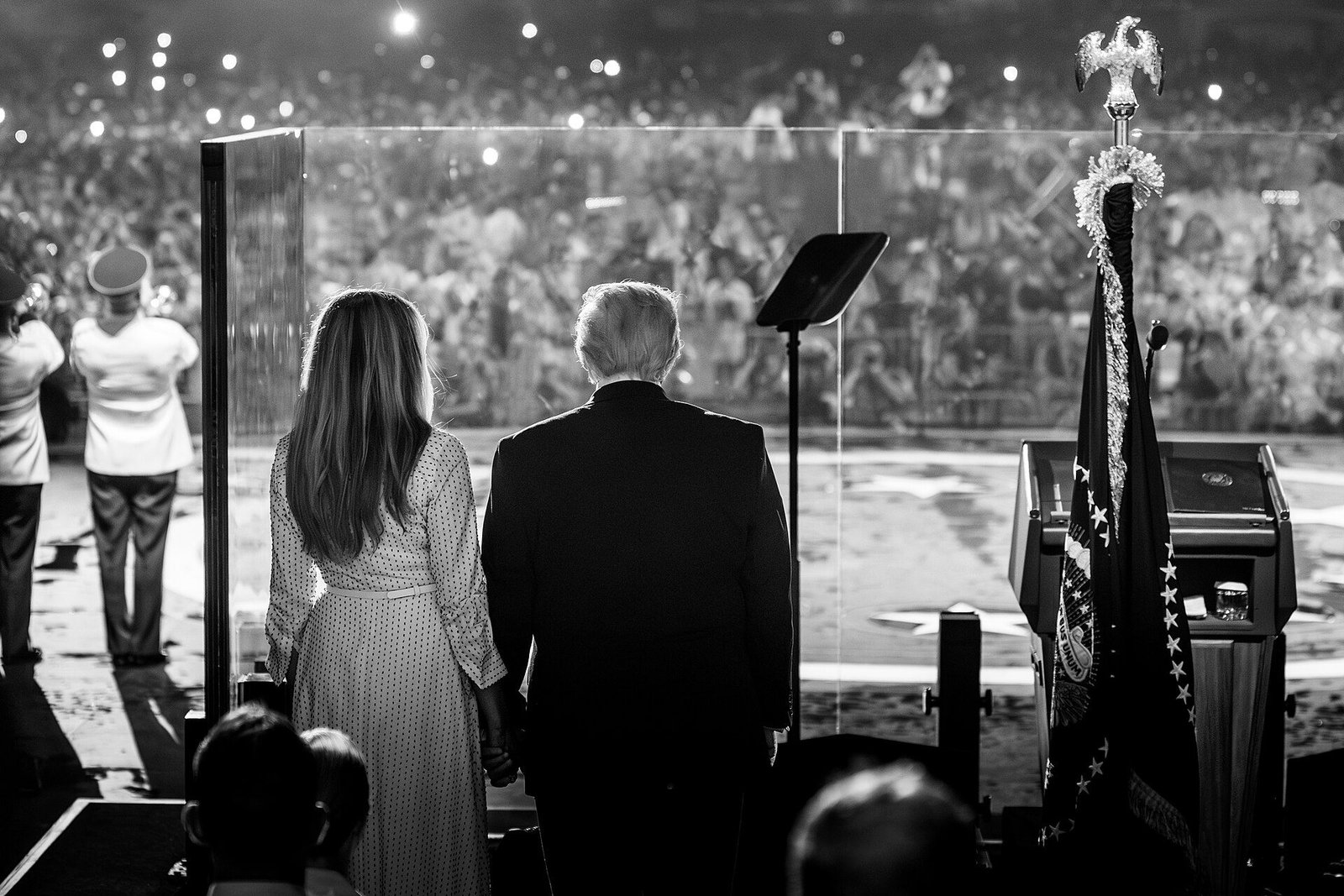
Photograph Source: The White House – Public Domain
What will be Donald Trump’s legacy? Obviously, there’s two-plus years left in his second – and, hopefully – last term in office. But who knows, he might declare a “national emergency” and attempt an “FDR” and go for a third term. Nevertheless, even without a crystal ball, his legacy looks pretty bleak.
Never-ending revelations about Trump’s use of his position — and the federal government — for self-aggrandizement is offending many of his staunchest supporters; his interventional into the World Cup decisions makes his power evermore petty. Add to these Israel’s Benjamin Netanyahu suckering him into a doomed war with Iran; his failed tariff policies; his over-zealous targeting of immigrants; and rising inflation that is hurting working Americans while his super-rich backers get richer.
However, Trump’s long-term legacy may be the president who ended the “American Century.”
Henry Luce, founder of Time (1923) and Fortune (1929), opened his legendary 1941 article, “The American Century,” with these words: “We Americans are unhappy. We are not happy about America. We are not happy about ourselves in relation to America. …”
Going further, Luce offered a grand concept of a new America:
… our vision of America as a world power includes a passionate devotion to great American ideals … a love of freedom, a feeling for the equality of opportunity, a tradition of self-reliance and independence and also of cooperation … we are the inheritors of great traditions of Western civilization – above all Justice, the love of Truth, the ideal of charity. …
It now becomes our time to be the powerhouse from which the ideals spread throughout the world and do their mysterious work of lifting the life of mankind from the level of the beasts to what the Psalmist call a little lower than the angels.
This vision linked the rise of America’s international hegemony to the engine of domestic economic prosperity that would both fuel the nation’s global military reach and assure popular allegiance.
Reading Luce today, one is struck by how he anchored the “American Century” in the 20th century. He seems to refer to “century” as the 100-year between 1901 and 1999, not the century between 1941 and 2041 and beyond.
Writing in support of the U.S.’s likely military alignment with England and entry into World War II, Luce’s “century” was the era of First World War and the Great Depression as well as the promise of the New Deal’s great recovery and mass industrialization – along with the coming wars in Europe and Asia.
Now, a quarter-century into the 21st century, has what Luce – and others – envisioned as the “American Century” been historically superseded? Luce argued that the new, “American Century” would redefine America – simultaneously – by domestic as well as global developments. Domestically, war-driven economic growth and rising levels of per capita income would foster the postwar consumption-driven prosperity. Globally, the war-driven – what Gen/Pres. Dwight Eisenhower dubbed – “military-industrial complex” fostered U.S. hegemony.
Over the last half-century, as the Center on Budget and Policy Priorities notes, “The years from the end of World War II into the 1970s were ones of substantial economic growth and broadly shared prosperity.” It adds, “Beginning in the 1970s, economic growth slowed and the income gap widened.”
For many, the great turning point in the erosion of the American Century came with Reagan’s revolution. In the wake of the 1982 recession, which featured the worst unemployment rate since the Great Depression, Pres. Ronald Reagan championed a recovery characterized by de-industrialization, union busting and trickle-down economics. While some 12 million new jobs were added during Reagan’s presidency, the bulk of them were in the service sectors of FIRE (finance, insurance and real estate), health care and retail as well as the construction sectors. High-paying, unionized manufacturing jobs were a thing of the past.
This decline was intensified in the wake of the COVID-19 recession. The recession of 2007-2009, while short-lived, was the deepest since the downturn in 1937-1938. More telling, achieving the American Century was predicated on a progressive or equitable income tax system. Between 1963 and 2003, the top bracket saw its tax rate decline to 35 percent from 91 percent. Reagan championed a further reduction in the income tax rate for the rich and super-rich; in 1988 and 1989, under the Tax Reform Act of 1986, the rate for the rich fell to 28 percent. (In 2017, it was reset to 37 percent and, in 2025, made permanent.)
The U.S.’s global imperialism is also slowly eroding. As the World Economic Forum outlines the eclipse of U.S. global efforts over the 21st century:
George W Bush withdrew from the Kyoto Protocol [2001] on climate change and opposed the Rome Statute creating the International Criminal Court. Barack Obama [2011] ended US involvement in Iraq. Donald Trump withdrew [2017] the US from the Trans-Pacific Partnership, pulled out of the Paris Agreement on climate change and renounced the Iran nuclear deal.
It adds, “US relative power may not have changed much since the 1990s, but these examples show a decline in America’s willingness to engage and commit internationally as well as in how credible others view its international pronouncements.” Trump’s debacle in Iran only exaggerates the decline.
Sadly, under Trump 2.0, America is returning to the worst of Gilded Age obscenities. Glamour and greed define not only the over-indulgences of the wealthy but also the mass-market fictions hyped by the corporate media. Many perceive politics as a “pay-to-play” sport in which all involved are happily on the take; deals are cut to benefit those with the most at the expense of those with the least.
And not unlike the Gilded Age, the stage is being set for a significant socio-economic crisis, the end of the “American Century.” U.S. global hegemony is eroding both economically and militarily. John Mearsheimer, among others, identifies this has a shift from a “unipolar” to a “multipolar” global order, from a U.S.-dominant to divided order with an ever-increasingly economically stronger China along with a potentially more united Europe and more integrated “BRICS” countries (i.e., Brazil, Russia, India, China, South Africa, Egypt, Ethiopia, Iran, Saudi Arabia, the United Arab Emirate and Indonesia.)
As Mearsheimer warns, “The new multipolar world will feature three realist orders: a thin international order that facilitates cooperation, and two bounded orders—one dominated by China, the other by the United States—poised for waging security competition between them.” Under Trump, the unipolar world order has given way, and a multipolar world order is emerging.
In 1821, Percy Bysshe Shelley prophetically wrote, “To him that hath, more shall be given; and from him that hath not, the little that he hath shall be taken away. The rich have become richer, and the poor have become poorer; and the vessel of the State is driven between the Scylla and Charybdis of anarchy and despotism.” (In The Odyssey, Scylla and Charybdis are monsters that block the water routes to Ithaca.)
Two centuries later, monsters of the Trump administration are blocking an “American Dream” economy, thus making sure that the rich get richer and the rest of us shall have ever less. The “American Dream” was the social anchor of the “American Century,” the belief that anyone could achieve success through hard work. It led to a good job, an affordable private home, good schools, quality markets and medical care. Sadly, in 2026, a Gallup American Dream Study found that less than half of Americans (46%) believed the American Dream is achievable today.
No wonder that there’s a growing disillusionment with both the Trump regime and his Congressional zombies as well as with the ever-cautious Democratic Party. Not surprisingly, there’s a “socialist” resurgence growing throughout the country.
On January 1, 2026, Democratic Socialist Zohran Mamdani was sworn-in as mayor of New York City – America’s biggest city. Most recently, he fulfilled a campaign promise when the NYC Rent Guidelines Board approved a historic rent freeze for about one million one-year or two-year rent-stabilized apartment lease renewals. As the Mayor said, “This is the relief that working people across our city deserve.”
A century ago, during the 1910s-1920s, more than 1,000 socialists were elected to public office, including two members of Congress, dozens of state legislators and more than 130 mayors.
Today, there are three “democratic socialists” in Congress – Sen. Bernie Sanders (I-VT) and two in the House, Alexandria Ocasio-Cortez (D-NY) and Rashida Tlaib (D-MI). Socialist mayors include Katie Wilson (Seattle) and Emma Mulvaney-Stanak (Montpelier, VT). Rolling Stone and Wikipedia claim there are 250 elected officials affiliated with the Democratic Socialists of America (DSA) as well as other “socialist” officials affiliated with the Working Families Party (WFP) and the Green Party.
The challenge before Americans, promoted by socialists and other progressives, is to contain the worst of the approaching end of the “American Century.” The U.S. is at the door that someday may be referred to as the “Global Century.” Trump and his Heritage Foundation associates, including the more militant Christian nationalist movement and Trump-aligned neo-Nazis, pose a profound threat to a 21stcentury, multipolar, multi-cultural America. Their collective vision or goal is to return America to the pre-WW-II era that inspired Luce, but history doesn’t go backwards.
[ad_2]
Source link
