
[ad_1]
In one of the scariest moments in modern history, we're doing our best at ScheerPost to pierce the fog of lies that conceal it but we need some help to pay our writers and staff. Please consider a tax-deductible donation.
The United States, in its recent war on Iran, has completely misread the Iranian people and failed to recognize the deep revolutionary spirit that pervades Iranian culture. Rather than inciting Iranian people against their government, the US-Israeli war on Iran has united the population. Rather than promoting democracy in Iran and empowering the people, US economic punishment and aggression have accomplished the opposite and have made life more difficult for most Iranians. Like Cuba, Iran is being targeted because it will not relinquish its sovereignty. As Chris Hedges explains, Iran is being punished for “its refusal to become a client state aligned with American interests in the region.”
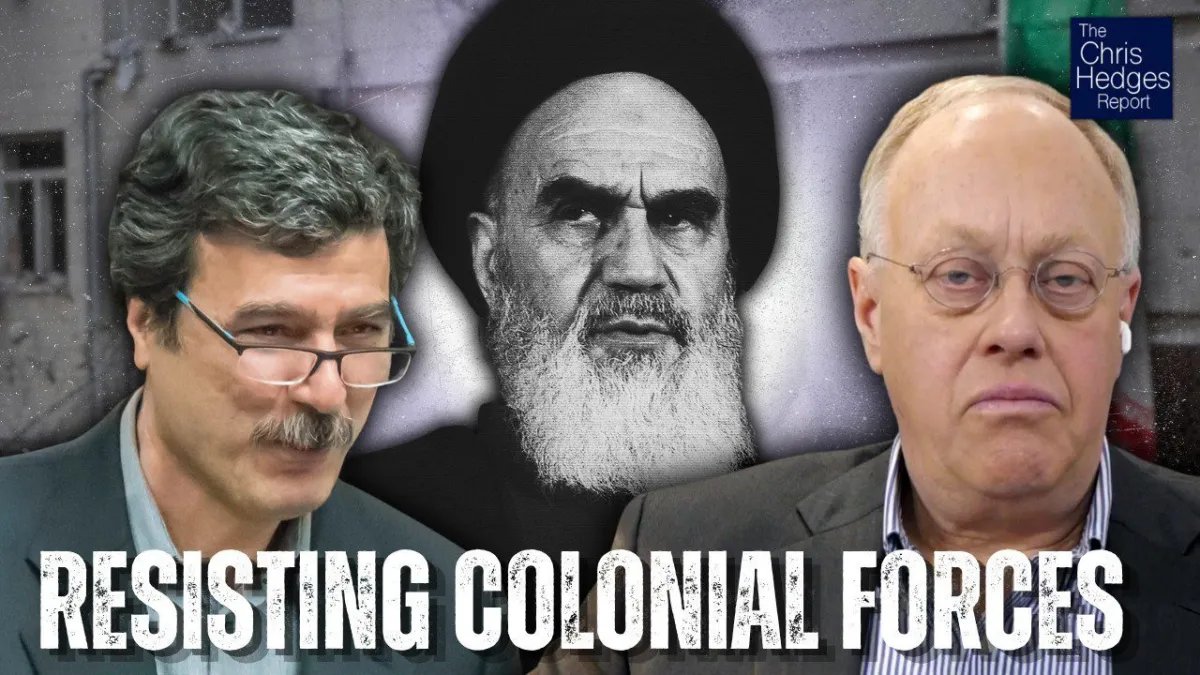
In this episode, Hedges speaks with Professor Behrooz Ghamari-Tabrizi, the author of “The Long War on Iran: New Events, Old Questions” (OR Books, January 2026). Ghamari is currently a visiting scholar at the Center for Place, Culture and Politics at the CUNY Graduate Center in New York. In his book, Ghamari tackles the myths perpetuated by the United States to demonize Iran in order to justify the imposition of severe sanctions and to go to war on Iran twice in less than one year. He discusses the many reasons why the Islamic Republic does not trust the United States to negotiate in good faith.
Year zero in the current struggle, Ghamari explains, was 1953 when the United States and the United Kingdom conducted a successful coup of the democratically elected Prime Minister Mohammad Mossadegh. This led to the Iranian Revolution in 1979, described by Ghamari as “the largest, most populous revolution in world history [that] defeated the fifth largest military in the world at the time.” Following that, events such as the Eight Year War, in which the United States provided the tools for chemical warfare on Iranians by Iraq, and the betrayal of Iran by President Bush, calling it part of the Axis of Evil despite Iran playing an instrumental role with the US in defeating the Taliban in Afghanistan, have created the conditions for “ the transfer of collective revolutionary consciousness generation after generation.”
Ghamari discusses Iran’s support for the Axis of Resistance as a way to create a “Ring of Fire” around it, opportunities to struggle against US and Israeli imperialism outside of Iran’s borders with the hope of avoiding a war at home. He states that initially Iranians opposed the use of resources to support Palestinians, Hezbollah and the defense of Syria, but now they understand the utility. Iranians see themselves in these struggles, and that is why a popular movement has taken the streets night after night against US attacks.
The outcome of the current conflict is uncertain, but Ghamari theorizes, and Hedges agrees, that Iran has a strong hand to play and the best result would be a return to a lifting of the economic sanctions in return for limits on Iran’s nuclear enrichment efforts, as was agreed in the Joint Comprehensive Plan of Action in 2015. The wildcards are the United States and Israel, who may be unwilling to compromise and may resort to dropping nuclear bombs in desperation.
Host
Chris Hedges
Executive Producer:
Max Jones
Intro:
Margaret Flowers
Transcript:
Margaret Flowers
Crew:
Sofia Menemenlis and Thomas Hedges
Chris Hedges: In February 1984, Behrooz Ghamari-Tabrizi was a prisoner on death row at Evin Prison in Tehran. He was alone in an infirmary cell, weak with advanced lymphoma. He had been arrested three years earlier for membership in a radical Marxist organization that sought to overthrow the Islamic Republic. He had been sentenced to death four months after his arrest. Now, to himself and his guards, he appeared to be dying.
The regime of Saddam Hussein, locked in a bitter war with Iran that began in the summer of 1980, was bombing Tehran, an attempt, not unlike the recent bombing by Israel and the US, to disrupt Iranian morale and compel Iranians to overthrow the government. But like most Iranians, Ghamari-Tabrizzi, although sentenced to death, would not transfer his loyalty to a foreign aggressor. In 1985, after the high judicial court annulled his death sentence, he was granted medical parole, left Iran, and was treated at Stanford University Hospital with aggressive chemotherapy. He went on to get his doctorate and was the chair of the Department of Near Eastern Studies and director of the Center for Iran and Persian Gulf Studies at Princeton University from 2020 to 2024.
In his latest book, “The Long War on Iran”, he implodes the myths used by US administrations to demonize Iran and impose not only crippling sanctions, but twice in the last year, wage an unprovoked war. “Since its inception in 1979, the Islamic Republic of Iran has exercised its own sovereign power to extend its regional political authority,” he writes.
The enduring question of the last four decades is Iran’s sovereignty, its refusal to become a client state aligned with American interests in the region. The United States and its European allies instrumentalize the Islamic Republic’s repressive state apparatus, its appalling violations of human rights – though arguably much less so than Western allies in the region – patriarchal legal system, and its limitations on civil liberties to justify their attempts to force Iran to submit to their demands. Joining me to discuss this latest iteration of the long war on Iran waged by Israel and the United States is Professor Behrooz Ghamari-Tabrizi, who is currently a visiting scholar at the Center for Place, Culture and Politics at the CUNY Graduate Center in New York.
Let’s begin with what you write about in the book. The assumption by Western leaders that the use of sanctions and, in the last year, the use of brute military force is an effective method by which Iranians will reject the regime and institute, of course, what they want is a kind of pro-American ruling class
Behrooz Ghamari: First, thank you, Chris, for having me on the program. The logic of sanctions goes like this: that if we put enough pressure on a society and communicate that with the people there, that we are inserting this pressure on you because of the fault of your government, then at some point when the pressure gets too much, people will rise up and overthrow their own government.
Sometimes this logic changes and they say that “We are not actually sanctioning the people, we are sanctioning the state.” But that sort of second logic is somewhat difficult to subscribe to because inevitably when you sanction the state, it would affect people’s lives.
In reality, however, that stated objective never is realized in the way that the proponents of this policy advocated. Possibly the first thing that happens with sanctions is the impoverishment of people of all walks of life – the middle classes would go down in immiseration and lose their means of livelihood, the working class would lose its means of livelihood. And the idea that when people are losing the means of their livelihood, they would then go and mobilize and organize against their own government is just a fantasy. The more people think about their bread-and-butter issues, the harder it becomes to go out and mobilize and form a formidable political movement.
The second thing that happens is that it securitizes society. I’ve had a number of conversations with people in the American government who were promoting this policy, and they always say that we are doing this to help to democratize society. And I always say that if you go and look at the consequences of these policies, you always realize that these policies actually securitize the society and enhance the power of those repressive forces inside the state that you are trying to contain.
Last but not least, it creates a non-transparent form of economy that is the hotbed and a very fertile ground for the emergence of economic corruption. Because the state is not going to throw their hands up and say, “Okay, now you sanctioned us, we are going to submit to your demands.” They’re going to find ways to go around sanctions and operate their economy and their trade. And since they do this in secret, they create this network of cronies who have access to trade and economic resources. And no one knows exactly how this trade is happening and who owns the businesses, corporations and factories. And that’s why we see in the past 15 to 20 years in Iran a very rapid and deep economic corruption inside the state, which, for the most part, is the result of these sanctions. And, of course, people take advantage of the opportunity that is provided to them by these sanctions and distribute economic resources towards their own sort of networks. Nepotism grows and sons and daughters and cousins and all that would benefit from this kind of very non-transparent economic activities.
Chris Hedges: I think a fundamental point that you make several times in the book is the utter misreading of Iranian society and the Iranian revolution, which, of course, was a coalition of groups including leftist university students, Marxists. Yes, those groups were crushed later, actually fairly quickly and fairly brutally by the Islamic regime. But, you make the case that that revolutionary spirit still exists within Iran and, of course, we saw it with the latest street demonstrations in January and a fairly brutal response on the part of the regime and a fairly counterproductive insertion of armed units apparently by the US and Israel into those protests. Talk about our misreading of Iranian society.
Behrooz Ghamari: I mean part of it is intentional – that sort of fabricating and manufacturing a kind of state of being in Iran that justifies the US and its allies’ policy towards Iran – and some of it, therefore, is very intentional. Some of it is a misreading on the part of a lot of mass media and other observers who talk about Iran. They constantly see that every few years – two years, three years, four years – we see a massive protest movement in Iran, and it ends up anytime that this happens, we read that on the front pages of the New York Times, Washington Post, all major newspapers. And that kind of protest movement sometimes suggests that the situation in Iran is so brutal, so unbearable and so difficult to manage that constantly people are pouring into the streets and protesting. I think that’s the source of misunderstanding that there is of course that protest movement and this kind of revolutionary consciousness among people in Iran, but that’s not necessarily an indication that the Iranian state is so extraordinarily brutal and extraordinarily repressive that it forces people to come to the streets as the last resort of expressing their grievances.
Actually, it is always the other way around. If the regimes are so brutal and they don’t leave any possibility of expression of any kind of grievances, we don’t see that often people coming to the streets. Iran, the Islamic Republic, is as repressive as any other country in the region, possibly less than other countries in the region. At least there are electoral processes in elections. We might argue that they are not real, they are fake, they are all these things. But, nevertheless, in no shape or form, Iran is more repressive than its neighboring countries and possibly in most other countries in the world, actually.
And the reason we see this kind of protest is actually that kind of what I call the transfer of collective revolutionary consciousness generation after generation. I think this is possibly the most important achievement of the revolution in 1979 that people came to this realization that they can express their grievances, they can express their demands by marching on the streets. And we need to remember that the Iranian Revolution of 1979 was the largest, most populous revolution in world history and they defeated the fifth largest military in the world at the time.
Chris Hedges: And let me just interrupt, of the most brutal secret SAVAK, one of the most brutal, largely Israeli-trained secret police networks certainly in the Middle East.
Behrooz Ghamari: Absolutely. Mossad was a major part of the training of SAVAK. The CIA had advisors in Iran during the reign of the Shah. So, that consciousness that people could actually overthrow, for the most part, by nonviolent means. This was not an armed revolution, this was a revolution that asserted its power through the sheer numbers. In 1978, the population of Tehran was around four million people and there were demonstrations, rallies that more than one million people participated in. Basically, one out of four people was participating in revolutionary rallies. And I think, that kind of subjectivity, that kind of collective consciousness we see that has been transferred, at least now, three generations after the revolution. And the reason we see all these protests movement is that that revolution of ‘79 continued in a sense in the mind of Iranian people rather than a reflection of the extreme brutality of the Iranian regime.
Chris Hedges: Let’s talk a little bit about Iranian consciousness of Western aggression, which you write about. The fact that the United States – not just the United States – the French and others supplied Iraq during the Eight Year War with Iran. Iraq used, of course, chemical weapons, which the Iranians did not respond with chemical weapons. The numbers were staggering. I mean, probably a few hundred thousand people were affected by Sarin and these toxic, chemical agents. And the West looked away, and not only looked away, but in the case of the United States and their famous visit of Rumsfeld traveling to Baghdad and shaking Saddam’s hand, they funded and sustained this effort. And that’s, even now, embedded into the consciousness, I think, of most Iranians.
Behrooz Ghamari: That is so true. I mean, it always puzzles me when there is a conversation about trust during these negotiations as if Iranians are the ones who need to build trust while the recent historical record actually points to the other direction, that it’s the Americans and their allies who need to build trust for Iranians because that has been repeated over and over again in the past half century that Iranians cannot really trust Americans. And you mentioned the Iran-Iraq War, which was, at the time, of course, Saddam Hussein in 1979, 1980 was a client state of the Soviet Union. But nevertheless, the whole of the countries of the West came to the rescue because once they realized that the war was not going in the directions that they envisioned – Americans, Germans, French, the UK, all Arab countries with the exception of Libya and Syria – they all helped Saddam Hussein
And they delivered even chemical weapons. The German companies delivered the material for chemical weapons. The US provided the means of delivery of chemical weapons. And at the time, even when Iran put a grievance in the United Nations Security Council to condemn the Iraqis use of chemical weapons, the country that vetoed that was the United States. And I think that this has left a scar for Iranians, that every time that they try to think about a rapprochement or a détente – and we see in the recent years that in the middle of negotiations, they attack and in their attack, they are very indiscriminate and they do all these kind of things that amount to war crimes and it’s very openly exercised both in rhetoric and in practice – so, I think Iranians have good reasons to be skeptical of American intentions. And the need to build trust sort of falls in the court of Americans rather than the other way around.
Chris Hedges: Well, you mentioned the fact that Israel and United States bombed in the midst of negotiations, both in Oman and Geneva. It’s not in your book, but you can go back all the way to the Algiers Agreement, which was the agreement after 1979, in which the United States promised not to carry out aggressive policies towards Iran and then immediately violated it. And then, as you do write about in your book, the fact that Iran was an ally in terms of the installation of the Karzai government. Iran has enmity with the Taliban. And then, also the fact that when the Americans were fighting the Sunni insurgency in Iraq, Iran physically had troops on the ground, militias on the ground, that were tacit allies of the United States to crush that insurgency.
Behrooz Ghamari: That is so true. And I think that goes back to this idea that one of the justifications of this current war is that no matter how hard Iranians try to change their own situation, they face dead ends, and that the only alternative left was an external intervention, which is far from truth. And we see in the past 40 years, particularly at the end of the Iran-Iraq war, Iranian society has gone through major transformations. When 9-11 happened, for example, Iran, both at the state level and at society level, was the only country in the Middle East that had organized massive public mourning for the victims of 9-11 in New York City. And this was not a kind of a veneer with some sort of sinister policy behind it.
Actually, as you mentioned, Iranians helped the U.S. to overthrow the Taliban. And in 2002, in the Bonn Conference, when they’re deciding about the future of Afghanistan, the U.S. delegation was very open about the fact that without Iran, they could not have toppled the Taliban that easily. But this was a kind of a reformist government under President Khatami at the time and there were some high hopes riding on this moment. Iran and the Islamic Republic wanted to show that they’re putting that kind of revolutionary fervor behind and ready to engage the US with mutual respect as equal partners. And then suddenly in State of the Union speech, George W. Bush comes out – this is after Iran was a partner in war and terror – and calls Iran one of the Axis of Evil.
And I think that really, again, we are speaking of the question of trust. That really inflicted irreparable damage to the Iranian reformist movement. Because if you show that much flexibility, if you show that much readiness to engage on different terms with the United States and the result is being called Axis of Evil, then how possibly could you justify any kind of rapprochement after that? I mean, they again justified it. They again tried to try that road unsuccessfully up to this point. And I think again, it’s very important to remember that all these US policies towards Iran, although the stated objective always has been that we want to help democratic elements inside Iran, in reality, every single policy that the US adopted undermine democratic elements inside the Iranian state and Iranian society.
Chris Hedges: Well, and of course, perhaps the most illustrative example of that is the coup that overthrew the Prime Minister Mohammed Mossadegh, who attempted to take control of Iranian oil, which was controlled by the British. And I think, as I remember from your book, the Iranians didn’t even know how much oil was being exported out of their country. Workers in the oil fields were paid slave wages. Of course, the CIA and the British came and destroyed one of the most vital democracies in the Middle East.
Behrooz Ghamari: That’s so true. The U.S. and Iran have a long history together, but I think if we want to understand this situation today, I think the year zero is 1953 for Iran and the U.S. And there were a lot of hopes at the end of Second World War that the US was going to emerge as a force for good. Whether that was true or not, at least that was the perception in many corners of the world because the US’s posture was an anti-colonial posture against the British Empire, against the French Empire. But that never materialized. And, and even Mossadegh, at the beginning of this movement for nationalization of oil, thought that the U.S. would support his initiative against the British oil company, which was a very colonial kind of contract. Oil was discovered in Iran in 1908 and the British basically controlled the production, distribution, everything. And by the time that oil was nationalized in Iran, the profit that Iran shared of the oil the production was only 18%. 82 % of the profit went to the British. 30 % of that was directed to the British government. And so that really set a kind of tone in the next 25 years for Iran-U.S. relations.
And in so many different ways in my other work, I argue that the Iranian revolution was Iranians’ response to the 1953 coup. And it’s impossible to understand the revolution without having the 1953 coup, CIA and MI6 coup, in mind. Because without that, it’s impossible to understand the Iranian revolution. Without that, because a lot of Americans, the only thing they remember of Iranian revolution is the taking over of American embassy in Tehran, the hostage crisis. And I think without the 1953 coup, the hostage crisis is incomprehensible. Not justifiable. I don’t think it was justified, but one needs to understand the mindset of those students who took over American embassy that they were thinking about the 1953 coup and the possibility of the US and the CIA attempting to sabotage the revolution once again.
But this is so important that year zero is 1953 and we need to really give enough attention to that time in order to understand what happened in the 1979 revolution, hostage crisis, and to a certain degree, what’s going on today. This is basically the foundation of a colonial imperialist relation between the two countries that needs to be overturned. And this is the whole kind of debate there, that the revolution basically changed the map of the Middle East. The struggle, the point of contention today, is to go back to the pre-1979 map of the Middle East with Iran as a client state and Iran as a state whose political authority does not exercise a political authority, does not undermine American interest or Israeli interest in the region.
Chris Hedges: Yeah, very close parallels with Cuba, wouldn’t you say?
Behrooz Ghamari: Absolutely. I gave this talk a couple of weeks ago at the University of Maryland and one of my colleagues there who’s a Cuba specialist, at the end of my talk, he said, “I just wanted to correct you one thing that wherever you said ‘Iran’, you should have said ‘Cuba’” because the similarity is really astonishing that this is the same policy. These are the same points of contention. And as we see in Cuba, what is the result of like 70 years of embargo, the immiseration of an entire nation. And it’s exactly the same. When that happens, you’re actually empowering the ruling classes. You are not disempowering them because you’re empowering the ruling classes and that can continue for decades after decades after decades as is the example in Cuba. And this is the example in Iran as well, that the more kind of free flow of ideas, trade, political relations, the better it is for the emergence of democratic movements in any country.
Chris Hedges: Before we talk about where we are now, you write that Iran’s existence depended on creating a ring of fire around its borders as a deterrent to the American and Israeli ambitions to redraw the map of the region. Explain the ring of fire.
Behrooz Ghamari: For years the Iranian state, the Islamic Republic, argued that helping neighboring countries in Syria, in Lebanon, in Palestine, is a deterrence for Americans and Israelis to bring the war directly to Iran. I remember when Hillary Clinton was the Secretary of State, there was a conference in Istanbul and the war in Syria had started and she said, “We are in Syria. We are going to clip the wings of the Iranians.” And, particularly after 9-11-2001, it was very clear that that kind of project of “seven countries in five years”, the biggest reward for that policy was toppling the Islamic Republic in Iran.
So, Iranians consciously created that kind of what I called a ‘ring of fire’ as a deterrent to say that “If you attack us, if you pressure us, we have the ability to respond in other places.” And, of course, I say this with a little bit of a caveat there. That doesn’t mean that there was no ideological commitment there as well. I believe that the Islamic Republic is committed to the Palestinian cause. They do instrumentalize it as well. But that doesn’t mean that they don’t genuinely believe that Palestinian’s right to return and statehood must be defended. But, in 1984, I believe, Henry Precht, who was the in charge of the Iran desk at the State Department, in a piece he said that Iranians basically are not interested in dominion abroad. They are interested in security and safety at home. And whatever they do outside their borders is a way of protecting that stability and security at home.
I don’t believe that the Islamic Republic, at any moment, had this kind of expansionist ambitions. And even about the question of Israel that they say, “Death to Israel. Death to America,” but that really did not translate into a specific policy of going towards annihilation of the state of Israel. This was basically a rhetorical gesture and with no actual plan. During the war with Iraq, there was a battalion of Revolutionary Guards who basically crossed the border from Iraq down to go to Lebanon and they said that we are going to just go down to Israel and liberate Palestine. And Khomeini, at the time, who is still alive, immediately said, “Just turn around, turn around. We don’t want to go to Israel. This is all about protecting our own borders. This is not about going anywhere else.” So, they all turned around and so basically at the beginning of the revolution, there was this misunderstanding that when they say that we are going to export the revolution, we are actually going to go and arm and liberate other lands. This was more of an inspirational kind of rhetoric rather than an actual kind of planned military and offensive plan to go and liberate other countries.
Chris Hedges: You’re right. I think you wrote the book, you’re responding to the bombings in June, but they can, of course, it is current for the latest round of attacks. “Fresh in the minds of Iranians was Israel’s genocide in Palestine. Bombing Iranian cities immediately evoked the image of complete destruction of Gazan cities. Iranians knew that the Israelis possessed no inhibition in committing war crimes and acts of genocide. They and their American backers wanted Iranians to have the image of Gaza in their mind, of the atrocities they are capable of, and to force them to surrender unconditionally in the first few days of the assaults. They also had hoped that the attacks would instigate regime change through mobilization from below, led by domestic and diasporic dissidents.” You write a lot about the diaspora, quite scathingly and correctly. “Bombing Evin Prison could be understood as a manifestation of the naive fantasy of the latter option. Raising the prison gates with the masses storming Evin carrying freed political prisoners on their shoulders and celebrating the end of the Islamic Republic in a replay of the fall of the Bastille.” I think that is what they thought and I think it’s probably another example of the complete corrosion or disintegration of the U.S. diplomatic corps. In a sense, you have to rely on diplomats who, to a certain extent, are bi-cultural. But let’s talk about the latest assault. What do you think it’s done within Iran? And what do you think the Iranian regime will do from here on out?
Behrooz Ghamari: The last part of your question is very hard to tell and we don’t know. But I want to emphasize this, that I truly believe that without genocide in Gaza, we would not be talking about this war in Iran.
The genocide in Gaza, I think, was an exercise in impunity. The transformation of the so-called rule-based world order through this genocide in Gaza opened up this possibility of war crimes that otherwise could have been unthinkable. I mean, it was unthinkable to do such a thing, to have a president of the United States openly saying that “We are going to annihilate an entire civilization.” I don’t think we could imagine anything like this five years ago, 10 years ago. And I think that was made possible by the genocide in Gaza. And Israelis, I think, were very much aware of this. And for that reason, I put much of the responsibility of what’s happening in Iran on the shoulders of the Biden administration. Because they had the opportunity to intervene and stop that genocide at its very, very early stages. Not only did they refuse to do so, but they helped to carry that out. And I think that really changed the face of war in the 21st century.
And I think that the word impunity is very key there, too. And Israelis tried it, and I think they tried it successfully, that the genocide that unfolded in front of the world’s eyes could be carried out for two years without any kind of consequences. I mean, there is an ICC indictment, but you know these are really not something that could ever stop that war machine against Palestinians in Gaza. And they knew that the only way they could attack Iran, declare war on Iran, was through a similar campaign of blanket bombing and destruction of civilian infrastructure that they did in Gaza. And that’s what they did.
And even today, they understand that there is no other option. What are they going to do? I would imagine even they might go as far as, God forbid, to drop a nuclear bomb on Iran because what other options do they have? They can’t invade Iran. And the only option they have is to basically what exactly President Trump is saying, to annihilate the entire nation and to do so very openly.
And so, I think, for Iranians this was a moment of a great lesson because for many years, when these kind of protests in Iran were happening and people were very dissatisfied with their own state and there was a lot of publicity about the diversion of Iranian resources to help the Axis of Resistance, the Palestinians, Hezbollah, Syria, and in a lot of these protests, Iranian people were shouting, “No, not for Gaza, not for Lebanon, my heart only is for Iran, I sacrificed my life for Iran.” And now they realize that all those things that the state was saying came to be true, that if they don’t have this fight in the streets of Damascus, they have to do it in the streets of Tehran. It might not sit well with the Syrians who live in Damascus, and for good reasons. But that was the reality that in the absence of Hezbollah, in the absence of Palestinian resistance – I mean, Iran doesn’t have very strong relations with Hamas, and that’s another misunderstanding of this whole thing – but with Palestinian resistance now the war has come to Iran and Iranians have to deal with it. And I think this was a moment that a light went on in many Iranian’s mind that there was some truth to that, that this was a project in the making at least for the past 20 years to bring this war to Iran and as Netanyahu always said, “To cut the head of the snake.” And that ‘head’ is Iran, and that’s the major reward for this sort of re-envisioning the Middle East. And that’s why we see a very strong rallying around the flag in Iran and these nightly gatherings, congregations in public squares in Iran. That started as a state initiative, but then it turned very quickly into a kind of a civil society movement that people show up all night waving flags and with families, with kids, with elderly, with disabled people. Everyone is showing that kind of support.
But where it leads, that’s a major, major question because we really don’t know what’s going to happen at the end of this war. The economic situation in Iran was already very hard. The inflation is between 60 to 70 percent and is going to get worse. Now, there is an estimate that four million people have lost their jobs because of the war. And the unemployment rate was already about 15 % before the war. So, all those economic grievances that started in December and January last year, now I think it’s going to resurface at the end of this war. And I don’t know whether the government has the resources to offer any kind of satisfactory alternative to how they are going to deal with that kind of very grave economic crisis.
It all depends on how the war ends and what kind of agreements they make. And if all the sanctions are lifted, maybe there is a possibility that the government can cope with the economic consequences of this war. But I truly worry about what’s going to be left in those ruins in relation to the state exercising its authority and the people who are trying to find a way to continue their means of subsistence.
Chris Hedges: It does appear that the Iranian regime has a high degree of leverage over the Strait of Hormuz. And of course, if they can get the Houthis to shut down the Bab al-Mandab, that will block Saudi oil that is being shipped through a pipeline and shipped out not through the Strait. And I’m just asking, it also appears to me anyway that there are certain non-negotiable demands on the part of the Iranian government. That is one, reparations; two, the unfreezing of Iranian assets, which are at least $100 billion; some kind of UN guarantee that they won’t be attacked again – they’ve been attacked twice within the last year – and then also this ability to collect tolls, if you want to call them that, usually in Chinese currency, I think exclusively in Chinese currency, which are a kind of backdoor form of reparations perhaps. But just your take on the Iranian position, Iranian negotiating strength. I know, I’m not asking you to predict the future, that’s a dangerous thing to do, but at least the trends.
Behrooz Ghamari: Right. I mean, the last proposal Iranians sent, in which they tried to separate the nuclear question from the crisis of Strait of Hormuz. And they said that, “We lift the blockade of Hormuz and then the U.S. lift the blockade. And then you unfreeze our assets and then we’re all good to go”
But of course, for the U.S., I think that’s a non-starter. I don’t think the U.S. is going to accept separating the nuclear issue from terms of ending this war because if they do, this is a very open admission of defeat for the U.S. because that was the whole idea of this war. Although no one knows what the idea of this war was, the objective of this war.
Up to this point, I think Iranians have the upper hand. They always knew that the Strait of Hormuz is their winning card, and they wanted to save that for a day like this. And now they’re using it and they’re basically holding the whole world economy hostage. And the world also knows that this hostage crisis is caused by the US, not by the Iranians.
I don’t know if you heard the German Chancellor the other day. I mean if the Germans are blaming the US for this, then we can say with a certain level of confidence that the world believes that the responsibility of this situation is on the shoulders of the US. So, Iranians have the upper hand and how they’re going to use this upper hand is not quite clear. And I believe that they’re ready, and they have said so before this war started, to agree to a certain number of years of freezing their enrichment program. And I believe that at the end, this is the kind of agreement that they can sort of work with that Iran would freeze for a certain number of years their enrichment program and the sanctions are lifted and some confidence building and so on and so forth. And then we go back to where we were last year. The painful part of it is that we could have achieved this without all this destruction and death. And now our hope is that we could get to an agreement that is something close to what we could have agreed on a year ago.
Chris Hedges: Great, thank you Behrooz. I want to thank Max and Sophia, who produced the show. You can find me at chrishedges.substack.com.
Editor’s Note: At a moment when the once vaunted model of responsible journalism is overwhelmingly the play thing of self-serving billionaires and their corporate scribes, alternatives of integrity are desperately needed, and ScheerPost is one of them. Please support our independent journalism by contributing to our online donation platform, Network for Good, or send a check to our new PO Box. We can’t thank you enough, and promise to keep bringing you this kind of vital news.
You can also make a donation to our PayPal or subscribe to our Patreon.
Please share this story and help us grow our network!
[ad_2]
Source link
