
[ad_1]
In one of the scariest moments in modern history, we're doing our best at ScheerPost to pierce the fog of lies that conceal it but we need some help to pay our writers and staff. Please consider a tax-deductible donation.
The former head of Mossad, once central to Israel’s security doctrine, now argues the country’s greatest threat lies not abroad—but in the unchecked violence and policies unfolding at home.
Joshua Scheer
A rare critique has emerged from within Israel’s own security establishment. Former Mossad chief Tamir Pardo—a veteran intelligence figure who once helped shape the country’s most sensitive operations—has publicly condemned what he witnessed during a recent visit to Palestinian communities in the West Bank.
Pardo, who served under Prime Minister Benjamin Netanyahu and rose through the ranks after a long military and intelligence career, is not an outsider or ideological dissident. His background includes elite service alongside Yoni Netanyahu and leadership of Israel’s intelligence apparatus during some of its most consequential years. Yet today, he is sounding an alarm that cuts against the dominant narrative of external threats.
After meeting Palestinian residents affected by settler violence, Pardo drew stark historical parallels and expressed a profound sense of moral crisis—arguing that the danger facing Israel may stem less from adversaries abroad and more from the realities unfolding within its own borders. His remarks mark one of the most forceful internal critiques yet from a former senior official, raising urgent questions about accountability, policy, and the country’s future direction.
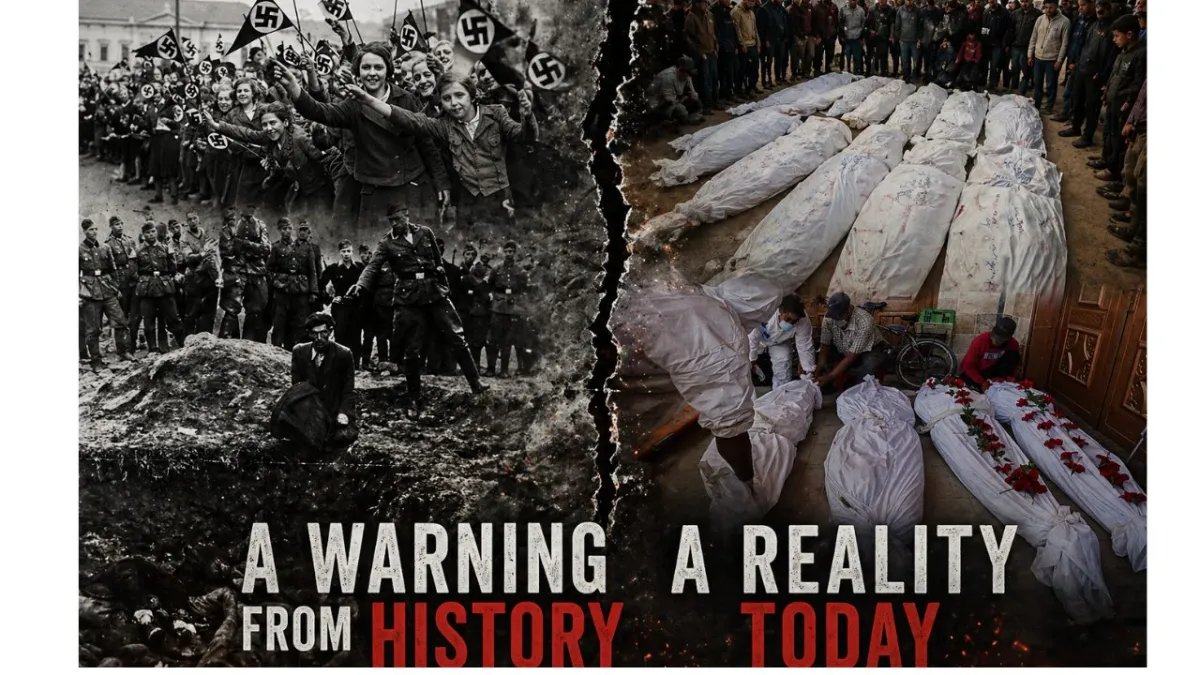
Saying “My mother is a Holocaust survivor,” Pardo said. “What I saw here today reminded me of events that happened in the last century in a very developed country – the same phenomena directed there against Jews. And I feel ashamed to be a Jew here today.”
The authorities, he added, “know what is happening here and choose to ignore it.” By doing so – and by supporting the violent settlers both politically and financially – he declared that the Israeli government “is planting the seeds for the next October 7.”
Pardo’s testimony now joins a much older and wider chorus—one carried for decades by Jews who have stood in the streets of New York, London, Barcelona, and beyond, insisting that state violence cannot claim their identity as its shield. It is the same moral current behind the chant that has echoed from synagogues to student walkouts to mass civil disobedience: not in my name. Not in the name of a people whose history is too often invoked to justify the suffering of another. Not in the name of those who survived the last century’s horrors only to watch their memory weaponized against the powerless.
By invoking his mother’s survival, Pardo did more than offer a personal anecdote—he placed himself inside that tradition of refusal. He drew a line between memory and complicity, between the lessons inherited and the realities unfolding before him. And in doing so, he exposed a truth that many governments would rather bury: that dissent from within is often the clearest measure of a nation’s moral temperature.
His warning—that the state is “planting the seeds for the next October 7”—is not simply a critique of policy. It is a reckoning with what happens when a society looks away from the violence committed in its name, when it confuses power with safety, when it mistakes silence for loyalty. It is a reminder that the gravest dangers are not always external; sometimes they are the ones nurtured at home, ignored until they erupt.
In the end, Pardo’s words force a choice. A country can continue down a path paved with impunity, or it can confront the mirror he has held up. The future will be shaped by whether that mirror is shattered—or finally, painfully, looked into.
Editor’s Note: At a moment when the once vaunted model of responsible journalism is overwhelmingly the play thing of self-serving billionaires and their corporate scribes, alternatives of integrity are desperately needed, and ScheerPost is one of them. Please support our independent journalism by contributing to our online donation platform, Network for Good, or send a check to our new PO Box. We can’t thank you enough, and promise to keep bringing you this kind of vital news.
You can also make a donation to our PayPal or subscribe to our Patreon.
Please share this story and help us grow our network!
[ad_2]
Source link
