
[ad_1]
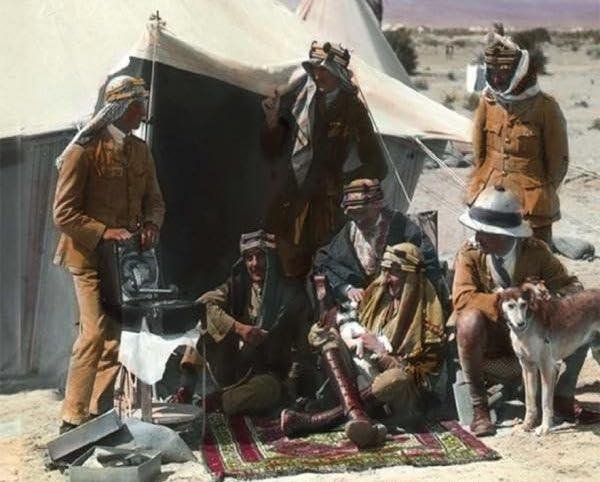
Cover photo for the book The Arab Bureau: The Story of Britain’s Most Ingenious Intelligence Unit by Eamonn Gearon
Many years ago, Eamonn Gearon returned from an epic camel journey across North Africa. He nearly died along the way, surviving in isolation until finally rescued by a radio crew. Having known solitude in difficult places myself, I understood the psychological weight of such experience.
A few years later, I shared a long hike with Gearon outside London, just the two of us, not far from where Graham Greene spent part of his childhood—a fitting landscape, perhaps, in which to discuss private conscience and personal loyalties.
Stimulating company, Gearon is one of those rare people who seem at once amused by life and deeply serious about it. The very first sentence of his new book—The Arab Bureau: The Story of Britain’s Most Ingenious Intelligence Unit—shows this: “Academic monographs are often seen as boring—as is the word ‘monograph’—mainly because many of them are.”
The cover image—taken in Aqaba—also serves a narrative function. A group of enigmatic British figures, including T. E. Lawrence, stand outside a canvas tent beneath a harsh desert light. Though likely posed, it captures the Bureau’s essential ambiguity: British officers attempting not merely to move through the Arab world, but imaginatively to inhabit it.
Their clothing suggests an uneasy fusion of Bedouin dress and early-twentieth-century expeditionary costume. Loose desert robes in sandy browns and ochres are paired with scarves, keffiyeh-style wraps and layered head coverings concealing much of the face. Anyone familiar with the Middle Eastern deserts understands how quickly such garments cease to appear theatrical and become practical.
I mention this not just to acknowledge my potential bias, but to show that despite Gearon’s Oxford doctoral research and clean prose, he also knows physically the world he describes. He is also a relative outsider. As the Arabic proverb quoted later puts it: “Ask the experienced rather than the learned.”
In The Arab Bureau, drawing on newly uncovered Arabic documents and neglected archives—blowing the sand off forgotten pages—Gearon reconstructs the history of the little-known intelligence unit established in Cairo during the First World War—whose influence on espionage, propaganda and the modern Middle East proved far greater than its obscure reputation might suggest.
The book argues that the Bureau unsettled aspects of what Edward Said later termed ‘latent Orientalism’ within the ways empire understood the Arab world. Gearon has said elsewhere that other intelligence services would adapt the Bureau’s tactics but forget its strategy—“and the cost of that amnesia can be measured in a century of failed Middle East interventions and wasted billions.”
Missing from the cover image, though not from the book—in which she features prominently—is Gertrude Bell. Bell played a leading intelligence and political role within the British-run Bureau, becoming one of its foremost experts on Mesopotamia, centred in present-day Iraq, through her extensive travelling, Arabic and Persian fluency, and deep knowledge of tribal and political networks. She had unusual authority in imperial diplomacy at a time when women were largely excluded from such roles.
I particularly enjoyed the section on intelligence and innovation. Espionage has always been a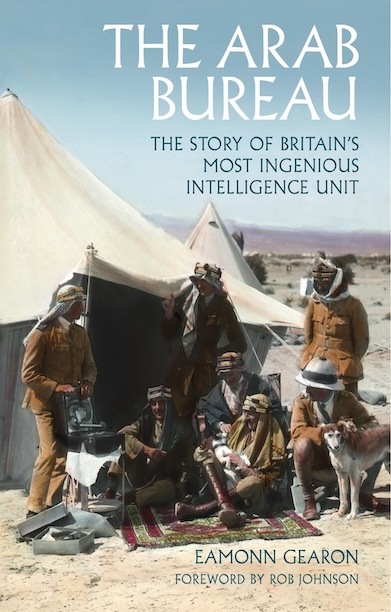 treacherous business, but its inventiveness remains compelling. When archaeologists, academics and soldiers converge in the same narrative, fantasies of adventure are never far away. Yet the Bureau’s achievement was fundamentally collective. As Dr Rob Johnson notes in the foreword, it functioned less as a gathering of isolated geniuses than as “an epistemic community that created new frameworks for understanding complex regional dynamics.”
The Bureau pioneered its worldly forms of cultural intelligence through secret reports, propaganda campaigns, and publications such as the 85,000-word Thawrat al-Arab, described by Gearon as the longest British wartime propaganda text written in Arabic. Produced in support of the Arab Revolt, it “has been appreciated in the Sudan, whence a demand for further copies has been received,” as one memorandum reported in the clipped language of administrative success.
Overshadowed by Lawrence of Arabia, the Bureau’s influence over modern intelligence and Middle Eastern politics has nevertheless remained largely obscured until now, and one suspects some of its more fastidious members might have preferred it to stay that way.
Reading Gearon’s book today, amid the devastation in Gaza and continuing instability across the Middle East, one is tempted to wish for some measure of the Bureau’s intellectual seriousness—however compromised a colonial setting may ultimately have been. Indeed, some of those imperial assumptions, British and French alike, still cast long shadows across the modern Middle East.
I note from the book that obliging booksellers often concealed Arab Bureau-backed publications among more ordinary popular reading, softening the appearance of overt propaganda. Gearon recounts that when copies of al-Haqiqa were bought as far afield as Afghanistan as wrapping paper, the Bureau recognised the accidental efficiency of distribution through everyday commercial exchange—though the Bureau itself was never allowed to interfere with the neighbouring India Office. Gearon deserves praise for recovering historical details of this kind.
Books about imperial intelligence exist in an uneasy space between admiration for ingenuity and recognition that it served sometimes ruthless colonial masters. Gearon is not in the business of admiring effectiveness alone. His larger aim appears to be to recover what has been forgotten, neglected or deliberately obscured. At the same time, he remains attentive to the consequences for those governed, manipulated and divided by such operations.
That attentiveness matters because terms such as “innovation”, “cultural intelligence” and “sophisticated propaganda” can, in lesser hands, sound deceptively neutral. In reality, these were instruments of wartime influence and imperial control, carrying real human consequences, and some of the borders, alliances and political expectations formed in that period have proved remarkably enduring, no matter how ‘civilised’ some of its members appeared.
Colonial powers sought not just to govern populations, but to shape the realities through which those populations understood the world. Any serious account must recognise both the Bureau’s historical importance and the extent to which British policy in the region served strategic interests rather than Arab self-determination. Gearon manages this balance well.
He closes with his own “Seven Pillars of Intelligence Wisdom”. The conceit is a clever one: extracting contemporary lessons from historical methods and proposing “a blueprint for understanding intelligence in our increasingly complex global environment.”
As Gearon notes, the Bureau commissioned many local writers. Its network “included Cairo-based journalists, Syrian and Lebanese émigrés, local intellectuals, and strategic allies, a diverse ecosystem of information exchange.” You could say the description reads more like a dispatch from the present than archival history.
Today, the region’s intelligence wars are waged through cyber operations, surveillance systems, proxy militias, and digital propaganda as much as traditional espionage. Iraq and Afghanistan demonstrated, repeatedly, that technological superiority cannot compensate for cultural illiteracy.
The tools are new. The limits of outside power are not.
[ad_2]
Source link
