
[ad_1]
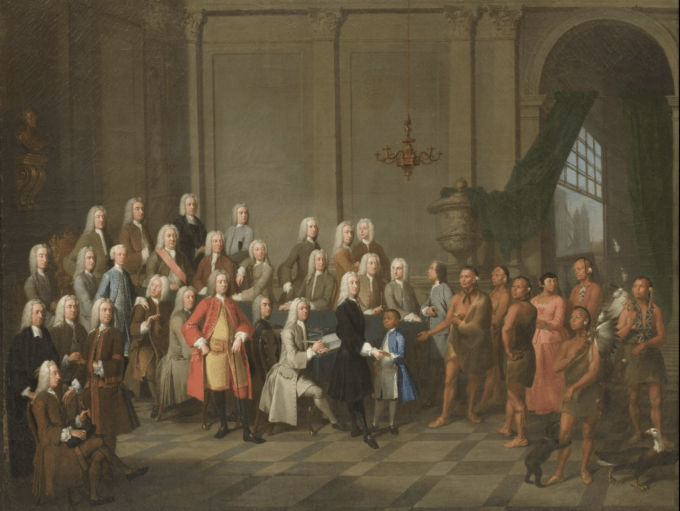
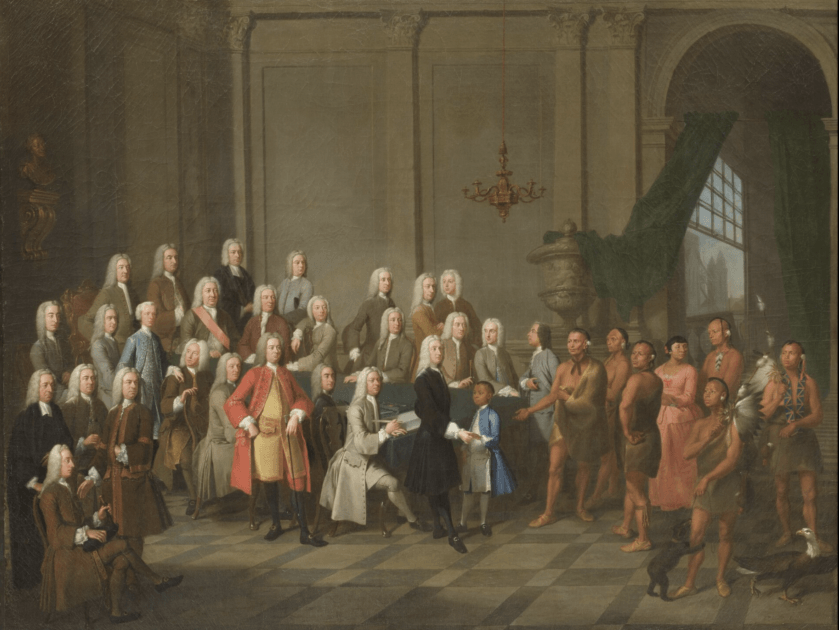
A Delegation of the Creek tribe meets with the Trustees of Georgia by William Verelst. Public domain.
It took a single sentence in Ken Burns’ documentary series The American Revolution to change the way I thought about the American Revolution.
It was a passing reference to British agents living among the Cherokee.
The documentary quickly moved on, but I couldn’t. Who were they? Were they soldiers, diplomats, or traders? Did they wear uniforms? Did they speak Cherokee?
What I found showed me an often overlooked side of the Revolution. Away from the famous battlefields, it seems Britain’s war was also fought through secretive Indigenous alliances, intelligence networks, and frontier agents who looked more grizzled than polished.
These men carried influence into parts of a continent where red coats rarely ventured as readily as a drawstring purse of gold.
Throughout, these frontier agents waged a conflict that stretched all the way from the Great Lakes to the southern Appalachians and into Georgia. Nor were they the over-romanticised characters imagined later by James Fenimore Cooper, such as Natty Bumppo. They were more mysterious than that.
A traveller approaching a Cherokee town in 1776 might notice a stranger among the warriors. At first glance he hardly looks British at all. No bright red coat. No polished gorget. Instead, a hunting shirt, buckskin leggings, moccasins stained from weeks of travel, and a hat pulled low against the summer sun.
Yet this man represents the British Crown.
Before anyone talks war, gifts are laid out: blankets, powder, lead, vermilion, kettles. Each is accepted with formal thanks before the council begins. The exchange is more than generosity. It shows respect, friendship, and Britain’s willingness to honour a relationship that both sides know carries obligations.
But the gifts are only the beginning. The man carries letters from distant officials, promises of detailed support, and intelligence. Behind him stands a packhorse—one can almost hear it snort—laden with gunpowder, lead, muskets, blankets, and other trade goods for the next undeclared port of call.
Alexander Cameron was one such man, an intrepid Scot who emigrated to Georgia and spent years among the Cherokee. Cameron showed us more than anyone an aspect of the Revolution that many readers, even well-educated ones, may never have encountered.
I hear the Revolution is still commonly taught as a struggle between Patriots and the British, rather than as a multinational civil war of Loyalists, numerous Indigenous nations, enslaved people seeking freedom, and imperial agents.
Fluent in Cherokee politics and deeply familiar with the nation’s big families, Cameron became one of Britain’s most influential representatives in the southern backcountry.
Another was Henry Stuart, brother of John Stuart, a veteran Indian Department official who knew that frontier influence depended less on rank than on relationships.
Like Cameron, Stuart travelled constantly between settlements and Cherokee towns, distributing presents, gathering intelligence and maintaining Britain’s presence.
By 1775, London faced a tricky problem. Its empire stretched around the globe, but North America was immense. There were simply not enough regular troops to garrison every frontier settlement or to police the huge interior. British officials had to rely on a different strategy. They had to bolster old alliances and forge new.
They relied on the Cherokee in the South, the Haudenosaunee nations in the North, and Native communities across the Ohio Country, supported by those Loyalist rangers, traders, interpreters and frontier agents. Together, they extended British influence far beyond the reach of regular troops.
Nowhere was this more visible than among the Cherokee.
During 1775 and 1776, British agents travelled through Cherokee country, warning of continuing Patriot expansion. The British Crown always presented itself as the power more likely to hold back colonial expansion and preserve Indigenous territory, however imperfectly.
To be fair, the Cherokee’s chief concern would have been territorial survival, not the constitutional disputes dividing Britain and her colonies.
The British found keen listeners among leaders such as Dragging Canoe, who already knew what American settlers meant to Cherokee lands. When war came, British diplomacy and supplies reinforced a decision many Cherokee leaders were already moving towards as the number of settlements grew and grew. The resulting British-backed Cherokee offensive swept across frontier settlements in present-day Tennessee, Virginia, North Carolina, South Carolina, and Georgia.
Yet these campaigns turned out to have been only one strand in a much larger British strategy.
Far to the north, another remarkable figure occupied a similarly unusual position.
Joseph Brant was Mohawk by birth, educated in English schools, familiar with both Native and British societies, and uniquely positioned to bridge the two worlds. To British officials he was priceless. To many frontier settlers he became one of the most feared men in North America.
The history of the Haudenosaunee Confederacy tells us that Brant’s warriors, again alongside Loyalists and other Indigenous allies, launched many raids across the New York frontier from bases along the Susquehanna, hitting settlements throughout the Mohawk and Schoharie valleys.
British supplies reached them through a strategic hub on the Niagara River. Fort Niagara served as the nerve centre of Britain’s northern frontier war, moving supplies, intelligence and diplomatic messages.
The Seneca Nation became one of Britain’s most formidable allies. In November 1778, Seneca warriors joined others in the devastating raid on Cherry Valley, one of the Revolution’s most notorious frontier attacks.
The violence became so severe that George Washington eventually ordered the Sullivan Expedition of 1779, a massive campaign intended to break the military power of the Haudenosaunee nations allied with Britain in New York.
Across thousands of miles of wilderness, the pattern remained remarkably the same: local allies fought for their own interests while Britain supplied the things that kept alliances alive—more gifts to honour old friendships, more powder and lead for war, more letters from distant officials, and more agents travelling from town to town with news, promises and instructions.
What makes the story especially fascinating to me is that many of the men holding the system together felt just as at home in Indigenous worlds as in British.
John Butler, commander of Butler’s Rangers and a skilled cultural broker, worked closely with Iroquois communities and could communicate in Mohawk, relying on interpreters when necessary.
Other British agents and traders married Native women, raised mixed families, and lived for years in Native towns, developing family ties that lasted generations.
Some spoke Cherokee, Mohawk or other Indigenous languages, while interpreters bridged the remaining gaps.
These were the indispensable go-betweens of Britain’s frontier empire.
What is more, successful frontier agents understood how Native politics worked. They knew who held influence, and that councils, ceremonies, kinship ties, and gift exchanges mattered just as much as military force. At the same time, the Americans faced a basic contradiction.
Many Patriot leaders waxed lyrical about liberty while their frontier settlers continued pressing westwards onto Native lands. For many Indigenous nations, that westward expansion posed the more immediate threat.
The American Revolution is remembered as one of marching armies, sieges and set-piece battles. Yet across the rich forests of eastern North America this other conflict kept unfolding.
The British representative most characteristic of such a hidden war was rarely the upright officer in a Costwolds-dyed red coat. More often he was the multilingual, deft and agile frontier agent, seated in a Cherokee council house or an Iroquois longhouse, listening far more than he spoke.
For all the forgotten intrigues and ingenuity of this frontier network, however, it could not alter the outcome of the war. The Crown’s agents succeeded in building remarkable alliances and extending British influence deep into the interior, but diplomacy and Indigenous partnerships proved no substitute for victory in the main theatres of the Revolution.
When Britain finally recognised American independence in 1783, many of the Native nations that had fought alongside Britain found themselves abandoned to an expanding United States, while frontier agents like Cameron, Stuart and Butler faded into the margins of history.
Britain lost the war, and with it the frontier system these men had spent years patiently building. That is precisely why they deserve to be remembered. They reveal to us today just how much larger, more complex and more deeply interconnected the American Revolution really was.
Happy 4th of July.
[ad_2]
Source link
