
[ad_1]
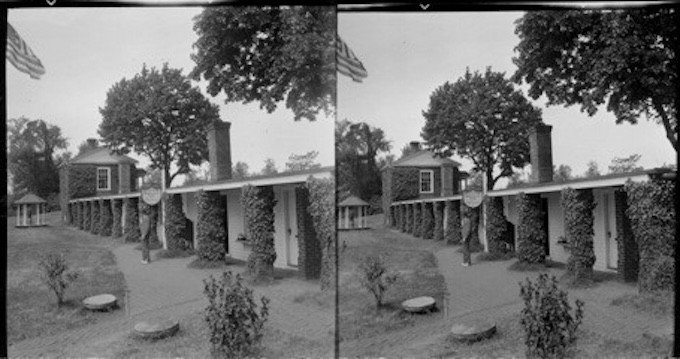
Slave quarters at Monticello, James C. Sawders, Keystone View Company, Keystone-Mast Collection, UCR/California Museum of Photography, University of California at Riverside.
The segregated American media spent the week leading up to the Fourth of July praising the founding fathers and paying tribute to other American heroes. Heroes to them. Monsters to us.
For CNN, Kit Carson is a hero. They showed a scene in which Carson walked miles, nearly barefoot, to rescue his men. We grew up watching the exploits of Kit Carson on cartoon shows. Our Settler education didn’t inform us that Kit Carson committed atrocities against the Navajo. How did the Navajo regard the American hero, Kit Carson? From a site called Partnership with Native Americans.
In 1863, General James Carleton began a renewed effort to eradicate the Navajo. In charge of the operation was Colonel Kit Carson. Knowing he couldn’t defeat the Navajo militarily, Carson began to destroy the Navajo homes, crops, and livestock. More than two million pounds of corn, a staple of the Indian diet, were burned. Forced to survive on nuts and berries many families, starving during the long winter months, began turning themselves into the military. About 8,000 men, women, and children were forced to make the “Long Walk” to Basque Redondo, a reservation in New Mexico about 300 miles away. Many died on the way of hunger and cold. Others drowned when they were forced to cross the Rio Grande during the spring floods.
Douglass Brinkley is a good guy. I spent a couple of days with him in New Orleans under a grant he’d received to bring writers to New Orleans. But now, he’s become a TV historian instead of someone who would challenge the decadent old boy Historical establishment, now under attack from a generation of women, Black, and Native American historians. But he’s right at home in a media that considers Confederacy apologist Ken Burns a historian. On a Wed.TV show, he expressed his admiration for Theodore Roosevelt.In 2021 Brinkley was named the inaugural historian in residence at the Theodore Roosevelt Presidential Library.
How do Blacks feel about Theodore Roosevelt?
America’s Black Holocaust Museum’s Post
On December 30, 1906, President Theodore Roosevelt ordered the dishonorable discharge of 167 Black soldiers from the U.S. Army’s 25th Infantry Regiment following what became known as the Brownsville Affair—one of the most consequential racial injustices in American military history.
The events that led to the order began months earlier, on the night of August 13, 1906, in Brownsville, Texas. A white bartender was killed and a police officer wounded by gunfire. Almost immediately, white residents accused Black soldiers stationed nearby at Fort Brown. Despite testimony from commanding officers that the soldiers were in their barracks at the time, and despite glaring inconsistencies in the physical evidence, local authorities focused exclusively on the regiment.
… No individual soldier was identified as a suspect, and no court-martial ever took place.
Nevertheless, under political pressure and citing a supposed “conspiracy of silence,” Roosevelt imposed collective punishment. His order stripped all 167 soldiers of their honor, pensions, and the possibility of future federal employment. Many of the men had served honorably for years, including during the Spanish-American War. Some were nearing retirement and lost the economic security they had earned through decades of service.
The consequences were lifelong. Families fell into poverty. Reputations were destroyed. The Army’s decision reinforced a painful contradiction: It was not until 1972 that the U.S. Army formally acknowledged the wrongdoing and exonerated the soldiers.”
I asked one of Theodore Roosevelt’s biographers why he omitted Roosevelt’s role in the Brownsville incident. He said that he didn’t have space to include it. Booker T. Washington tried to persuade Roosevelt to give the soldiers a fair trial.
Francine Prose showed up in the Guardian on July 2nd, where she expressed her reverence for Thomas Jefferson, a hypocrite who found slavery ”excreable,” yet bred Slaves like livestock and consigned them to cramped quarters that were unsanitary. He broke up families and had his slaves beaten. Indeed, he might have beaten them himself. A visitor from France said that he accompanied Jefferson as he reviewed his slaves and that while walking up and down, he slapped a riding crop in his hand. The slaves responded to this gesture by trembling. Though much has been made about his having a Black mistress, another oral tradition describes him as a promiscuous rapist. Why would feminists honor this man? I think Jefferson is admired for his Hollywood Raj look, the name given to Cary Grant and other British actors who acted in films that promoted British imperialism.
Benjamin Franklin was called “Old Double-Face; ” yet he was smarter than the other Founding Fathers. Franklin began opposing slavery in the late 1750s after visiting a school for Black children and realizing their lack of education was due to their environment, not nature. His opposition peaked at the end of his life. He became the president of the Pennsylvania Society for the Abolition of Slavery in 1787. He petitioned Congress to end slavery in February 1790. While Washington, Jefferson, and Hamilton advocated the extermination of Native Americans, Franklin protested the massacre of Native Americans.
Benjamin Franklin protested the 1763–1764 slaughter of 20 peaceful, unarmed Susquehannock (Conestoga) Indians by writing a fiery pamphlet titled A Narrative of the Late Massacres in Lancaster County. He condemned the killers as a “barbarous mob” and passionately argued against collective racial punishment.
So if the country needs a founding father, maybe it should be Franklin?
[ad_2]
Source link
