
[ad_1]
Joshua Scheer
As the United States celebrates the 250th anniversary of the Declaration of Independence, politicians from across the political spectrum are invoking the familiar language of freedom, democracy and American exceptionalism. Fireworks, patriotic speeches and national celebrations present the nation’s founding as the birth of liberty and self-government. political leaders across the ideological spectrum have once again embraced the familiar language of American exceptionalism. From President Donald Trump to former President Barack Obama, the nation’s founding is celebrated as the beginning of an extraordinary experiment in liberty and self-government. This patriotic narrative leaves out some of the country’s most defining realities.
In this provocative powerful and vital essay, Joseph Massad challenges the mythology surrounding America’s founding, arguing that the ideals proclaimed in 1776 existed alongside slavery, settler colonialism and the systematic exclusion of large portions of the population. Rather than dismissing these realities as unfortunate contradictions, the article contends they were central to the political and economic foundations of the early republic. He challenges the traditional story of the American Revolution, arguing that the promise of freedom proclaimed in 1776 was never intended to apply equally to everyone. While the Declaration of Independence spoke of liberty and equality, millions of enslaved Africans remained in bondage, Indigenous nations faced continued displacement, and political rights were reserved largely for white male property owners.
“It is the millions of Americans who resisted, and continue to resist, this oppressive system… who must be celebrated on the Fourth of July, not the system that oppresses them.”
This was former President Barack Obama speaking recently on MSNOW about America at 250 and how he believes the nation’s founding should be understood, arguing that America’s founding story should be understood in all of its complexity, saying, “I think sometimes we get confused in thinking that these two stories are separate. They’re intertwined.” Obama said it is possible “to be a great admirer of George Washington, and also acknowledge he was a slaveholder,” adding, “That does not negate his greatness, it simply acknowledges that there’s a profound deep flaw in these Founding Fathers who were also geniuses and gave us these tools.” While acknowledging that “the founders fell terribly short of the Declaration’s promise, leaving slavery intact, allowing states to restrict the franchise to white men who owned property,” Obama also argued that “in drafting a Constitution and a Bill of Rights, they did have the foresight, the genius, to provide us with a framework that allows each generation to make our union more perfect.”
However rather than viewing these contradictions as unfortunate exceptions, Massad contends they were deeply embedded in the political and economic system created by the new republic. writing “The truth… is that the independence of the United States was, and remains, the best thing that ever happened not to the world, but to the white supremacists in it.”
The piece also examines how westward expansion, slavery, and settler colonialism became central to the growth of the United States after independence. It draws on historians who argue that Native communities suffered systematic violence and dispossession while slavery remained essential to the country’s early economy and constitutional order.
Massad further argues that the mythology surrounding American independence has been reinforced for generations through politics, education, and corporate media, presenting the United States primarily as a force for freedom while minimizing or overlooking the experiences of those who were excluded from those promises.
The article also extends its critique beyond the nation’s founding, connecting historical patterns of racial hierarchy, military expansion, and economic power to more recent U.S. foreign policy. In the author’s view, the celebration of American exceptionalism continues to obscure the costs borne both at home and abroad.
Whether readers agree with every conclusion or not, the essay raises enduring questions about how history is remembered, who gets included in the national story, and whether commemorating America’s founding should also mean confronting the injustices that accompanied it.
As the country reaches its quarter-millennium milestone, the debate is not simply about the past. It is about what kind of democracy Americans believe they are celebrating—and whose voices and experiences remain absent from that celebration.
Key Arguments
The promise of liberty was never universal.
While the Declaration of Independence declared that “all men are created equal,” the new nation protected slavery, denied political rights to women, excluded Indigenous peoples from citizenship and limited political participation largely to white male property owners. The article argues that these were not temporary oversights but defining features of the nation’s founding.
The Revolution protected existing economic interests.
Massad revisits arguments made by historians who suggest the American Revolution was also driven by economic concerns. British restrictions on western expansion, taxation and growing tensions over slavery created conflicts with colonial elites whose wealth depended heavily on land speculation and enslaved labor.
The essay highlights scholarship arguing that many colonial leaders viewed British moves toward limiting slavery as a threat to their economic system, making independence as much about protecting existing power structures as expanding freedom.
Native Americans paid a devastating price.
One of the article’s strongest themes is the treatment of Indigenous nations. It argues that westward expansion following independence accelerated campaigns of dispossession, warfare and forced removal. The essay connects early government policies with later events such as the Indian Removal Act and the ideology of Manifest Destiny, portraying them as part of a longer project of territorial expansion at Indigenous peoples’ expense.
Slavery remained central to the new republic.
Although freedom became the defining language of the Revolution, slavery continued to expand after independence. The Constitution protected slaveholders’ interests, and many of the country’s most influential founders either owned enslaved people or benefited from the institution.
The article points to this contradiction as one of the defining paradoxes of American history: a nation celebrating liberty while millions remained in bondage.
American exceptionalism shapes historical memory.
Massad argues that schools, political leaders and much of the corporate media continue to present an idealized version of American history that minimizes its violence and contradictions. According to the essay, the dominant national narrative celebrates democratic achievements while often overlooking the experiences of Indigenous peoples, enslaved Africans, workers, women and others who were denied many of those same freedoms.
Connecting the Past to the Present
The article also draws connections between America’s founding and contemporary politics.
Massad argues that the language of American freedom continues to be used to justify military intervention abroad while discouraging deeper examination of the country’s own history. He contends that understanding the nation’s origins requires confronting difficult questions about race, empire, economic inequality and political power rather than relying solely on patriotic symbolism.
The essay further suggests that genuine democracy has often advanced not because of the country’s founding institutions alone, but because generations of abolitionists, labor organizers, civil rights activists, Indigenous leaders, anti-war movements and grassroots organizers forced the nation to confront its own ideals.
Why This Debate Matters
Whether readers agree with Massad’s conclusions or strongly disagree, the article raises important questions that continue to shape public debate:
- Who benefited most from American independence?
- Whose stories have traditionally been left out of the nation’s founding narrative?
- Can a country celebrate its achievements while honestly confronting its injustices?
- Does patriotism require defending historical myths, or can it also include critical reflection?
With “The unceasing terror that this first independent state has imposed – and continues to impose – on its own Black and Indigenous population, its working classes, and the imperialised rest of the world is rewritten as a story of ‘American freedom.’” and “The truth… is that the independence of the United States was, and remains, the best thing that ever happened not to the world, but to the white supremacists in it.”
As America enters its next 250 years, these questions remain deeply relevant. The anniversary is not only an opportunity to celebrate the nation’s accomplishments, but also to examine the contradictions that have shaped its history and continue to influence its politics today.
For supporters, critics and everyone in between, the discussion ultimately asks what kind of democracy Americans hope to build—and whether a more complete understanding of the past is necessary to achieve it.
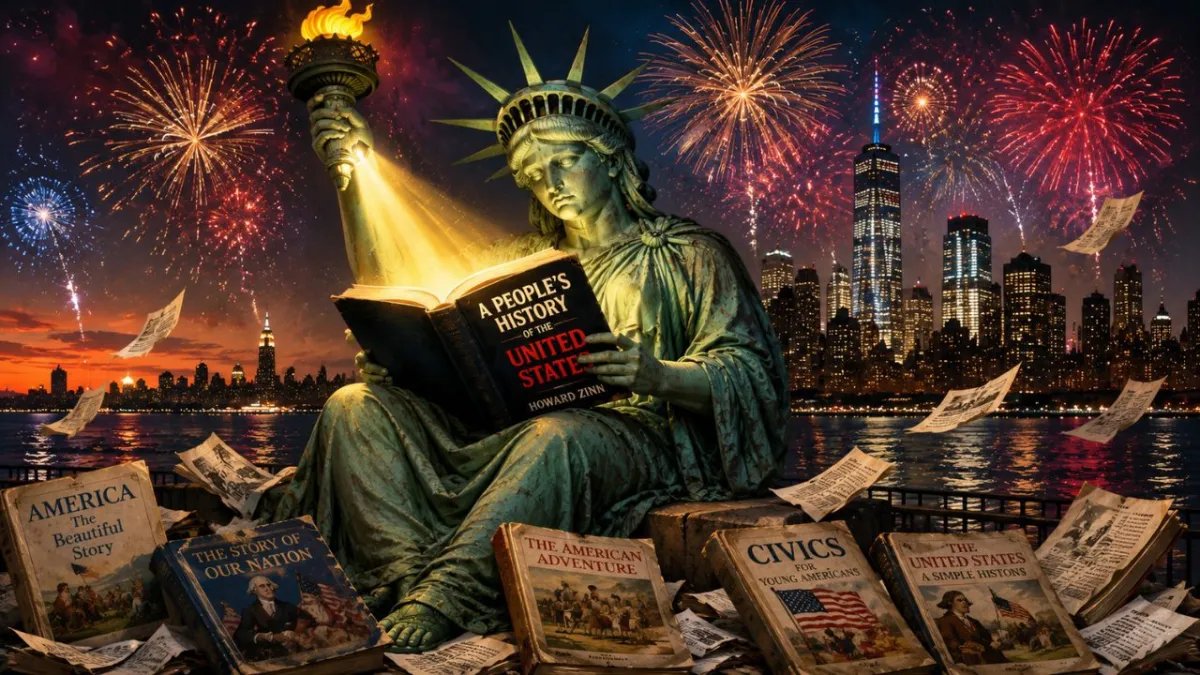
As we mark another Fourth of July, I’ve included two videos that helped shape my understanding of American history. One is A People’s History of the United States, a book that became my real history textbook and one I believe every student in this country should read. The other continues that examination of the United States beyond the myths many of us were taught growing up.
We can each come to our own conclusions about the United States, its history, and its role in the world. Some see an imperfect democracy striving toward its ideals; others see an empire built on conquest and inequality. But whatever our perspective, our opinions should be grounded in historical fact—not comforting mythology.
For generations, many history books presented slavery as a system where enslaved people were content, suggested that Native Americans willingly gave up their lands, and glossed over the violence, dispossession, and resistance that shaped this country’s history. Those narratives have left generations of Americans with an incomplete understanding of the past.
If we truly value freedom, then we should also value an honest accounting of our history. Only by confronting the full story—the achievements alongside the injustices—can we build a more just future.
Happy Fourth of July. My hope is not simply that we celebrate independence, but that we continue the ongoing work of creating a society that lives up to its highest ideals. Real change has always come from ordinary people willing to challenge injustice, and history reminds us that every generation has the opportunity—and the responsibility—to do the same.
Editor’s Note: At a moment when the once vaunted model of responsible journalism is overwhelmingly the play thing of self-serving billionaires and their corporate scribes, alternatives of integrity are desperately needed, and ScheerPost is one of them. Please support our independent journalism by contributing to our online donation platform, Network for Good, or send a check to our new PO Box. We can’t thank you enough, and promise to keep bringing you this kind of vital news.
You can also make a donation to our PayPal or subscribe to our Patreon.
Please share this story and help us grow our network!
[ad_2]
Source link
