
[ad_1]
Joshua Scheer
The sentencing of the so-called “Filton Four” has become a flashpoint in a much larger debate about protest, direct action, terrorism legislation, and the role of juries in the British legal system.
The case marks the first time that “criminal damage” convictions in the UK have been classified as terrorism.
Supporters of the activists argue that the case is not really about criminal damage or even a confrontation with police. Instead, they contend it is about the expanding use of terrorism powers against anti-war and pro-Palestinian activism, and about whether governments can sidestep longstanding legal traditions when politically convenient.
At the center of the controversy is the claim that a judge effectively overrode the spirit of a jury’s findings by treating the activists as terrorists despite the jury’s more limited conclusions regarding intent. Critics say the case reflects a broader effort to criminalize direct action campaigns targeting arms manufacturers linked to Israel’s war in Gaza, while supporters of the sentences argue that serious criminal conduct warrants severe punishment regardless of political motivations.
With the legality of the British government’s proscription of Palestine Action facing continued legal scrutiny, the Filton Four case has become a test of where the line between protest and terrorism is drawn—and who gets to draw it.
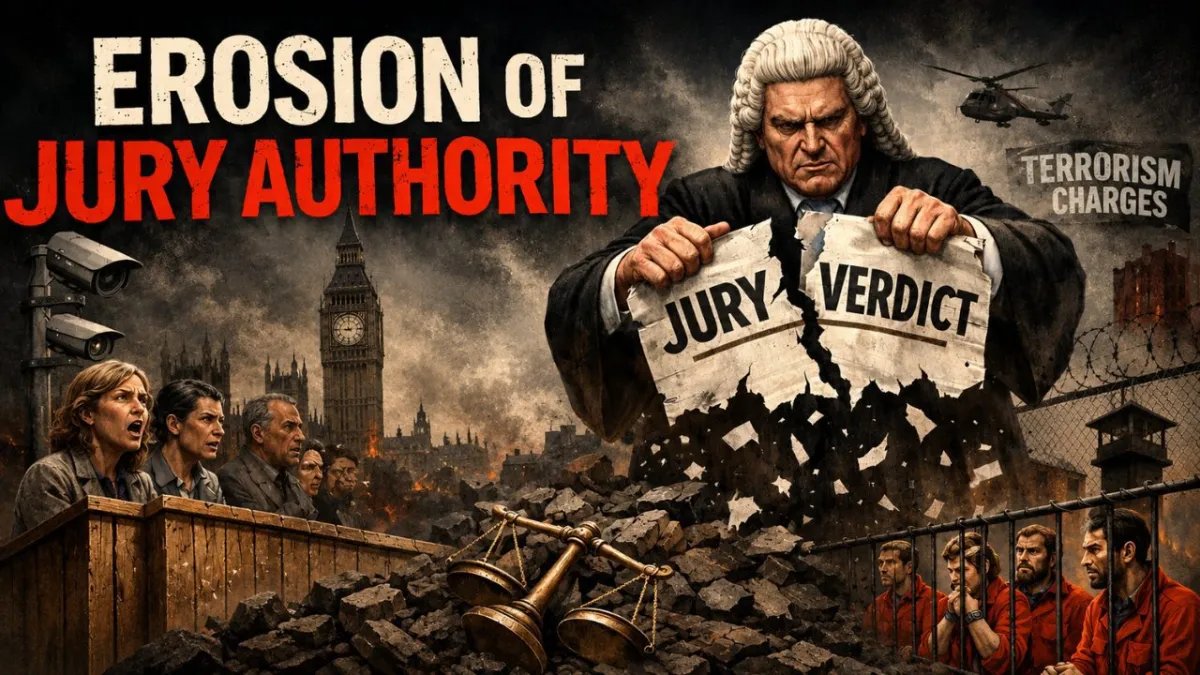
The following commentary argues that the case represents a dangerous erosion of jury authority, civil liberties, and the right to engage in political direct action.
This from Jointhan Cook’s Substack
There are lots of people drinking the security services Kool Aid over the sentencing of the Filton Four.
They believe the judge was right to overturn the jury’s decision to convict four anti-genocide activists of criminal damage and make it a terrorism offence instead, overturning centuries of legal precedent.
Why? Because, they claim, the four activists broke / smashed / shattered a police woman’s spine.
But that obviously can’t be the explanation because three of the activists had nothing to do with that incident and yet they were convicted as terrorists by the judge anyway.
Even Samuel Corner, the activist who was convicted over this incident (which left the police woman with a minor fracture, according to the medical authorities who testified), shouldn’t have been sentenced as a terrorist for it because that is not what the jury, which heard the actual evidence, decided.
The jury convicted Samuel Corner of grievous bodily harm without intent. The prosecution had charged him with GBH with intent because they needed that as his conviction to build a public mood in support of the proscription of Palestine Action as a terrorist organisation.
If Corner could be presented as having entered Israel’s Elbit weapons factory with intent to commit violence, then the implication would be that the other activists were in on that plan – a conspiracy – and the government would be off the hook of violating fundamental legal norms by proscribing Palestine Action.
By stripping out intent, the jury pulled the rug from under the government’s feet.
Judge Johnson’s task was put the rug firmly back in place by riding roughshod over the jury’s decision and sentencing them as terrorists anyway.
The timing couldn’t be more convenient. On Monday, the Appeal Court will be deciding on the government’s appeal against the High Court declaring its proscription of Palestine Action unlawful.
If you’re peddling the “But they smashed the back of a police woman” line you’ve been fed by the Daily Mail and BBC, it’s because that is exactly what the government needs you spouting as it upends our age-old rights to jury trials, as it stamps out an honourable tradition of direct action dating back to the Suffragettes and before, and as it gives itself cover for continuing complicity in a genocide.
Stop being a cuck. Don’t fall for this psy-op.
For more on the troubling legal precedent established by this ruling, Natasha Lennard reports in The Intercept that the sentencing of four Palestine Action activists in the so-called Filton Four case marks an unprecedented development in British law. Although a jury convicted the activists of criminal damage—not terrorism offenses—Justice Jeremy Johnson applied a post-trial “terrorist connection” designation at sentencing, making this the first known case in the UK in which criminal damage convictions have been treated as terrorism.
The activists, who targeted equipment at an Elbit Systems factory linked to the production of military drones used by Israel, now face years of additional imprisonment and long-term counterterrorism restrictions despite never being convicted by a jury of terrorist crimes. Human rights advocates warn that the ruling creates a dangerous precedent that could be used against future protest movements and acts of civil disobedience.
“Criminal damage has never been treated as terrorism within the UK justice system before, and it is completely disproportionate to do so because the offence occurred at a protest,” said Kerry Moscogiuri, chief executive of Amnesty International UK.
“A terrorism sentence carries restrictions that stay with a person for the rest of their life. We should all be worried about what this means for other individuals taking direct action in protest at a genocide or any other issue,” Moscogiuri added, calling the ruling “a new low in the ongoing crackdown against protest across the UK.”
Critics have also pointed to the stark contrast between the treatment of the Filton Four and the sentences handed down to participants in violent far-right and racist riots, arguing that the decision reflects an increasingly expansive use of counterterrorism powers against political dissent.
For more on this case
Legal Profession Revolt Against The UK Judge Whose Job Is To Protect Israel’s Genocide
UK judge Gags Palestine Action Defendants to Secure ‘Terror’ Stitch-Up
British Parliament Votes To Ban Palestine Action Despite Public Outcry
Editor’s Note: At a moment when the once vaunted model of responsible journalism is overwhelmingly the play thing of self-serving billionaires and their corporate scribes, alternatives of integrity are desperately needed, and ScheerPost is one of them. Please support our independent journalism by contributing to our online donation platform, Network for Good, or send a check to our new PO Box. We can’t thank you enough, and promise to keep bringing you this kind of vital news.
You can also make a donation to our PayPal or subscribe to our Patreon.
Please share this story and help us grow our network!
[ad_2]
Source link
