
[ad_1]
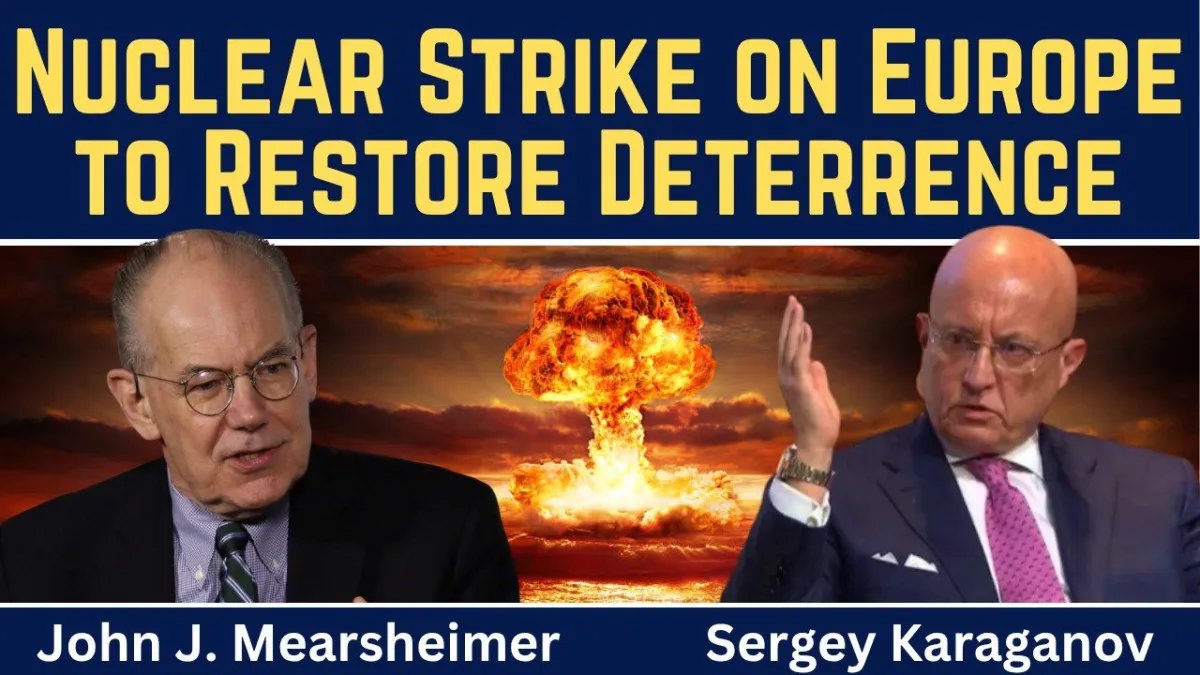
The following discussion features political scientist John Mearsheimer and longtime Russian strategist Sergey Karaganov in a conversation hosted by Glenn Diesen on one of the most alarming questions facing the world today: whether the war in Ukraine and the escalating confrontation between NATO and Russia could ultimately lead to the use of nuclear weapons.
What follows is not an endorsement of the views expressed, but an examination of arguments increasingly being made within influential foreign policy circles as the conflict continues to intensify. Mearsheimer and Karaganov debate the collapse of Cold War-era deterrence, the risks of NATO escalation, the future of European security, and the possibility—however unthinkable—of limited nuclear war.
Their exchange offers a rare and unsettling window into how some prominent strategists view the dangers of the current moment, raising profound questions about deterrence, escalation, and the future of global security. Whether readers agree with their conclusions or not, the discussion underscores the growing fear that the world may be entering its most dangerous nuclear era since the Cold War.
Follow Prof. Glenn Diesen: Substack: https://glenndiesen.substack.com/ X/Twitter: https://x.com/Glenn_Diesen Patreon: / glenndiesen
Key Highlights: Mearsheimer & Karaganov on Nuclear Deterrence, Europe and the Future of War
1. Karaganov Argues the World Has Already Entered a New World War
One of the most striking arguments in the discussion is Karaganov’s claim that the world is already in the opening stages of a broader global conflict. He argues that the post-Cold War order is collapsing as Western dominance declines and a multipolar system emerges.
According to Karaganov, the war in Ukraine is only one front in a much larger struggle involving economic, technological, political, and military competition. In his view, the danger is not merely Ukraine itself, but the absence of new rules capable of managing great-power rivalry.
2. Mearsheimer Says the West Forgot the Lessons of the Cold War
Mearsheimer repeatedly returns to a central theme: during the Cold War both Washington and Moscow understood where the red lines were and generally avoided crossing them.
He argues that Western policymakers have abandoned that caution.
Among the examples he cites:
- Ukrainian attacks inside Russian territory.
- The 2024 Kursk incursion.
- Attacks on components of Russia’s nuclear deterrent.
- Escalating NATO involvement in the war.
According to Mearsheimer, actions that would have been considered dangerously provocative during the Cold War are now treated as routine.
3. The Debate Is Not Really About Winning a Nuclear War
A major point of discussion is the distinction between “winning” a nuclear exchange and restoring deterrence.
Mearsheimer argues that no one can win a full-scale nuclear war because all sides would be destroyed.
Karaganov responds that he is not advocating a massive strategic exchange but rather discussing whether a limited nuclear strike could force adversaries to back down and recognize red lines.
The conversation centers on coercion rather than conquest: using the threat of escalation to compel a change in behavior.
4. The Moral Argument Against Nuclear Use
Despite his reputation as one of Russia’s most hawkish strategic thinkers, Karaganov repeatedly emphasizes what he calls the moral barrier against nuclear weapons.
He argues that Russia could potentially achieve military objectives through limited nuclear use but says doing so would represent a profound moral catastrophe.
The discussion reveals a tension between strategic logic and ethical considerations, with Karaganov repeatedly returning to the fear that crossing the nuclear threshold would permanently alter international politics.
5. Germany Emerges as the Unexpected Focus of the Conversation
Perhaps the most revealing section of the interview concerns Germany.
Mearsheimer argues that the post-1945 security architecture solved what strategists once called the “German problem” by placing Germany under the American security umbrella.
But if U.S. power declines in Europe and Germany rearms independently, both Mearsheimer and Karaganov believe Europe could enter a fundamentally different era.
Mearsheimer warns that an independent Germany may seek its own nuclear deterrent.
Karaganov describes that possibility as one of Russia’s greatest strategic fears.
6. The Future of NATO Is the Real Question
The discussion suggests that the Ukraine war may be less important than the broader transformation taking place inside NATO itself.
Mearsheimer argues that Washington increasingly wants Europe to shoulder responsibility for its own defense while the United States focuses on China and other global priorities.
If that transition accelerates, Europe could become more militarized, more independent, and potentially less stable.
7. Karaganov’s Larger Concern Is the Breakdown of Restraint
One of the most overlooked aspects of the conversation is Karaganov’s repeated insistence that the real danger is not simply military escalation but the collapse of norms.
He points to:
- Open discussion of assassinating political leaders.
- Expansion of proxy warfare.
- Cyber warfare.
- Biotechnological threats.
- Autonomous weapons and drone warfare.
His argument is that the world is gradually abandoning the restraints that helped prevent direct great-power conflict for decades.
8. Both Men Believe Europe Is Underestimating the Risks
Despite their differences in tone, both Mearsheimer and Karaganov ultimately arrive at a similar conclusion: European leaders appear increasingly willing to engage in policies that they believe Russia will never answer militarily.
The central warning of the discussion is that deterrence only works when both sides believe escalation is possible.
If one side concludes that its adversary will never respond, the danger of miscalculation increases dramatically.
For both men, the greatest threat is not deliberate nuclear war—but the possibility that a series of escalations, assumptions, and misread signals could eventually make catastrophe unavoidable.
Editor’s Note: At a moment when the once vaunted model of responsible journalism is overwhelmingly the play thing of self-serving billionaires and their corporate scribes, alternatives of integrity are desperately needed, and ScheerPost is one of them. Please support our independent journalism by contributing to our online donation platform, Network for Good, or send a check to our new PO Box. We can’t thank you enough, and promise to keep bringing you this kind of vital news.
You can also make a donation to our PayPal or subscribe to our Patreon.
Please share this story and help us grow our network!
[ad_2]
Source link
