
[ad_1]
Posted by Joshua Scheer
As reports emerge that Washington and Tehran may be nearing a framework agreement to halt the devastating Iran war, fundamental questions remain unresolved: Has the conflict truly ended, or is the region entering a new and more dangerous phase of instability?
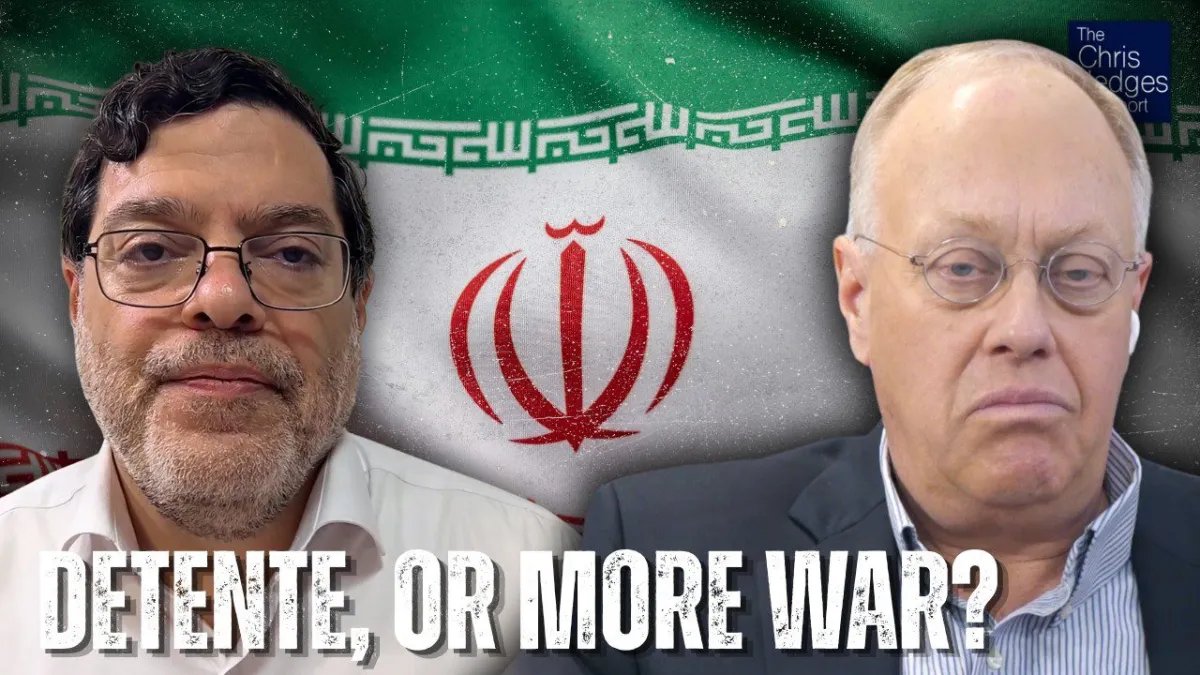
In this wide-ranging conversation, journalist Chris Hedges speaks with Iranian scholar and former nuclear negotiator adviser Mohammad Marandi about the state of negotiations, Iran’s position after the war, the future of Lebanon and Gaza, and the broader geopolitical consequences of a conflict that has already reshaped the Middle East and rattled the global economy.
Marandi argues that despite immense destruction and economic hardship, Iran emerged from the war politically intact and strategically strengthened, while the United States and Israel failed to achieve their core objectives. He also warns that any agreement remains fragile, pointing to Israel’s continued military operations in Lebanon, long-standing Iranian distrust of U.S. commitments, and the risk that renewed conflict could once again threaten global energy markets and economic stability.
The interview offers a rare opportunity to hear directly from a prominent Iranian voice about how the war is understood inside Iran, what Tehran is demanding in negotiations, and why many in the region believe the struggle is far from over.
EDITOR’S NOTE
The following is a cleaned and edited transcript of Chris Hedges’ interview with Mohammad Marandi on The Chris Hedges Report. Minor edits have been made for readability, grammar, punctuation, and formatting while preserving the substance, arguments, and meaning of the original discussion. Repetitions, verbal stumbles, transcription errors, and audio artifacts have been removed. No substantive changes have been made to the content.
Chris Hedges Interviews Mohammad Marandi
Introduction
Chris Hedges:
Pakistan’s Prime Minister Shehbaz Sharif announced today that a peace agreement between the United States and Iran is likely to be finalized within 24 hours. The Iranian Foreign Ministry, however, says a deal may take a few more days to formalize.
Despite Iranian losses and an economic crisis triggered by the war—with an estimated $270 billion in damage—none of the core U.S. and Israeli objectives have been achieved. The Iranian state has not collapsed. The new Iranian leadership, centered around the Islamic Revolutionary Guard Corps (IRGC), remains defiant.
Iran continues to control the Strait of Hormuz, through which roughly 20 percent of the world’s oil and natural gas supplies transit. The country reportedly charges as much as $2 million—often paid in Chinese currency—for oil tankers to pass through the strait.
If the Strait of Hormuz does not reopen soon, the global economy could be headed toward a major crisis. Strategic petroleum reserves in countries such as Japan and the United States, which have been used to offset oil shortages, are being rapidly depleted. Gasoline prices in the United States are now 34 percent higher than a year ago, while diesel prices have risen by more than 50 percent. These increases are compounded by shortages of critical products, including nitrogen fertilizer, aluminum, and helium.
Trump and his Israeli allies are acutely aware that, whether they like it or not, Iran currently holds significant leverage.
Iran’s principal demands include:
- An immediate and permanent halt to military operations across all fronts, including Lebanon.
- A U.S. commitment not to interfere in Iranian internal affairs and to respect Iranian sovereignty.
- The lifting of the U.S. naval blockade within 30 days.
- Withdrawal of U.S. forces from areas surrounding Iran.
- Reopening of the Strait of Hormuz under Iranian arrangements.
- Suspension of sanctions on Iranian oil, petrochemical products, and related industries.
- Reconstruction assistance estimated at $300 billion from the United States and its allies.
- A 60-day negotiation period to address nuclear issues, sanctions relief, and relevant U.N. Security Council and IAEA resolutions.
- A renewed Iranian commitment under the Nuclear Non-Proliferation Treaty not to pursue nuclear weapons.
- The release of $24 billion in frozen Iranian assets before negotiations begin, with additional funds released as negotiations proceed.
Joining me from Tehran to discuss the war, its regional and global consequences, and the proposed memorandum of understanding is Dr. Mohammad Marandi, professor at the University of Tehran and former adviser to Iran’s nuclear negotiating team.
Negotiations Remain Fragile
Chris Hedges:
Mohammad, President Trump has announced some version of a peace deal dozens of times. Perhaps we shouldn’t call this one a peace deal yet, but rather an agreement to begin negotiations. Pakistani officials seem optimistic, while the Iranian Foreign Ministry says a final agreement could still take several days. From your perspective in Tehran, where do things stand?
Mohammad Marandi:
There is no final deal yet. Significant differences remain.
When Iranian officials say that a signing tomorrow is unlikely, it’s because those differences have not been resolved. Even if both sides sign a memorandum of understanding, that does not mean peace is guaranteed. Many things can happen in the days and weeks ahead.
It’s already clear that the Israeli regime is attempting to prevent any normalization of the situation in the region. The assault on Lebanon has intensified. Villages and towns across southern and central Lebanon are being bombed daily. Men, women, and children are being killed. The objective appears to be the destruction of southern Lebanon—to make it resemble Gaza. In many places, it already does.
Even if an agreement is signed, Israeli actions and pressure from the Israeli lobby could derail progress. And if we move beyond an initial agreement, we enter a second phase that becomes even more complicated.
There are sanctions that must be lifted, many of which are embedded in U.S. law. Iran’s nuclear program is also non-negotiable in certain respects. Iran will not abandon uranium enrichment because it views enrichment as a sovereign right.
So there is a minefield ahead. The Strait of Hormuz remains effectively closed, and the global economy is moving toward a crisis. Even if an agreement is signed, any disruption could result in the strait being closed again.
Nothing is certain.
Lebanon, the Strait of Hormuz, and the Limits of Any Agreement
Chris Hedges:
I want to ask about Lebanon. From the moment the ceasefire was announced, it appeared to be a ceasefire that both the United States and Israel immediately violated. We saw heavy attacks in Lebanon almost immediately afterward. We have also seen what happened in Gaza, where nearly a thousand Palestinians have reportedly been killed since the so-called ceasefire was put in place.
Are we moving into a situation where agreements exist on paper, but in practice there are periodic violations, periodic strikes, and a refusal by Israel to comply with one of Iran’s core demands—namely an end to hostilities in Lebanon? The understanding seems to be that Iran will refrain from attacking U.S. allies, but Israel and the United States would likewise refrain from attacking Iranian allies such as Hezbollah.
Mohammad Marandi:
The issue also includes Gaza, although Gaza is not specifically named in the proposed agreement. Lebanon is named directly because of the ongoing airstrikes against villages, towns, and cities.
What you’re describing is certainly a possibility, and it is precisely what Iranian officials say could cause the agreement to fail.
Iran’s leverage is the Strait of Hormuz.
Iran has the ability to restrict access to the strait for countries aligned with the United States. It’s important to understand that Iran has never completely closed the Strait of Hormuz. Countries that remained friendly toward Iran during the war—or that did not participate in the campaign against it—have continued to move ships through the waterway.
There were brief periods when the Americans effectively forced a complete closure, but generally speaking, vessels associated with countries such as Saudi Arabia, the United Arab Emirates, Kuwait, Bahrain, and Qatar have faced restrictions because those governments participated in the war effort.
Under the proposed agreement, those countries would once again be allowed to use the strait. However, if Israel violates the agreement, then from Iran’s perspective the United States has violated it as well.
We saw this after the 39-day war. There was an agreement to end hostilities in Lebanon, and the Strait of Hormuz was expected to reopen for shipping connected to those countries. But when Netanyahu resumed bombing Lebanon, Iran responded by preventing those ships from leaving. Trump then imposed a siege on Iranian ports.
As a result, the strait remains largely closed to countries allied with the United States.
The important point is that this is not going to be another JCPOA.
Back in 2015, Iran fulfilled its commitments under the nuclear agreement. The Americans, in many cases, did not. President Obama was supposed to carry out a series of obligations but failed to implement many of them. That experience left a deep scar in Iran and is one reason the JCPOA is viewed unfavorably by many Iranians today.
This time, Iran is insisting on a different sequence.
The United States must first release Iranian assets. The United States must first help bring an end to the slaughter in Lebanon. Only then can the process move forward.
The sequencing is fundamentally different from the JCPOA, where Iran acted first and then waited to see whether the Americans would fulfill their obligations. In some areas, Washington will have to move first. In others, implementation will occur simultaneously.
Why Tehran Doesn’t Trust Washington
Chris Hedges:
The United States has a long history of failing to honor agreements with Iran. That goes back to the Algiers Accords and numerous other understandings in which Washington promised not to interfere in Iranian affairs.
From the Iranian perspective, there is a long record of agreements being violated—whether through sanctions, military actions, or other forms of pressure.
Mohammad Marandi:
Absolutely.
And it goes beyond the nuclear agreement. There were understandings involving Afghanistan, Iraq, Lebanon, and other issues over the years.
In every case, from the Iranian point of view, it was the Americans who violated the agreement.
That history explains the skepticism in Tehran.
I don’t know anyone who believes that an agreement will be signed, that Washington will voluntarily fulfill all of its commitments, and that the two sides will then move smoothly into a second phase leading to a comprehensive settlement.
Personally, I find that highly unlikely.
Anything can happen along the way.
Even now, I am not entirely certain that an agreement will be signed. I think the chances are relatively high because Trump is under tremendous pressure, but there remains substantial disagreement over issues that Iran considers deal-breakers.
The Americans do not want Israel’s hands tied in Lebanon.
The Iranians are saying there must be a genuine ceasefire. Israel cannot simply retain the ability to attack Lebanon whenever it chooses.
Trump’s Pressure and Iran’s Battlefield Confidence
Chris Hedges:
Israel clearly has a vested interest in sabotaging any agreement.
That seems to expose a growing divide between Washington and Tel Aviv. Trump is facing pressure because he appears to be standing on the edge of a global economic crisis. Strategic oil reserves are running down. Time is not on his side.
Mohammad Marandi:
That’s exactly right.
Iran’s leverage comes from both the battlefield and the economy.
The Iranians believe they performed very well during the 39 days of fighting. They don’t simply believe they survived. They believe they won.
They feel they successfully struck Israeli targets, U.S. facilities, and allied assets in response to attacks on Iranian infrastructure and civilian sites.
As a result, confidence inside Iran is very high.
When the war began, there was concern. Some people believed Iran would prevail, while others feared the worst. But what was remarkable was the calm.
Even after it became clear that major leaders had been killed, people did not panic. There was no rush on grocery stores. There was no widespread hoarding. Gas stations remained relatively orderly.
Then, gradually, public confidence increased.
After ten days or two weeks, many people believed Iran was winning the war.
When Iran eventually accepted the ceasefire—after Trump shifted from demanding unconditional surrender to accepting Iran’s ten-point framework for negotiations—many Iranians actually argued that the war should continue.
Even now, there are many people who believe that if the Americans refuse Iran’s demands, Iran should resume fighting.
I don’t know whether they are the majority. But what is clear is that confidence today is far higher than it was before.
That confidence leads many Iranians to believe their position is stronger than Washington’s.
And if either the Americans or the Israelis violate an agreement, I don’t think Iran will simply accept it.
We saw that in Lebanon. When Israel intensified its attacks on Beirut and threatened vast civilian populations there, Iran responded directly.
From the Iranian perspective, that demonstrated both capability and resolve.
Chris Hedges:
Where do you see the economic situation going?
Trump is flirting with what could become a global depression if the Strait of Hormuz remains restricted. At the same time, Iran has suffered significant war damage. Inflation is high, especially for basic necessities. There is clearly a price Iran has paid for this conflict.
Mohammad Marandi:
No doubt.
The 39 days of war caused significant damage. The attacks targeted pharmaceutical factories, steel production facilities, petrochemical plants, and Iran’s main gas field. Schools, hospitals, and apartment buildings were struck. The destruction was substantial.
If you come to Tehran today and drive around the city, you won’t necessarily see devastation everywhere because it is such a large city. But if you know where to look, the damage is evident.
The siege imposed on Iranian ports has created additional problems. The United States has restricted Iran’s ability to export and import goods. Oil exports have fallen significantly, and Iran’s ability to bring in food, medicine, and medical supplies through its southern ports has been severely affected.
Iran is attempting to replace those trade routes through Central Asia, the Caspian Sea, the Caucasus, Pakistan, and to a lesser extent Afghanistan. But these alternatives are not sufficient.
There is no denying that the situation is difficult.
Yet despite these pressures, Iranians have shown extraordinary resilience.
Many people view this as a war for national survival. They believe they won the war, and that belief has strengthened public confidence.
Iranians are also resilient by culture. More broadly, Shia communities across the region have a deeply rooted tradition of resistance.
The story of Imam Hussein and the Battle of Karbala—the willingness to stand against oppression regardless of the odds—is deeply embedded in the worldview of many people throughout the region.
That tradition helps explain the resilience we see in Iran, in Lebanon, and among groups such as Hezbollah. It is one reason why many refer to what exists as the “Axis of Resistance.”
A War of Survival vs. A War of Choice
Mohammad Marandi:
In my view, Iran will outlast the United States in this economic confrontation.
The siege imposed by Washington is a double-edged sword.
The United States is attempting to crush the Iranian economy. At the same time, it is inflicting severe damage on the global economy and pushing its own economy toward crisis.
The difference is psychological as much as economic.
Iranians see themselves as victims of aggression. They believe they are defending their country and therefore must endure hardship.
By contrast, most Americans do not see this as a war of survival.
They see it as a war of choice.
And many people around the world increasingly view it as a war fought on behalf of Netanyahu and the Israeli government rather than one driven by their own national interests.
Lessons from the Iran-Iraq War
Chris Hedges:
Anyone who wants to understand Iranian resilience should study the eight-year war with Iraq. As I understand it, you fought in that war yourself.
Mohammad Marandi:
Yes.
I volunteered when I was sixteen years old.
During the war I was exposed to chemical weapons twice. I survived both mustard gas and nerve agent attacks.
A mutual friend of ours, Alastair Crooke, wrote a book many years ago called Resistance and the Essence of the Islamist Revolution. It’s an older book, but I still think it offers useful insights.
There is not a great deal of high-quality material available in English about Iran, but that is one book I often recommend. Another is Going to Tehran.
For anyone trying to understand the concept of resistance and how it shapes Iranian thinking, those works provide valuable context.
Kharg Island and the Prospect of a Ground War
Chris Hedges:
We recently heard Trump threaten to seize Kharg Island.
With Trump, it’s often difficult to know whether such statements represent actual policy or simply late-night improvisation. But if negotiations collapse, what would such a move mean?
How realistic is it?
Mohammad Marandi:
It would be difficult, but not impossible.
The United States has moved substantial numbers of troops and large amounts of equipment into Kuwait, the United Arab Emirates, Bahrain, and other locations around the Persian Gulf.
Maintaining those deployments is challenging. It’s summer in the Gulf, and conditions are extremely hot and humid. Still, the forces are there.
If an attack occurred, my understanding is that Iran would likely allow American forces to take some territory initially and then begin targeting them with drones, rockets, and missiles.
In fact, during the war, Iranian military officials told me they almost wanted the United States to launch a ground invasion.
Their view was that Iran’s strengths become far more significant once American forces are physically present on Iranian territory or occupying islands and fixed positions.
At that point, those forces become vulnerable.
Iran’s military strategy has long been centered on making the cost of invasion unbearable.
The goal is not necessarily to defeat the United States in a conventional sense. The goal is to inflict enough pain that future American leaders decide such a war is never worth attempting again.
Decades Preparing for Invasion
Mohammad Marandi:
People often underestimate the extent of Iran’s preparations.
For decades, Iran has built extensive underground facilities. These underground cities contain missile systems, drone infrastructure, factories, air defense networks, and even components of Iran’s air force.
These facilities were not built overnight.
Iran has spent more than three decades preparing for the possibility of an American invasion.
And those preparations have worked.
Iran has also spent decades preparing for the possibility of a ground war.
The results have surprised many observers.
Based on conversations I’ve had with people in China, Russia, and elsewhere, there is genuine astonishment at how effectively Iran managed the conflict.
If the United States were to launch a major ground invasion, I believe many people would be equally surprised by the outcome.
I do not think it would go well for Washington.
Personally, I don’t believe Trump wants such a war.
But given the influence of the Israeli lobby and the unpredictability of political events, I would never say anything is impossible.
A Changed Balance of Power
Chris Hedges:
How has the war changed the regional balance of power?
Mohammad Marandi:
I think Iran’s position has been strengthened significantly.
This is especially true in relation to Russia and China.
Officials in both countries have expressed admiration for how Iran handled the war. They might not use the word “surprised,” but I think surprise is part of what they felt.
Many people expected Iran to collapse.
They thought Iran would fold during the initial twelve-day phase of the conflict. Then, after American intervention, they believed Iran would collapse within days.
Instead, Iran remained steadfast.
There was destruction. There was loss of life. There was suffering.
But there was never a sense that the country was falling apart.
I always believed Iran would survive, but even I was surprised by how resilient ordinary people proved to be.
That resilience became one of the decisive factors in the war.
Chris Hedges:
One of the remarkable things during the war was the public response. When there were threats to bomb bridges and critical infrastructure, we saw ordinary Iranians gathering around those sites, almost spontaneously, to protect them.
Mohammad Marandi:
Yes.
My own students were constantly contacting me during those first days. They would ask, “What can we do? Where should we go? How can we help?”
Honestly, I often didn’t know what to tell them.
I was spending so much time doing media interviews that, ironically, I sometimes knew less about what was happening on the ground than ordinary people did.
But I had students—eighteen and nineteen years old—calling me constantly.
What struck me most was that some of those students had participated in protests and riots only months earlier. Several contacted me privately and said, “We made a mistake. How can we make up for it?”
Some of those conversations were emotional.
I would suggest volunteering with the Red Crescent, helping at local mosques, or finding ways to assist their communities. People simply wanted to contribute.
Throughout the entire 39 days of war, there was an extraordinary spirit among ordinary Iranians. But for me, those first weeks were unlike anything I had ever experienced.
What Happens if an Agreement Is Signed?
Chris Hedges:
Let’s assume the memorandum of understanding is eventually signed.
You mentioned earlier that there are still major obstacles, especially Israel’s determination to undermine any settlement.
What do you think happens next?
Are we looking at a future of periodic strikes, intermittent escalations, and an endless low-intensity conflict similar to what we’ve seen in Gaza and Lebanon?
Mohammad Marandi:
Thank God I’m not a betting man.
But I do believe the Iranians are not going to allow what they view as a genocide to continue indefinitely.
In Lebanon, I think Iran will be extremely firm both at the negotiating table and in enforcing any agreement that emerges.
Gaza presents a different challenge.
In my view, many governments in the region have abandoned the Palestinians.
Turkey, Egypt, Saudi Arabia, Jordan, and others all accepted what Iran sees as a fundamentally unjust ceasefire arrangement. They effectively endorsed it.
Since then, Israel has continued military operations beyond the agreed limits, and large numbers of Palestinians have been killed.
The problem for Iran is that Washington can simply respond by saying there is already an agreement in place.
That limits Iran’s leverage regarding Gaza.
Lebanon is different.
There, Iran has direct leverage through the Strait of Hormuz and through its ability to impose costs if agreements are violated.
Because of that, I don’t believe Iran will allow the United States to behave as it did after the signing of the JCPOA in 2015.
The Question of “Greater Israel”
Chris Hedges:
What effect has this war had on the broader project of what many call Greater Israel?
One of the disturbing developments was the recent discussion between Tucker Carlson and the U.S. ambassador to Israel, in which the ambassador suggested that if Israel were to dominate the region, that would be acceptable.
Many people see that as reflecting an unofficial but real element of American policy.
Mohammad Marandi:
What’s extraordinary is that Iran and Yemen are actually among the countries least directly threatened by a Greater Israel project.
Countries such as Syria, Lebanon, Jordan, Turkey, Iraq, Saudi Arabia, and Egypt would face far more immediate consequences.
In Lebanon, for example, I believe the current government was installed with strong American backing and has actively worked against the resistance.
The authorities have restricted aid, limited movement, and made life more difficult for displaced communities.
Iranian assistance has often been blocked. Aid from Iraq has been obstructed. Borders have been closed.
Yet despite these pressures, Hezbollah has continued to function.
If Greater Israel were ever to become reality, it would be the neighboring Arab states that would face the greatest consequences.
But I don’t think that project will succeed.
I believe Netanyahu has failed.
And I believe this war with Iran represents a major turning point.
A Historical Turning Point
Mohammad Marandi:
The conflict between the United States and Iran will be remembered as one of the defining events of this era.
Many people assumed Iran would collapse.
Instead, Iran survived.
More than that, Iran forced negotiations under conditions that many believed impossible only months earlier.
When prominent American strategists and longtime advocates of intervention describe this as one of the greatest defeats in modern U.S. foreign policy, it shows the scale of what has happened.
I don’t believe Netanyahu can achieve his long-term objectives after this.
I don’t believe the Israeli state can continue indefinitely on its current path.
Since October 7, Israel’s actions have transformed global opinion.
The war against Iran, combined with the destruction in Gaza and Lebanon, has intensified international opposition.
At the same time, the conflict has disrupted the global economy and created consequences that extend far beyond the Middle East.
In my view, people around the world will increasingly associate those consequences with the policies that led to this war.
Militarily, Israel can inflict enormous suffering. It can kill large numbers of Palestinians and Lebanese civilians.
But ultimately, I do not believe military force alone will secure its future.
I think this ends badly for the Israeli regime.
Chris Hedges:
Inshallah.
Thank you.
Mohammad Marandi:
Thank you very much for having me.
And I’d also like to thank Diego, Max, Noel, and Thomas, who helped produce the program.
END OF TRANSCRIPT
EDITOR’S NOTE
The preceding transcript has been edited for clarity, grammar, punctuation, and readability while preserving the substance and meaning of the original conversation. Repetitions, transcription errors, verbal stumbles, and audio artifacts have been removed. No substantive changes have been made to the discussion.
Editor’s Note: At a moment when the once vaunted model of responsible journalism is overwhelmingly the play thing of self-serving billionaires and their corporate scribes, alternatives of integrity are desperately needed, and ScheerPost is one of them. Please support our independent journalism by contributing to our online donation platform, Network for Good, or send a check to our new PO Box. We can’t thank you enough, and promise to keep bringing you this kind of vital news.
You can also make a donation to our PayPal or subscribe to our Patreon.
Please share this story and help us grow our network!
[ad_2]
Source link
