
[ad_1]
There is a particular kind of arrangement that no law forbids and no scandal quite captures, because nothing in it is hidden. It sits in plain view, in regulatory filings and procurement requests, and it works precisely because everyone involved can say, truthfully, that they broke no rule. Friedrich Merz’s Germany is building one of these in real time.
Start with the weapons. In July 2025, Defense Minister Boris Pistorius told Washington that Germany wanted to buy the American Typhon launch system and Tomahawk cruise missiles — the system’s first foreign sale, the decision left entirely to the United States. Trade outlets, citing Politico, put the order at three launchers and some 400 Tomahawk Block Vb missiles, north of €1 billion. Nearly a year later, Washington has not answered. The request stalled after Merz criticized the American war on Iran and Trump pulled 5,000 troops out of Germany and canceled a planned long-range-fires deployment. Europe’s would-be military leader, it turns out, cannot get deep-strike capability without American factories and a president’s goodwill. So much for sovereignty.
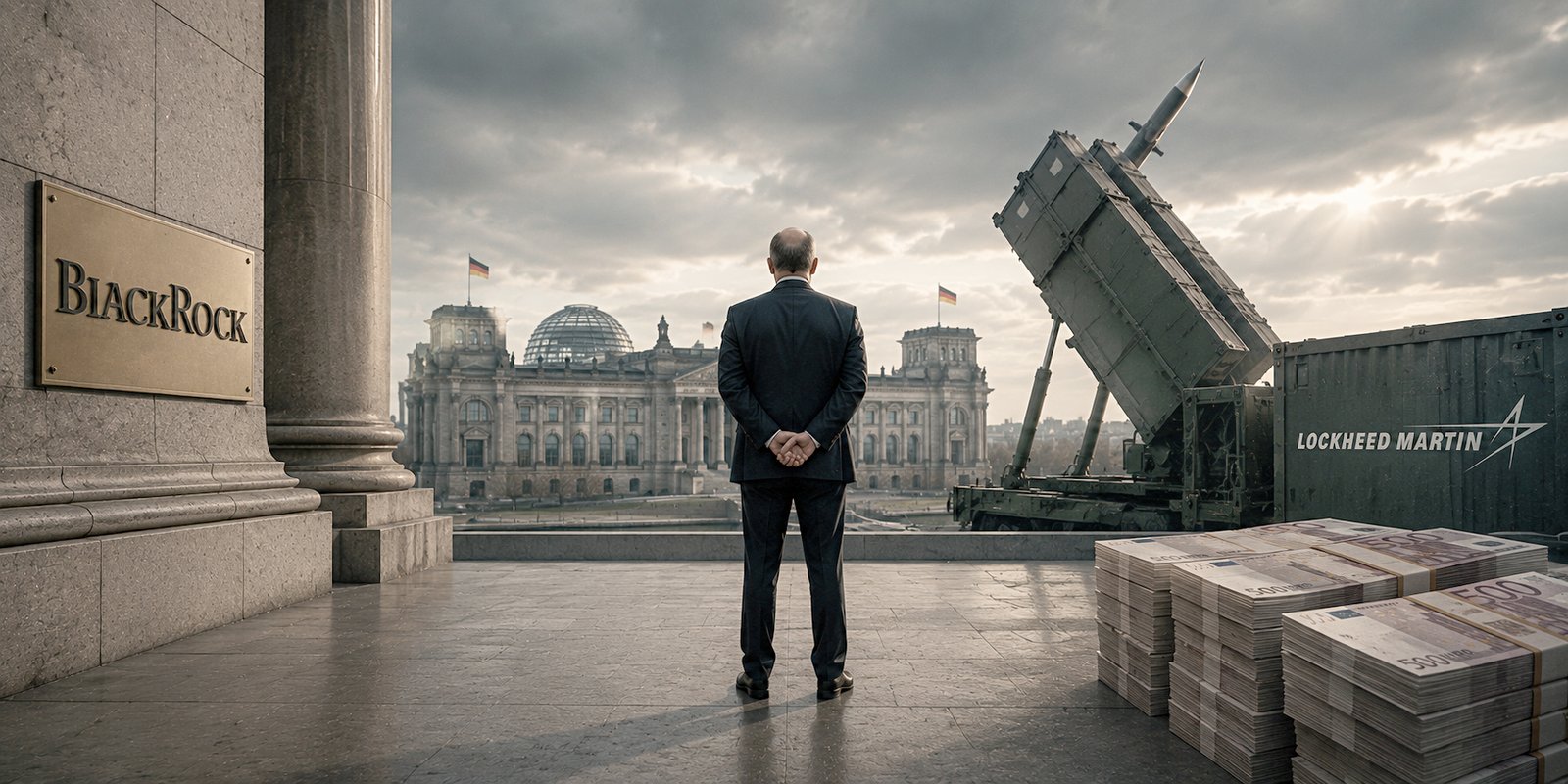
Now follow the money, because that is where the story actually lives. The Tomahawk is built by RTX, formerly Raytheon, where BlackRock sits among the largest institutional holders. The Typhon launcher is Lockheed Martin’s, where BlackRock has disclosed beneficial ownership above 5 percent in a Schedule 13G filed with the SEC. And BlackRock is where Merz spent four years before climbing back into politics: from 2016 to 2020 he chaired the supervisory board of its German arm. The man asking Washington to sell Germany missiles was, until lately, the public face of a firm that profits when the missiles are sold.
His time there was not quiet. In November 2018, while Merz chaired its supervisory board, prosecutors raided the Munich offices of BlackRock Asset Management Deutschland over cum-ex trades — the dividend-stripping fraud that drained the German treasury of tens of billions of euros. The conduct under investigation predated his arrival, prosecutors named him no suspect, and he called the practice “completely immoral” and ordered the firm to cooperate. Note the pattern all the same: this is a man who has spent his career adjacent to the machinery, never holding the smoking gun, always in the room.
Then came the policy. The fiscal lock came off before Merz was even sworn in. As leader of the election-winning CDU and chancellor-in-waiting, he drove through the outgoing Bundestag — on March 18, 2025, weeks before he took office, and deliberately before the newly elected parliament could convene — the amendment exempting defense spending above 1 percent of GDP from the constitutional “debt brake.” The borrowing limit Germans had treated as sacred since 2009 was gone, replaced by an open tap. German military spending rose 24 percent in 2025 to $114 billion, the largest in NATO Europe. Merz has pledged more than €750 billion for the armed forces.
And BlackRock holds the contractors cashing in. It disclosed a 6.91 percent stake in Rheinmetall, the tank-maker whose shares have soared since 2022, with the ownership chain running through the very German subsidiary Merz once chaired. It crossed the 5 percent threshold in the sensor firm Hensoldt. These are not idle positions. They are the firm collecting on a rearmament its former chairman set loose.
Merz, naturally, denies the whole framing. “I never accepted a lobbying mandate,” he told Die Zeit. The transparency group LobbyControl notes that BlackRock’s own description of his job included cultivating contacts with governments and regulators — which is what lobbying is, whatever euphemism rides on the business card.
This is how the war economy actually feeds itself. Not through bribery or secret cabals, but through a revolving door wide enough to drive a tank through, lubricated by the language of deterrence. The threat is real enough to justify the spending; the spending enriches the contractors; the contractors’ largest shareholders sit on both sides of the ocean; and the men who open the spending taps are drawn from, and return to, the same financial firms. Eisenhower warned about the acquisition of unwarranted influence by the military-industrial complex. He did not quite foresee that the complex would one day supply the chancellor.
And the spending does not even buy what it promises. Economists at the Berlin School of Economics argue that NATO’s headline targets are “a poor substitute for strategic prioritisation,” that pouring money in risks “increasing inputs while failing to strengthen security.” Spending is an input; deterrence is an outcome; and the gap between them is precisely where the contractors and their shareholders make their living.
Worse, the buildup manufactures the danger it claims to answer. SIPRI’s data show Russian military spending grew just 5.9 percent in 2025 — slower than Europe’s 14 percent surge. An arms race justified by the Russian threat is also an engine of it: every European budget hardens Moscow’s conviction that it is being encircled, which justifies its next budget, which justifies the next NATO target, around and around, while the men who profit count their dividends and call it security.
Merz broke no law. He simply spent four years learning, from the inside, how the largest pool of capital on earth profits from the policies he would later set in motion — and then went and set them in motion. The scandal isn’t any single transaction. It’s that the whole thing is legal.
Thomas Karat writes investigative work published at karat.substack.com and the Libertarian Institute, drawing on a corporate career and academic training as a behavior analyst to examine how institutions manufacture consent and influence.
Join the Discussion!
We welcome thoughtful and respectful comments. Hateful language, illegal content, or attacks against Antiwar.com will be removed.
For more details, please see our Comment Policy.
[ad_2]
Source link
