
[ad_1]
At a time when misinformation is widespread, teaching students how to think scientifically is more important than ever. At MacEwan University, Rodney Schmaltz teaches an upper-level psychology course titled “Separating Sense from Nonsense.” The goal is straightforward: help students become better consumers of information by teaching them to think like scientists. The course explores a wide range of fringe beliefs and paranormal claims, including ghosts, psychic powers, homeopathy, and conspiracy theories. Rather than simply dismissing these topics, students learn how to evaluate them systematically. What constitutes good evidence? How do we guard against our own biases? Why do people believe things that are not supported by data?
Throughout the term, students engage in a variety of experiential learning activities. They investigate a supposedly haunted location with the goal of critically analyzing claims made by ghost hunters. They learn to perform psychic readings using hot and cold reading techniques—skills students can become proficient in with less than an hour of practice. As proclaimed in the class, “What does it take to be a good psychic? About forty-five minutes!” Students also complete assignments such as the Pseudoscience Super Challenge, where they search for the best example of pseudoscience within walking distance of campus. The aim of these assignments is to help students identify characteristics of pseudoscience, such as vague or imprecise language, reliance on personal anecdotes, resistance to falsification, and a lack of progress. At the same time, students reinforce their understanding of key scientific concepts, such as hypothesis testing, operational definitions, control of variables, and awareness of placebo effects and experimenter bias.
The centerpiece of the course is a collaboration with the Center for Inquiry Investigations Group (CFIIG), the organization that offers a $500,000 prize to anyone who can demonstrate a paranormal ability under scientifically controlled conditions. The $500,000 Paranormal Challenge has a deceptively simple premise: if someone can demonstrate a paranormal ability under scientifically controlled conditions, they receive the prize. Over the years, applicants have claimed to possess a wide range of abilities, including psychokinesis, mediumship, weather manipulation, and mind reading. Despite many hundreds of applications over the twenty-five years of CFIIG’s existence, no one has ever passed the preliminary test, let alone the more rigorous final test for the actual money.
While many Skeptical Inquirer readers are familiar with the Challenge (or James Randi’s previous Million Dollar Challenge), they may not have seen a paranormal challenge used as a teaching tool. In the Separating Sense from Nonsense course, students draw on what they’ve learned throughout their studies, particularly in research methodology, to design protocols for testing extraordinary claims. This assignment is made possible through the close collaboration with CFIIG investigators Stan West and Randee Westendorf. West manages the intake and vetting of applications and communicates with claimants, selecting those who are appropriate for classroom use. Working in groups of four, students are assigned an actual paranormal claim submitted to CFIIG.
West and Westendorf also guest lecture in the course, once at the beginning of the term to provide context and again in the middle of the term to answer questions about the students’ developing protocols. At the time of this writing after two separate terms, the classes have reviewed twenty applications, three of which have proceeded to formal testing. At the end of the term, students observe and help run the tests live via Zoom. Even when no test occurs, the process of designing a protocol remains valuable. Students confront the challenge of narrowing down and defining vague or poorly articulated claims.
One particularly valuable aspect of the Paranormal Challenge assignment is that students learn how to translate loosely defined paranormal claims into clear, testable hypotheses that meet scientific standards. This is a crucial skill in everyday life, where students are constantly exposed to misinformation, poorly defined assertions, and bold claims that lack empirical support. As one example, a recent investigation reported in The Guardian found that about half of the mental health information on popular TikTok videos could be considered misinformation (Hall and Keenan 2025). Exercises such as this assignment are designed to train students to go beyond headlines and ask the essential question: How do we know any particular claim has any validity at all? Examples of more specific questions include:
- Is evidence claiming to refute climate change valid?
- Are vaccines the major lifesavers that scientists claim they are?
- Are UFOs the vanguard of an imminent invasion of the lizard people from Alpha Centauri 3, and should we be worried?
This kind of critical thinking is not abstract or theoretical; it becomes real when students are asked to apply it to actual claims. Moving from the broad idea of misinformation to the concrete task of designing a fair test helps students become better critical thinkers. The following example illustrates how even a seemingly simple claim can reveal unexpected challenges when subjected to empirical scrutiny.
A Case of Dream Prophecy
One case presented to the CFIIG involved a claimant who said they could see the future through their dreams. At first, students assumed this would be straightforward: the individual would record dreams and later compare them to actual events. However, as students worked through the protocol, the complexities quickly became clear. What qualified as a successful prediction? How specific did the dream content need to be? Could the predictions be verified independently? And how would they rule out confirmation bias or post hoc interpretation?
Students also had to determine the timeframe in which predictions would be judged—wait long enough and almost any prediction will come true. Not long enough, and it won’t be a fair test for the applicant. The students had to develop a system for preregistering dream content to prevent retrospective matching. Even defining what constituted a “match” required deliberation. Was a general statement about “an accident” enough if any unintended incident could be stretched to fit? These challenges required students to grapple with foundational issues in research design and issues of falsifiability, replication, and inter-rater reliability.
In the end, the claimant chose not to proceed with the test. While there was some initial disappointment, the process itself was highly instructive. It revealed how difficult it can be to turn intuitive or anecdotal experiences into scientifically testable claims. More importantly, it reinforced a central goal of the course: when students encounter extraordinary claims, such as those made by psychics, they should learn to ask, “How do we know this is true? What is the evidence? How can it be tested?”
A Case of Telepathic Touch
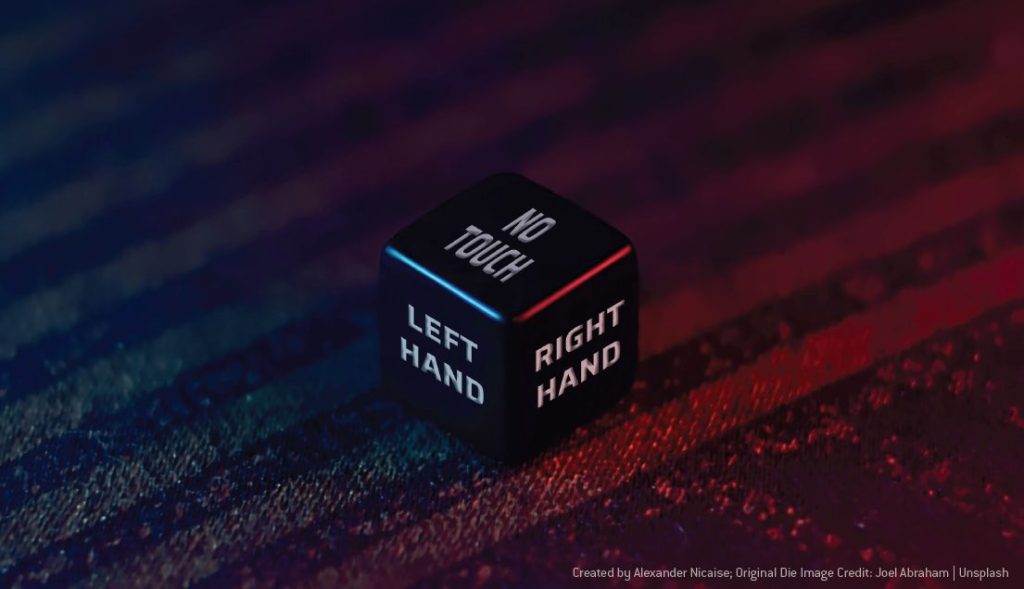
In another test, a person claimed they could “touch” someone telepathically. The protocol involved a test over a Zoom call with a student standing with their back to the camera and arms outstretched, while the applicant would try to telepathically shake the student’s hand on each trial. Another student rolled a die to randomly determine whether the left hand, right hand, or neither hand was to be shaken. The claimant would then attempt to mentally shake the indicated hand, and then the student would indicate if they felt which hand was being shaken or if none was. For this to be a successful trial, the claimant had to be correct on eighteen out of twenty trials. This was an interesting test; we all put a lot of work into the design and carefully ruled out any potential for error—or so we thought. As soon as the test started, we realized that we should not have included a “no touch” condition, because it was very likely that every trial would result in the student not feeling their hand being shaken. Much to our great concern, the first two rolls of the dice were “no touch,” and the applicant was two for two. Fortunately, the randomization evened out, and the applicant did not meet the statistical threshold of correct guesses. The experience highlighted how small oversights in experimental design can undermine an entire test, reinforcing the importance of careful scrutiny and methodological rigour in scientific work. None of the students wanted to be the first testers in twenty-five years to be responsible for obligating the CFIIG to pay out the $500,000!
Another group worked with a claimant who believed they could move clouds with their mind. The claimant had previously attempted a similar test in person at CSICon but had not succeeded (see “New Contenders for the Investigations Group’s $500,000 Paranormal Challenge in 2023” in SI May/June 2024). This time, a remote version was developed. Ten live webcam feeds from different regions in North America were selected, each showing fully clouded skies. The claimant had two hours to clear all ten locations to blue sky. The goal was complete clearing. Although a few skies showed minor clearing, none met the threshold of complete clearing as claimed by the applicant. The test itself was simple to run, but designing it raised important questions about defining “clear skies,” verifying webcam accuracy, and controlling for natural variation.
Respectful Framing
The students were not particularly surprised that the applicants could not demonstrate these paranormal claims. What stood out, though, was how the applicants responded when the tests did not go as expected. The claimants were sincere, polite, and genuinely disappointed. Watching these reactions helped students see that these were not intentional frauds but rather people who truly believed they had unusual abilities. Many students admitted they found they were cheering for the applicants. The experience emphasized a central idea in the course: we should be scientific skeptics, not cynics.
For instructors interested in using the Paranormal Challenge in their own teaching, CFIIG welcomes collaboration and provides support throughout. They help match instructors with suitable cases and can join the class to answer questions or offer guidance. Instructors can adapt the assignment to their course structure through group work, protocol design, or observation of paranormal challenge tests. The key is to frame the challenge as a serious, respectful investigation of extraordinary claims, not as entertainment or poking fun at the applicants. The CFIIG is incredibly respectful and works closely with the applicant to create a test that is fair while methodologically sound. And that’s really the heart of scientific skepticism: we stay curious, respectful, and don’t dismiss extraordinary claims outright. Instead, we ask for extraordinary evidence to match the claim. This is a mindset that students need to learn and carry with them as they confront misinformation.
This assignment helps students connect abstract concepts from earlier courses to real-world situations. Research methods, often seen as dry or overly technical, become far more engaging when tied to a high-stakes context, such as evaluating an extraordinary claim tied to a $500,000 prize. Suddenly ideas such as falsifiability, double-blind controls, and operational definitions matter in a tangible way. More than anything, the collaboration reinforces the core values of scientific skepticism: keeping an open mind while demanding the best available evidence. By the end of the term, many students say that they are better able to notice claims that may be pseudoscientific and often ask the question, “How do we know that is true?” In an era of increasing misinformation, cultivating the ability to question claims and assess evidence is one of the most valuable skills students can carry with them beyond their undergraduate training.
Reference
Hall, R., and R. Keenan. 2025. More than half of top 100 mental health TikToks contain misinformation, study finds. The Guardian (May 31). Online at https://www.theguardian.com/society/2025/may/31/more-than-half-of-top-100-mental-health-tiktoks-contain-misinformation-study-finds.
[ad_2]
Source link
