
[ad_1]
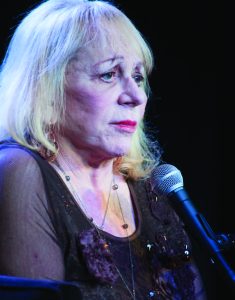 Sylvia Browne remains a notable figure for people who believe in psychics. In the years since her 2013 death, Browne’s claims continue to be circulated on the internet as proof of psychic abilities. Browne’s son, Chris Dufrense, often invokes her name in the context of his own psychic endeavors and has a social media presence using the @SylviaBrowneGroup social media handle. Its related YouTube account’s most popular videos comprise archival footage of Browne. Browne also founded a religious organization, Society of Novus Spiritus, in 1986 with its own theology based on reincarnation and a coequal female and male deity, among other beliefs (Browne and May 1998, 227–228). It appears to still be operating, albeit in a diminished capacity from its peak of eight churches when she was alive (Lindsay 2010). However, the most sympathetic and viral moment since her death was an apparent endorsement from Kim Kardashian during the COVID-19 pandemic when she posted a passage from Browne’s Prophecy: What the Future Holds for You that asserted “around 2020 a severe pneumonia-like illness will spread throughout the globe” (McRady 2020; Radford 2020). The quote, however, wrongly continues that the “illness will be particularly baffling in that, after causing a winter of absolute panic, it will seem to vanish completely until ten years later, making both its source and its cure that much more mysterious.”
It seems people wanting to believe Browne will overlook her history of inaccuracies and wrong predictions even after her death. Kardashian’s post of the passage is an accurate quote but ignores many wrong predictions from the same book. For example, Browne claimed: “By about 2020 we’ll see the end of the one-man presidency” where “our executive branch will be essentially phased out and absorbed into the legislative branch” (Browne and Harrison 2004, 135). Other examples include Brown writing: “Animal testing under any circumstances for any purpose will be declared intolerable and illegal” (Browne and Harrison 2004, 140). She also claimed: “By around 2010, controversial as it will be at first, it will be mandated that a DNA sample of every infant born in the United States is taken and recorded at the time of the baby’s birth” (Browne and Harrison 2004, 182). Browne’s predictions are not much better in her other books. For example, she wrote: “By approximately 2020, the educational system in the United States will undergo massive structural changes” where “higher salaries for teachers will attract more teachers and in 2020 there will never be more than fifteen grade-school students per teacher in any classroom” (Browne and Harrison 2008, 222). These predictions missed the mark.
However, Browne’s two most notable false predictions, as far as media attention goes, are her separately telling the parents of Shawn Hornbeck (in 2002) and Amanda Berry (in 2004) their children were dead when in reality they both were kidnapped and later found alive. While Hornbeck’s parents were reunited with him, Berry’s mother died in 2006 with the belief her daughter was dead. Berry, who was kidnapped in 2003 and escaped captivity in 2013, was watching her mother’s appearance with Browne on the Montel Williams Show when Browne told her mother she was dead. Berry said, “I just broke down crying because I couldn’t believe she said that” and when “my mom broke down crying” it “hurt even worse” (Dawidziak 2015). Berry concluded Browne was a “fraud” and unsuccessfully tried to persuade her kidnapper to send an anonymous letter to her mother warning “her not to listen to Sylvia Browne” (Berry et al. 2015, 109–110). Berry’s kidnapper later taunted her with a news article that reported her mother “took down the posters in my room and gave away my computer” because she doubted Berry was alive (Berry et al. 2015, 110). While held against her will and being abused, Berry said she received “strength from knowing that my mom is fighting for me” (Berry 2015 et al., 111).
Throughout Browne’s career, mistakes and criticism did little to slow her rise in popular culture. Indeed, her checkered history did little to stunt her celebrity from becoming an almost ubiquitous presence in print and television media during the 1990s. Gary Dufresne, Browne’s husband from 1959 to 1972, was interviewed on video by Robert Lancaster of StopSylvia.com in 2007. Dufresne recounted how, after a house party where Browne conducted tarot card readings, he asked her how she can tell people unfounded psychic “stuff.” He said that Browne replied, “Screw ’em. Anybody who believes this stuff oughtta be taken” (Lancaster 2007). Her 1992 no contest plea to securities fraud that was predicated on her claimed psychic “feelings” to investors about a gold mine’s profitability also did not change the trajectory of her career (Romano 1993; Gonzales 1993). Her acceptance, then avoidance, to demonstrate her claims for James Randi’s One Million Dollar Paranormal Challenge did not significantly diminish her fame. By the late 1990s and early 2000s, she was a regular on daytime television, had New York Times best-selling books, and was a familiar face on CNN’s Larry King Live. In fact, Browne allegedly had a four-year waitlist of people booked to pay $750 for a thirty-minute phone call reading in 2007 (Ronson 2007).
Purpose and Methodology
Here I’m providing an update to Skeptical Inquirer’s 2010 “Psychic Defective: Sylvia Browne’s History of Failure” article (Shaffer and Jadwiszczok 2010) and the 2013 update, “The Psychic Defective Revisited: Years Later, Sylvia Browne’s Accuracy Remains Dismal” (Shaffer 2013). The purpose is to review more than a decade later Browne’s predictions made to the families of people who were missing, killed, or otherwise harmed. With scientific advances to solve cold cases, there is more information about some of the cases Browne made predictions about. The 2010 article concluded Browne was correct zero out of 115 cases, with twenty-five cases being wrong and others having unknown outcomes. In the aftermath of Berry’s escape, the original 2010 cases were revisited, and a new case was discovered. The 2013 article found out of 116 cases (which included a prediction on a new case), Browne was correct in zero cases and wrong in thirty-three. The other eighty-three cases had unknown outcomes. The articles demonstrated Browne’s claim that her “accuracy rate is somewhere between 87 and 90 percent” was grossly inaccurate (Browne and Harrison 2004, 97). Here I add three newly discovered predictions and six wrong predictions to the previous studies. Consequently, as of today, Browne was wrong in thirty-nine cases, and eighty have unknown outcomes of 119 total cases. She was correct in zero of these cases.
The predictions about criminal cases were chosen for analysis because many of Browne’s other predictions are not possible to investigate. From her vague predictions about events dozens or hundred years into the future or telling people the names of their angels, those claims are not plausibly testable or verifiable. Likewise, Browne’s claims of “talking” to ghosts are not testable (“Persistent Ghosts” 1991). However, Browne’s “medical readings” provide more empirical bases that are testable. In 2010, reporter Craig Cheatham interviewed Terry Flans, who attended an event with Browne to get answers about the health of Flans’s hospitalized son. Browne said her son would get treatment and be better at the end of the month, so he should not be moved from the hospital to his home. According to a video recording, the mother described the medical doctor’s diagnosis and Browne replied, “I don’t give a damn what the doctors say. Your son will survive.” The son died two days later. His mother said he did not want to die in the hospital, but the family left him in the hospital because of Browne’s proclamation (Cheatham 2010). Yet such public reports about Browne’s health predictions to families and reports on specific persons’ health outcomes are rare.
In contrast, missing persons, murder cases, and other crimes are matters of public record through news reports, law enforcement websites, and court documents. Browne’s appearances on television and press reports about her interactions with the families of crime victims—promoted in the media at the time—provide an unbiased way to know what Browne said and find documented outcomes. In contrast, Browne’s own narration of her claimed involvement with police provides little contemporaneous evidence and records that can be analyzed. Browne’s book Adventures of a Psychic, originally written in 1986 before her regular appearances on daytime television in the 1990s, had a ten-page chapter titled “The Psychic Detective: The Temple of the Quiet.” In the 1998 revised edition of the book, she claimed to be involved in and accurately predict several murder and missing person cases but provided no documentation of the claim. For example, Browne wrote that she told police about a man brutalizing women who is “husky, dark-haired, white, but somewhat Negroid looking” with a “last name that begins with S,” and she claimed George Anthony Sanchez—dubbed the Ski Mask Rapist—was “the man with the initial S” who she had “seen” (Browne and May 1998, 217–218). Yet when CNN attempted to validate Browne’s claims in 2007, Anderson Cooper reported: “The Los Altos police confirmed Browne was involved with the case but could not tell CNN what extent, because the case happened so long ago” (“Islam Divided; Psychic Reality Check; Battle Under the Border” 2007). In contrast, television transcripts and news reports about what Browne told families allow one to independently investigate Browne’s predictions on disappearances and crimes. The information on the outcomes is often available in newspaper articles, court records, and on law enforcement websites.
Like the 2010 and 2013 articles, in this article I categorize the cases Browne made predictions about as wrong if Browne’s claims are substantially false compared to the reported facts of the case. If the claims are substantially supported by the facts, the prediction would be categorized as correct. I define “substantially” as significant and verifiable facts relevant to the crime or perpetrator rather than the contradictory, already known, tangential, or vague claims Browne gave, such as obscure or unavailable minute details not in publicly available records. If there has been no significant progress in the case since Browne’s predictions or there is not enough information to analyze the predictions compared to the reported facts, the cases are categorized as having an “unknown” outcome. In some cases, an outcome is reported, but details or transcripts about what Browne said are unavailable. Often details are unavailable in the public records, such as when Browne’s stating the name of a purported suspect was censored on the television broadcast or a convicted murderer’s vehicle license plate is not in the public record. However, because Browne gave this information to the victim’s families, such details were almost certainly provided to law enforcement. Yet there is no documented case where police credit Browne with breaking or solving a case—indicating that Browne’s claims were either incorrect or not useful or actionable.
In other unknown cases, authorities already came to conclusions, and it is unlikely further investigation will be made. For example, in the 2001 deaths of Patrick Hubbard and his three-year-old daughter Katelynn, the authorities concluded the death was an accidental fire in the residence caused by a cigarette. However, in 2004 Browne told the family electricity was involved. The Hubbard case remains on the unknown list, because there have been no reported developments since Browne’s predictions instead of authorities being unable to make conclusions about the deaths.
I conducted the research for this article using two overarching methods. First, I searched in newspaper and other databases for the names of the families or victims of cases categorized in the 2010 and 2013 articles with unknown outcomes. If there were any developments in the cases, I compared these developments to Browne’s predictions to see if she was correct, incorrect, or if the case’s outcome remains unknown. Second, Browne’s books, transcripts from the Montel Williams Show, and news articles were reviewed to see if more Browne predictions on crimes could be located. Like the 2010 article, this one includes a list of the names Browne made wrong predictions about (see the sidebar titled “Cases Sylvia Browne Was Wrong About”). Due to space limitations, the chart does not reproduce the details about the outcome of cases that have previously been categorized as wrong, such as the Hornbeck or Berry cases. Readers should refer to the 2010 and 2013 articles for those details.
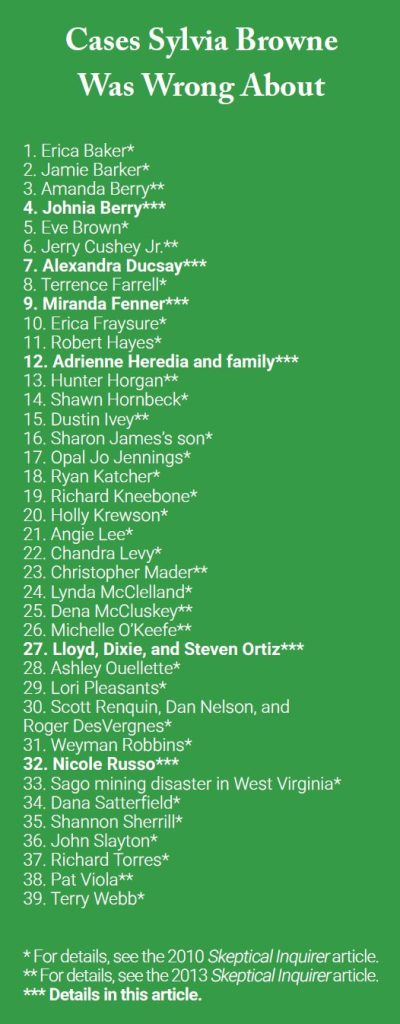
As for sources available, while one might expect more information to be readily accessible in databases in the decade and a half since the 2010 study, that is not the case. For example, transcripts or DVD copies of the Montel Williams Show are no longer available for purchase. Some transcripts that were accessible appear no longer available in databases, while Browne’s television appearances from the 1990s were never transcribed and remain unavailable for researchers. The lack of information is not entirely new. Even during the heights of popularity of Montel, its representatives said they could not “locate a copy of the episode and declined to comment” to a newspaper reporter about Browne’s reading of an alleged murder (Bailey 2000). Consequently, the cases analyzed here are not the entire universe of Browne’s predictions or errors but what is available in databases and public records. I welcome anyone with transcripts or newspaper articles to supply the information for further analysis.
Analysis of Resolved Cases
In the many years since the 2013 analysis of Browne’s predictions, there have been several updates and convictions of previously unsolved crimes. Here I expore seven cases that Browne made readings on that were previously categorized as having unknown outcomes. I conclude that Browne was wrong in five of these cases and the other two remain in the unknown category. Browne was correct in zero of these cases.
In 1998, eighteen-year-old Miranda Fenner was murdered while working as a clerk at a video store in Laurel, Montana. With no arrests, in 2006 her mother appeared on Montel to bring the story national attention and ask Browne for help. No transcript is available of the broadcast, but local news reports provide information about what Browne told the mother. According to the mother, Browne “gave me two names and went on to give me names, ages, kind of where they live, vehicle descriptions and partial license plate numbers” (Shay 2006). Browne claimed two people—aged nineteen and twenty-four—were involved in the murder, and one drove a specific make of motorcycle and a specific make of a truck “with a license plate that began with ‘K1’” (Associated Press 2006). Browne reportedly provided further details, including the names of the two murderers and clues about the murder weapon’s location, which did not appear on the broadcast. The mother told the press that “all” the information was passed along to the police (Associated Press 2006).
The crime went unsolved until April 2016, when Zachary O’Neill confessed to law enforcement. O’Neill, born in 1980 and eighteen at the time of the murder, committed the crime alone (Tollefson and Sukut 2019; Montana Department of Corrections 2025). Police had already known O’Neill was at the store and was interviewed by police in the initial investigation. In 2019, he pled guilty and said his objective was to rob the store to “support his drug addiction and killed her so she could not identify him” (Associated Press 2019). It is unclear from the reporting what, if any, vehicle O’Neill drove or if an associated license plate had a “K1,” but this would have been highly unusual and easy for police to investigate after the Browne reading. The standard (non-vanity/personalized) serial coding for Montana license plates have started with a number, not a letter, from 1934 until the present day (Reuter 2025). This is because the numbers on standard Montana plates—unlike most of America’s states—denote the specific county where the vehicle is registered. For example, if a vehicle associated with O’Neill was registered in Laurel, Montana, which is in Yellowstone County, then the license plate would have started with the numeral 3 (Reuter 2025). Based on the verifiable information about the number of people involved and O’Neill’s age, this case is categorized as wrong.
In December 1999, Lauria Bible and Ashley Freeman went missing from a home in Welch, Oklahoma. The house was set on fire and police found Freeman’s parents murdered in the ashes (Strader and Brunetti 2020). Bible’s mother and uncle subsequently appeared on Montel in 2002 to ask Browne about the missing girls. In response to the uncle mentioning his brother (Freeman’s father) was involved in marijuana and there were rumors drugs were involved, Browne told the family, “I think that there were drugs that were involved” and “money was owed.” She further said, “I think what happened is they wanted to get rid of them” and “they took the girls, but the girls are no longer alive.” Browne said their bodies were “in Guynan. They’re in Guynan,” and when seeking clarification from the family whether she meant Guymon, Oklahoma, Browne responded affirmatively. Browne further claimed, “If you were going from your house to Guymon or Guynan or whatever the hell it is, there seems to be a truck stop, roadhouse” with “Indian or a cowboy” in “desert country” on Highway 60 West where both girls’ bodies are.
In 2020, Ronnie Busick pled guilty to being an accessory to the family’s murder. He admitted committing the crime with two named men, who were deceased before his plea, and was sentenced to ten years in prison (Strader and Brunetti 2020). According to an affidavit from the State of Oklahoma, the three men “tortured and held the girls for days before strangling them to death” inside a mobile home in Picher, Oklahoma (Stogsdill 2018). It further alleged, “the three men visited the Freeman home on the outskirts of Welch with plans to sell drugs to one of the parents when the teens walked in unexpectedly.” Other witnesses, per the affidavit, claimed “the killings were carried out over a drug debt.” It should be noted that if the crime was committed over money, authorities discovered a purse with money in a car that was burned (Stogsdill 2018). The killers reportedly said the girls’ bodies were “in a pit in Picher.” The bodies remain missing. However, it is notable that Picher is more than 400 miles away from Guymon. Due to the unresolved issues, including the girls’ location, this case remains in the unknown category.
In 2002, Cecilia Garcia was murdered in California, and her family paid Browne $700 for a reading (Louie 2005). There are no public reports about what Browne told the family and no public indication she was helpful to police. Following a police investigation and trial, Bryan Vulgamore was convicted of the murder in 2014 (Johnson 2014). Without more information, this case also remains in the unknown category.
In December 2004, Johnia Berry was murdered in her Knoxville, Tennessee, apartment, and her roommate was repeatedly stabbed. Years later, Berry’s mother and the surviving roommate appeared on Montel to ask Browne for answers. Browne told the mother and roommate that the murderer’s name is “not common” and gave his name, but it is not known because it was “censored by network.” Browne also claimed, “This is a case of a guy that was around her that she rebuffed” and that she “knew.” Browne further asserted the murderer was involved in “horticulture work” and “working on yards” in Knoxville. Browne also said the murderer “goes after fairly tall blondes because” he is short “maybe 5’1, 5’2.”
Berry’s murder reentered the public attention in May 2025 with the release of ABC’s 20/20 documentary on the case titled “Blood on the Door.” The documentary focused on Berry’s mother’s effort to get answers and referenced the mother’s appearance on Montel. It even showed a video clip with Browne (“Blood on the Door” 2025). In September 2007, Taylor Olson, a twenty-one-year-old, six-foot-three man, was arrested and charged with Berry’s murder (McAlee 2025). DNA connected Olson to the murder, and his fingerprint was found on the murder weapon (“Blood on the Door” 2025). Olson also confessed to the crime and described how he went into the apartment to commit theft. Berry and Olson did not know each other (“Blood on the Door” 2025). These facts contradict Browne’s predictions. As for her claims about the last name, “not common” is vague and subjective. In the most recent data from the U.S. Census Bureau, the Olson surname is the 157th most used surname out of the top 1,000 in the United States, which is more frequent than names such as Simpson, Porter, or Hunter (Frequently Occurring Surnames 2010). There are no records available indicating Olson was engaged in “horticulture” or similar work. Olson committed suicide in 2008 before trial, but police continued investigating the crime and concluded he did it alone (“Blood on the Door” 2025). This case is moved from the unknown category to the wrong category based on the murderer’s intentions, his lack of knowing Berry, that he did not attack her because of her height or hair color, and the murderer’s incorrect height.
In June 2005, Adrienne Heredia, along with her boyfriend and four children, were murdered at their home in Arizona. Her mother appeared on Montel, where Browne told her the murderer was violently jealous of Heredia’s boyfriend, it was not “family retribution,” and the family was “in the wrong place at the wrong time.” She also claimed the murderer was about fifty years old and people were unlikely to suspect him of committing the crime. In April 2017, Preston Strong was convicted of the murders and later was given the death penalty for the crime (Associated Press 2017). Strong, born in 1966, was less than forty years old at the time of the crime and killed the family in a crime prosecutors said was motivated by money, with the boyfriend giving Strong thousands of dollars before cutting him off. Strong, who police dubbed a “career conman,” was separately convicted of murdering a doctor in 2007 and taking a large amount of money (Neff 2020). This case was previously categorized as unknown and is now categorized as wrong based on the available information about the convicted person: the murderer’s motivations and age.
Alexandra Ducsay was murdered in May 2006, and her mother appeared on Montel that year seeking answers. According to a transcript of the show, Browne claimed the murderer left a “matchbook” to which the mother said, “I didn’t find any matchbook or anything.” Browne also claimed there were four women who were victims, because the case is “sort of like” the Zodiac killer. The mother asked if “they’ll get him eventually.” According to the transcript, Browne did not say yes or no but contradictorily said: “What’s good about this is he won’t do it to somebody else.” The mother also asked, “Did my daughter suffer?” Browne replied, “He followed her in and just cracked her head.”
In 2015, Matthew Pugh, Ducsay’s ex-boyfriend who had a history of stalking and violence in their relationship, was convicted of the murder and first-degree burglary for breaking into her home (Swebilius 2015; Mayko 2015). Pugh bound, stabbed, and violently beat Ducsay so brutally “her teeth were later found in her stomach” (Griffin 2015a). The press reported the images and video shown, including “video showed that Ducsay’s head had been bashed in and she was missing an eyeball,” left jurors “shaken” (Griffin 2015b). Pugh was subsequently convicted of robbing and shooting another woman, who survived, during a subsequent and different violent crime in 2008 (Beach 2017). There is no information available that a “matchbook” was involved; rather, black vinyl tape linked the suspect to the crime. Browne’s prediction in the Ducsay case, previously listed as an having an unknown outcome, is classified as wrong due to the number of victims, it was not a serial killer, no matchbook was involved, and the manner of the victim’s death.
On Father’s Day 2011, the Ortiz family—Lloyd, Dixie, and Steve—were murdered with a pickaxe inside their home in New Mexico. One year later, Angela Spinks, Lloyd and Dixie’s daughter, asked Browne at a public event who killed her parents and brother. Browne said the murderer was her brother-in-law, Jesse Rios (Roesler 2012). A law enforcement officer told the local press “to disregard Browne’s answer because the show was rigged and … it was a stunt.” In 2016, Nicholas Ortiz—who was sixteen during the crime and is not related to the family—was convicted of the murders. Nicholas Ortiz’s cousins, Jose and Ashley Roybal, admitted involvement and said the intention of the crime was to steal marijuana and money (Haywood 2016; Haywood 2018). This Browne reading was previously added to the unknown list in the 2013 article and is moved to the category of wrong because Browne was incorrect about who committed the murders.
Analysis of Recently Discovered Cases
New research led to the discovery of three cases for which Browne made predictions that were not included in the original 2010 study and the 2013 update. Adding these three cases to the 116 count in the 2013 study brings the new total number of cases to 119 that Browne made predictions about. Of these new cases, one was categorized as wrong and two have unknown outcomes. With these cases, Browne’s predictions have been correct zero times, wrong thirty-nine times, and have unknown outcomes eighty times in 119 cases.
During a 1997 appearance on Montel, Browne told the parents of Nicole Russo, who was murdered in 1995, that Russo’s ex-boyfriend, Louis Urcinoli, was a serial killer who killed two others in New York or Pennsylvania (Williams 1997). Before Browne’s reading, Urcinoli had already been convicted in a New Jersey court in December 1996 of the murder along with other charges for conspiracy to murder his uncle and his family to prevent him from testifying at trial that Urcinoli confessed to the uncle about the murder (State of New Jersey vs. Louis P. Urcinoli 2025). As of 2025, Russo’s body has never been recovered (Shea 2025). In the thirty years since the murder, there are no publicly reported law enforcement suspicions, claims, charges, or convictions that Urcinoli killed anyone other than his ex-girlfriend (State of New Jersey vs. Louis P. Urcinoli 2025). This case is categorized as wrong.
In 1996, Carrie Culberson disappeared from Blanchester, Ohio, and the following year her ex-boyfriend Vincent Doan was convicted of her murder and sentenced to life without the possibility of parole. Her body remains missing (Ohio Attorney General 2025). A website that claims Doan is innocent discusses her parents’ 1997 appearance with Browne on Montel to apparently locate Culberson’s remains (Summary of Vincent’s Case 2026). The website uses a partial transcript from the show where Browne said a name that the television show censored as evidence of Doan’s innocence. Because Culberson’s body has not been recovered and further information about what Browne said is unavailable, this case is categorized as unknown.
In 1999, Cassandra Hailey’s mother appeared with Browne on Montel. She was seeking answers about the 1988 disappearance of her daughter and her classmate Keith Call, who were on their first date and headed to a party near Christopher Newport University. They were not seen again, and Call’s abandoned car was located along the Colonial Parkway in Virginia (Fox 2024). For more than a decade before Browne’s predictions, local police and the Federal Bureau of Investigation (FBI) probed the case. The mother told the Daily Press that Browne “showed no compassion” during the taping, whose appearance lasted less than three minutes in the broadcast and was interspersed with guests asking Browne to communicate with dead friends or relatives (Paust 1999). Browne claimed that Hailey—last seen in Virginia—ended up in Michigan and was dead. She said the killer was “sort of a transient … a lanky dark-haired guy” who was interviewed by the FBI, and then they “let him go.” Browne also said Hailey was killed quickly. After the show, Browne met with the mother privately and “gave her some additional information, including that the bodies specifically were in Ann Arbor and that Cassandra knew her slayer.” After the show, the mother spent time inquiring about unidentified bodies with Michigan authorities. Their bodies have not been recovered, and the crime remains unsolved.
In 2024, the DNA of Alan Wilmer—who died in 2017—confirmed his involvement in three different murders along the Colonial Parkway in Virginia, known collectively as the Colonial Parkway murders (Almasy and Smart 2024). According to Call’s sister, Wilmer was law enforcement’s first suspect in Hailey and Call’s disappearance, but the FBI “let him go” after he passed a polygraph (Fox 2024). Hailey and Call’s disappearance remains unsolved. There is no evidence linking them to Michigan, no one has been charged with their disappearance, there are no reports Wilmer and Hailey knew each other, and there is no evidence in the public record linking Wilmer to Hailey and Call’s disappearance. This reading is categorized as unknown.
Conclusion
Browne’s predictions on criminal cases not only failed to improve with time but further demonstrate a lack of clairvoyant abilities. Out of the 119 documented predictions and outcomes, she was wrong thirty-nine times. In contrast, she remains correct zero times. The remaining eighty cases have unknown outcomes due to a lack of details or new developments. In the over fifteen years since the original article, there has never been a documented case of Browne being substantially correct about people who were missing, died, or otherwise victims of a crime. This is especially notable given, for example, she told the press she was “working on at least 200 cases” in May 2003 (Mahoney 2003). Moreover, Browne also consistently avoided testing. Twice in 2001, Browne agreed on television to take the James Randi Educational Foundation’s One Million Dollar Paranormal Challenge, wherein she would demonstrate a psychic feat in exchange for $1 million (Randi 2006). Browne consistently avoided the challenge and never demonstrated a psychic ability in an objective environment, such as a double-blind test.
It is important to contextualize the motivations of the different people involved in these cases. Families of missing or murdered children will leave no stone unturned to bring their children home and find answers to crimes committed. One cannot blame the families. The fault rests with people, like Browne, who are willing to extinguish a family’s hope with a fictious story that their child, such as six-year-old Opal Jo Jennings missing in Texas, who “was taken and put into some kind of a slavery thing and taken into Japan.”
Fault also rests with the enablers—the influencers, the television hosts, and show producers—who uncritically promote claims that ignore empirical facts specifically and science broadly. Sometimes these people seek monetary gain, public attention, or both. Yet everyday supporters often have a different desire when accepting, supporting, and promoting the claims. For many, there is a human desire when sitting in front of a television or computer to think that there is something beyond the sometimes disappointing or mundane material world. This sentiment can include wanting to believe a person has psychic abilities to solve a cold case or otherwise provide answers to the families of a missing child. As disinformation and misinformation proliferates at increased rates with internet 2.0 apps, the public is increasingly being inundated with stories that appeal to that human condition. The best way to overcome the false information is to encourage people to question their beliefs and engage in fact-based research.
References
Almasy, Steve, and Sara Smart. 2024. DNA ties man who died in 2017 to 3 killings in Virginia in the 1980s, state police say. CNN (January 10).
Associated Press. 2006. TV show appearance leads to tips in old murder. Missoulian (March 2). Online at https://missoulian.com/breaker/tv-show-appearance-leads-to-tips-in-old-murderposted-on/article_0a36a62e-f7de-52ea-901c-a1ebf188fedc.html.
———. 2017. Arizona man convicted of killing best friend, woman, 4 kids (April 25).
———. 2019. 1998 Montana murder case dragged on as opportunities missed. NY1 (August 22). Online at https://ny1.com/nyc/manhattan/ap-top-news/2019/08/22/1998-montana-murder-case-dragged-on-as-opportunities-missed.
Bailey, Miranda. 2000. Recurring murder rumor dies hard. Journal Courier (October 28).
Beach, Randall. 2017. Milford killer gets 15 years in prison for New Haven shooting, robbery of Yale student. New Hampshire Register (January 26).
Berry, Amanda, Gina DeJesus, Mary Jordan, et al. 2015. Hope: A Memoir of Survival in Cleveland. New York, NY: Viking.
Blood on the door. 2025. 20/20. ABC (May 9).
Browne, Sylvia, and Antionette May. 1998. Adventures of a Psychic. Carlsbad, CA: Hay House.
Browne, Sylvia, and Lindsay Harrison. 2004. Prophecy: What the Future Holds for You. New York, NY: Dutton.
———. 2008. End of Days: Predictions and Prophecies about the End of the World. New York, NY: Dutton.
Cheatham, Craig. 2010. Sylvia Browne victim. YouTube (May 19). Online at https://www.youtube.com/watch?v=j_sdyTZU_nI.
Dawidziak, Mark. 2015. Amanda Berry and Gina DeJesus tell ABC’s Robin Roberts about resilience, survival and hope. The Plain Dealer (April 29). Online at https://www.cleveland.com/tv-blog/2015/04/amanda_berry_and_gina_dejesus_tell_abcs_robin_roberts_about_resilience_survival_and_hope.html.
Fox, Andy. 2024. New questions raised in Colonial Parkway murders. WAVY (April 15). Online at https://www.wavy.com/news/local-news/new-questions-raised-in-colonial-parkway-murders/.
Frequently occurring surnames from the 2010 census. 2010. U.S. Census Bureau. Online at https://www.census.gov/topics/population/genealogy/data/2010_surnames.html.
Gonzales, Sandra. 1993. Psychic gets 1-year probation for “good feelings” about venture. San Jose Mercury News (December 18).
Griffin, Alaine. 2015a. Pugh’s own words used against him in murder trial’s final arguments. Hartford Courant (February 26).
———. 2015b. Jurors shaken by brutal crime scene images on murder trial’s second day. Hartford Courant (February 11).
Haywood, Phaedra. 2016. Jury finds Ortiz guilty in El Rancho pickax murders. The New Mexican (December 9). Online at https://www.santafenewmexican.com/news/local_news/jury-finds-ortiz-guilty-in-el-rancho-pickax-murders/article_e93cba70-be58-11e6-948b-03cec12c1cad.html.
———. 2018. Ashley Roybal gets plea deal in El Rancho case. The New Mexican (June 14). Online at https://www.santafenewmexican.com/news/local_news/ashley-roybal-gets-plea-deal-in-el-rancho-case/article_eb4a4776-e8aa-5500-93d8-200d2ef9aaa7.html.
Islam divided; psychic reality check; battle under the border. 2007. Anderson Cooper 360 Degrees. CNN (January 30). Online at https://transcripts.cnn.com/show/acd/date/2007-01-30/segment/01.
Johnson, Autumn. 2014. Man gets 15 years to life for Livermore murder in 2002. Patch (August 29). Online at https://patch.com/california/livermore/man-gets-15-years-life-livermore-murder-2002.
Lancaster, Robert. 2007. Interview: Gary and Ree Dufresne. StopSylvia.com (March 14). Online at https://web.archive.org/web/20141105120959/http://www.stopsylvia.com/articles/interview_dufresnes.shtml.
Lindsay, Melvin. 2010. Psychic Sylvia Browne coming to Orpheum. The Commercial Appeal (February 16).
Louie, Eric. 2005. Police seek new leads in 2002 killing of Livermore woman; Gov. Schwarzenegger announced $50,000 reward for information that leads to arrest and conviction. Contra Costa Times (January 8).
Mahoney, Rebecca. 2003. Your questions answered. The Ledger (May 20).
Mayko, Michael P. 2015. Guilty verdict in murder of aspiring Milford actress. Connecticut Post (March 2).
McAlee, Hope. 2025. 2004 Knoxville murder case, mother’s persistence highlighted in ABC special. WATE (May 9). Online at https://www.wate.com/news/lonely-bones/2004-knoxville-murder-case-mothers-persistence-highlighted-in-abc-special/.
McRady, Rachel. 2020. Kim Kardashian shares message from psychic Sylvia Browne, seemingly predicting coronavirus. WKYC (March 12). Online at https://www.wkyc.com/article/entertainment/entertainment-tonight/kim-kardashian-shares-message-from-psychic-sylvia-browne-seemingly-predicting-coronavirus/603-b9c3d5eb-514d-45a0-9963-d8be0838a490.
Montana Department of Corrections. 2025. Offender search. Online at https://offendersearch.mt.gov/conweb/Offender/43286/638933028012006162/7aaac0ffd6b646f457430cc887c9592902b01649.
Neff, Terri Jo. 2020. Death penalty appeal hinges on alleged juror misconduct. Arizona Daily Independent (October 7). Online at https://arizonadailyindependent.com/death-penalty-appeal-hinges-on-alleged-juror-misconduct/.
Ohio Attorney General. 2025. Missing adult—Clarissa Ann Culberson. Online at https://www.ohioattorneygeneral.gov/Law-Enforcement/Local-Law-Enforcement/Ohio-Missing-Persons/Missing-Persons-Poster.aspx?printpath=/Files/Law-Enforcement/Investigator/Ohio-Missing-Persons/Missing-Adults-1/Culberson&classname=Custom.MissingPersonsDatabase.
Paust, Mathew. 1999. Psychic leaves York woman disappointed. Daily Press (April 14).
Persistent ghosts drive family to haunting lengths. 1991. Bakersfield Californian (January 5).
Radford, Benjamin. 2020. Sylvia Browne’s non-psychic, non-coronavirus prediction. A Skeptic Reads the Newspaper (March 12). Online at https://skepticalinquirer.org/exclusive/sylvia-brownes-non-psychic-non-coronavirus-prediction/.
Randi, James. 2006. Sylvia Browne’s clock—update. James Randi Educational Foundation. Online at https://web.archive.org/web/20100430151706/http://www.randi.org/sylvia/.
Roesler, Nico. 2012. One year later, suspicions linger in El Rancho pickax killings. The New Mexican (June 16). Online at https://www.santafenewmexican.com/news/local_news/one-year-later-suspicions-linger-in-el-rancho-pickax-killings/article_99ff5322-1a83-5092-a51a-39d9eb594cd9.html.
Romano, Bill. 1993. Spiritualist, ex-husband plead no contest in securities case. San Jose Mercury News (March 9).
Ronson, Jon. 2007. Sylvia Browne: Is she for real? The Guardian (October 27). Online at https://www.theguardian.com/world/2007/oct/27/usa.jonronson.
Reuter, Micheal. 2025. Exploring Montana’s unique license plate system: Deciphering county codes. 660 News Radio (March 6). Online at https://keyzradio.com/montana-county-codes-revealed/.
Shaffer, Ryan, and Agatha Jadwiszczok. 2010. Psychic defective: Sylvia Browne’s history of failure. Skeptical Inquirer (34)(2) (March/April): 38–42.
Shaffer, Ryan. 2013. The psychic defective revisited: Years later, Sylvia Browne’s accuracy remains dismal. Skeptical Inquirer (37)(5) (September/October): 30–35.
Shay, Becky. 2006. Laurel murder featured on Montel Williams show. Billings Gazette (February 15). Online at https://billingsgazette.com/news/local/laurel-murder-featured-on-montel-williams-show/article_29ef9632-4e19-5e2b-be4f-26cfaebbe993.html.
Shea, Kevin. 2025. He predicted he’d do 30 years for killing teen girlfriend. He has 10 more after appeal loss. NJ.com (April 28). Online at https://www.nj.com/ocean/2025/04/he-predicted-hed-do-30-years-for-killing-teen-girlfriend-he-has-10-more-after-appeal-loss.html.
State of New Jersey vs. Louis P. Urcinoli. 2025. Superior Court of New Jersey (April 28). Online at https://law.justia.com/cases/new-jersey/appellate-division-unpublished/2025/a-1557-23.html.
Stogsdill, Sheila. 2018. 18 years later, finally answers: How investigators solved the murders of 2 Welch girls. Tulsa World (April 28).
Strader, Stacie, and Augustus Brunetti. 2020. Busick sentenced to 10 years in prison for the disappearance of 2 Welch, Oklahoma girls. KOAM News Now (July 15). Online at https://www.koamnewsnow.com/news/crime/update-busick-sentenced-to-10-years-in-prison-for-the-disappearance-of-2-welch-oklahoma/article_93e4cedd-c3bc-525e-81fc-f44d5ec269fa.html.
Summary of Vincent’s case. 2026. Online at https://justiceforvincentdoan.com/summary-of-vincents-case.
Swebilius, Phyllis. 2015. Matthew Pugh found guilty of murdering ex-girlfriend Alexandra Ducsay of Milford. New Haven Register (March 12). Online at https://www.nhregister.com/connecticut/article/Matthew-Pugh-found-guilty-of-murdering-11361385.php.
Tollefson, Phoebe, and Juliana Sukut. 2019. Man admits killing Miranda Fenner in 1998. Billings Gazette (July 23). Online at https://billingsgazette.com/news/state-and-regional/crime-and-courts/man-admits-killing-miranda-fenner-in/article_766e84fc-46c5-5f47-890c-78fe3e53b7d9.html.
Williams, Carol Gorga. 1997. Psychic: Urcinoli killed 2 others. Asbury Park Press (October 2).
[ad_2]
Source link
