
[ad_1]
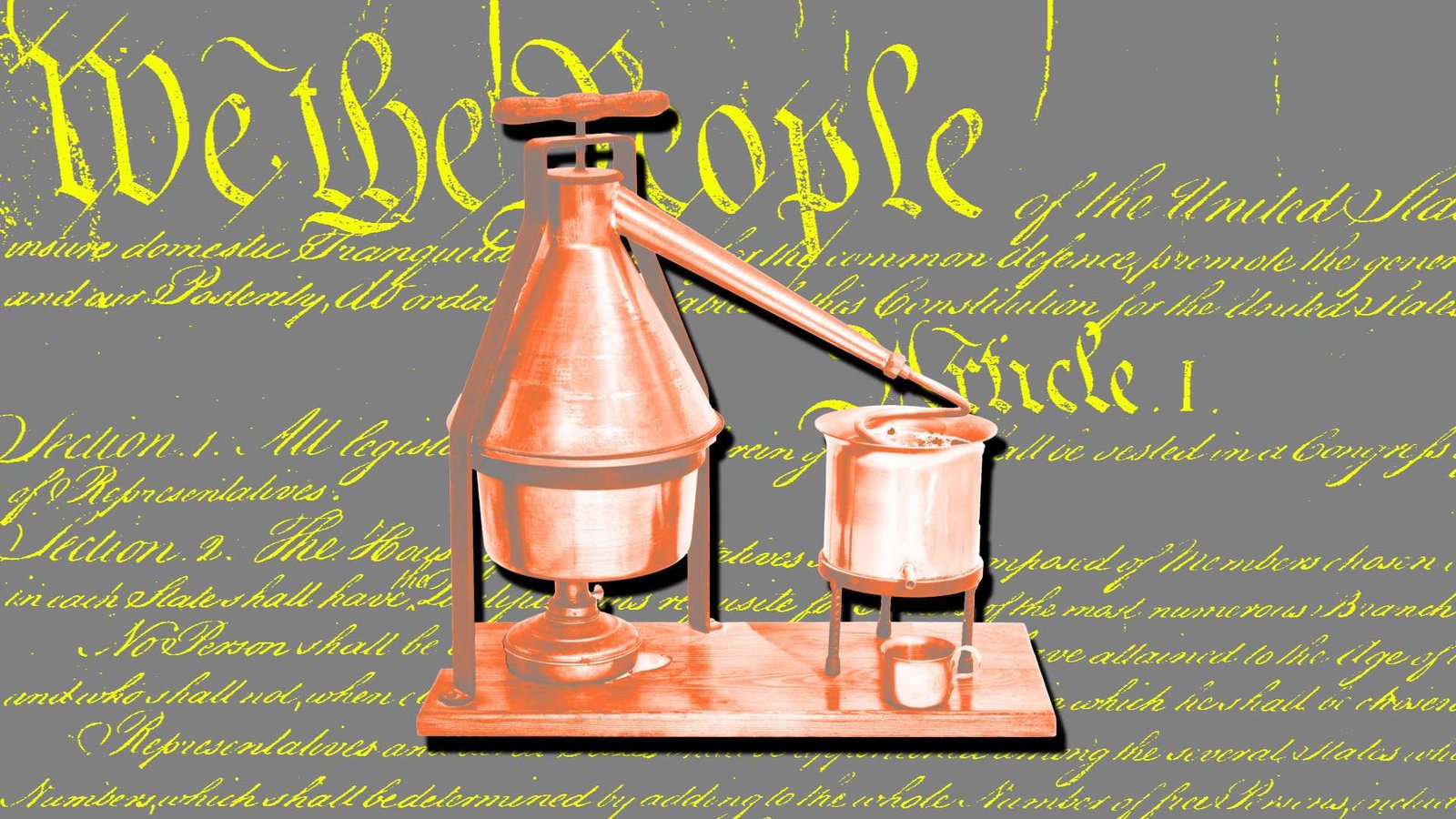
Yesterday, in Ream v. Department of the Treasury, the US Court of Appeals for the Sixth Circuit upheld an 1868 federal law banning home alcohol distilleries. The court ruled that the law is authorized by a combination of Congress’ tax power and the Necessary and Proper Clause, which gives Congress the power to makes laws “necessary and proper” for carrying into execution other federal powers. The ruling contradicts a recent decision by the Fifth Circuit striking down the same law.
The Sixth Circuit decision -written by prominent conservative Judge Raymond Kethledge – is badly flawed, because the law in question clearly is not “proper,” even if it may be “necessary.” Hopefully, the Supreme Court will overrule it.
Like the Fifth Circuit ruling, the Sixth Circuit rightly concludes this law is not authorized by the tax power alone, because it does not impose any tax or collect any tax revenue. Judge Kethledge’s opinion holds that the law is “necessary” because, by banning home distilling, it incentivizes more alcoholic beverage production outside the home, where it will be easier to tax, and thus generate more tax revenue. As I explained in my post about the Fifth Circuit ruling, this is probably enough to meet the broad definition of “necessary” embedded in longstanding Supreme Court precedent (though I think that definition is flawed).
But the Sixth Circuit is badly wrong to conclude that the law is “proper.” As explained in my earlier post, the Supreme Court, in NFIB v. Sebelius (2012), ruled that a “proper” power permissible under the Clause is one that is “ancillary” to the implementation of an enumerated power. It cannot be a “great, substantive and independent” power. The power to ban any home-based activity that might serve a substitute for taxable activity outside the home is clearly a “great and independent power.” As Judge Edith Jones explains in the Fifth Circuit ruling, “[u]nder the government’s logic, Congress may criminalize nearly any at-home conduct only because it has the possibility of concealing taxable activity.”
The Sixth Circuit tries to address this point by claiming alcohol is somehow special:
What limits the application of a factbound judgment to other cases are the relevant facts themselves. Here, those facts include a history of tax evasion as old as the Republic itself; and Congress concluded—based on that history, and after a month of testimony before a select committee of the House—that the home-distilling ban, along with the 1868 Act’s other provisions, were in fact necessary to collect federal excise taxes on spirits. That judgment rested on facts, not speculation; and those facts were peculiar to distilling spirits. Indeed, rules concerning alcohol more generally are unique as to the evasion that often accompanies them— from excise taxes, to Prohibition, to the use of fake IDs to obtain alcohol (itself almost a rite of passage for some generations), to moonshiners even today. The judgment required in this case, again, is an empirical one; and empirically, alcohol is sui generis, or very close to it.
This distinction between alcohol and all other commodities is totally arbitrary. The same reasoning could justify banning home production of anything else that is more easily taxed if produced outside the home. And there is a long history of home production of all kinds of other commodities taxed or severely regulated by the government, ranging from cigarettes to illegal drugs, to pornographic videos.
If there is greater “evasion” of laws regarding alcohol than many other goods, it is only because alcohol is more often regulated and taxed than most of the others. But there is nothing inherent in its nature that makes it “sui generis.” Far from it. Thus, Judge Kethledge’s attempt to treat alcohol as a unique special case fails.
It is also notable that the Sixth Circuit majority opinion does not attempt to explain why the Fifth Circuit ruling is wrong, or even bother to cite it. Usually, when a federal appellate court creates a circuit split, it at least acknowledges the earlier decision and tries to justify taking such an important step.
The dissenting opinion by Judge Mathis does cite the Fifth Circuit case. But he does not address the merits because he concludes (wrongly, in my view) that Ream lacked standing to challenging the home distillery ban.
Interestingly, the rulings here do not break down along traditional ideological lines. Both Judge Kethledge and Judge Edith Jones (author of the Fifth Circuit ruling) are well-known conservative jurists. The Fifth Circuit decision was also joined by Judge Graves, a liberal Obama appointee, while the Sixth Circuit ruling was joined by Judge Siler (a Republican George H.W. Bush appointee).
Finally, it’s worth noting that the Sixth Circuit – like the Fifth Circuit – does not consider the stronger potential constitutional rationale for the home distillery ban: The Supreme Court’s misguided Commerce Clause decision in Gonzales v. Raich (2005). See my post on the Fifth Circuit ruling for more on this point. But, unlike in the Fifth Circuit case, here the government has not forfeited the Commerce Clause argument. So if the Supreme Court were to review this decision, they could consider that issue too.
[ad_2]
Source link
