
[ad_1]
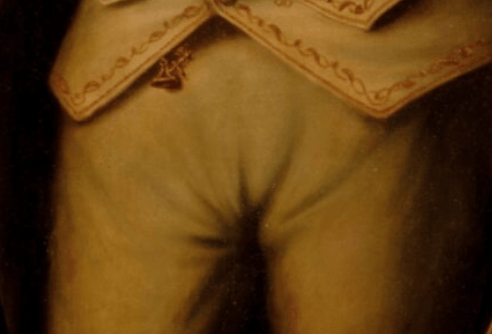
Portrait of George Washington (detail) by Charles Willson Peale (1776).
+ I excavated my way through Ron Chernow’s bulging, semi-woke (by the standards of the Texas Schoolbook Commission) biography of George Washington. I say, “semi-woke,” because while it discreetly admits that Washington was a patrician dandy of no exceptional military or administrative genius, who abused his troops, committed war crimes, bought his first election to public office with booze, and held 100s of slaves, often treating them cruelly in response to his own ineptitudes as a gentleman planter, it is quick to balance any evidence of fault in the character of the founding father with a statement to the effect that “while this may sound extreme to our ears, it was fairly typical for the time.” Which is, of course, exactly the point.
+ While Chernow’s text is rather elliptical on these decisive episodes in Washington’s life (there’s little risk of it being pulled from libraries in most of the states, at this point), the book is generously foot-noted with primary sources, many of them in Washington’s own hand (he was a prolific self-promoter of his own exalted life), which fill-in the more tenebrous aspects of his character.
+ The first member of the Washington clan to step foot in Virginia was John, who came ashore in the Tidewater area in 1676. George’s great-grandfather wasn’t much of a farmer (after all, he only owned three slaves and some Irish “servants”), but he did amass thousands of acres of land along the Potomac and received a military commission to kill Indians in Maryland, where he earned a reputation for treachery and slaughter. In one notorious incident, Washington murdered five Indian leaders who had come to negotiate a treaty, then claimed their land. He was known by the Potomac tribes as Conotocarious, “destroyer of villages, devourer of homes.”
+ It turns out George Washington could have easily run a CIA black site or the Gitmo torture camp. As an officer of the VA Regiment in the French & Indian wars, he proved a sadistic disciplinarian inflicting as many as 1500 lashes a day for relatively minor offenses: “drinking in and informed another officer he “was determined to hang two or three at a time as an example to the others. (ie., his soldiers).” He kept his condemned prisoners in iron chains in total darkness. In a letter to Robert Dimwiddie, the Lt Governor of VA, with whom he would later clash in the revolutionary war, Washington wrote coldly: Your honor will, I hope, excuse my hanging instead of shooting them. It conveyed much more terror to others and was for example’s sake we did it.”
+”To live in Virginia without slaves is morally impossible.”
– Rev. Peter Fontaine, 1757
+ Though they can’t be blamed for its pompous and derivative neo-classical design, seven master black carpenters built most of the plantation house at Mount Vernon. They were all enslaved by Washington. The overseer of the construction, Humphrey Knight, wrote Washington, assuring the young land baron that he wasn’t light with the whip when he spotted a loose board or crooked plank: “As to the carpenters, I have minded ’em all I posably could and has whipt ’em when I could see a fault.”
+ Martha Washington kept her own sister, Ann Dandridge, as a slave. Ann was the daughter of Martha’s father John Dandridge and a young, enslaved woman, who was half-black, half-Cherokee. Ann lived as a slave at Mount Vernon until 1802, after first George, then Martha died.
+ Re: Pentagon contracts & high-tech weaponry, when Washington learned the Continental Army only had 300 barrels of gunpowder–not the 10k he’d been promised–Benjamin Franklin urged him to arm the troops with bows and arrows. “They’ve worked pretty well for centuries,” Franklin wryly noted. If only the bow-makers had had a PAC!
+ George Washington had a brilliant aide-de-camp during the final three years of the Revolutionary War. No, not Alexander Hamilton. His name was John Laurens. Laurens was that rare thing: a wealthy abolitionist from South Carolina. Even rarer, his father had amassed the family fortune through the slave trade, purchasing and selling as many as 10,000 people captured in Africa and shipped in chains to Charleston. Laurens had already developed plans to free his own family’s slaves and eagerly approached Washington with a daring scheme to shift the balance of power in a stagnating war, especially in the South, where British forces had just ransacked and torched Savannah. Laurens proposed emancipating at least 3,000 blacks who would be willing to serve in a South Carolina regiment to confront the marauding troops of Banastre Tarleton, who had terrorized the southern coast from Virginia to Georgia. Members of the Continental Congress warmed to the plan and some even wanted to go further, emancipating all slaves who’d be willing to serve in the American army.
After all, at that point, the Continental Army was already more integrated than any US army until the Vietnam War, with free blacks accounting for more than six percent of the total force. But Washington, who still owned or controlled as many as 300 slaves, recoiled at the idea of arming emancipated blacks in the South. He rejected Laurens’ plan and quietly contemplated a scheme, typically reactionary, of his own: sell off the slaves of Mt. Vernon and his other properties and loan the proceeds to finance the maintenance of his bedraggled army. In a letter to his plantation overseer (and distant cousin) Lund Washington, the general wrote that if the Americans lost the war
it would be a matter of little consequence to me whether my property is in Negroes or loan certificates, as I shall neither ask for, nor expect, any favor from his Most Gracious Majesty…the only points therefore for me to consider are…whether it would be most to my interest, in case of a fortunate determination of the present contest, to have Negroes and the crops they will make, or the sum they will fetch and the interest of the money.
So the war dragged on another three years, until finally the decisive blow was struck at Yorktown, where the nearly all-black First Rhode Island Regiment made one of the most audacious raids. As for Laurens, who dreamed of abolishing slavery across the Americas, he soon became one of the last casualties of the war, shot in the head during a skirmish with British troops pillaging a rice field along the Combahee River, a couple of weeks after the British fled Charleston.
+ George Washington’s First Inaugural Address was written by James Madison. Congress’s Response was written by James Madison. And Washington’s rejoinder was written by…James Madison. At the operational level, America’s politics has always been a charade.
+ Even George Washington drew the line at separating the families of the people he “owned”…
+ Baron Johann de Kalb, a German mercenary whom Lafayette recruited to aid the American Revolutionaries on Washington’s military acumen:
He is the most amiable, obliging, and civil man, but as a General he is too slow, even indolent, much too weak and is not without his portion of vanity and presumption.
+ George Washington railed incessantly against the war profiteers and speculators during the Revolution, calling them “plundering scoundrels,” while today’s members of Congress (and sons of Trump) make millions trading in weapons and oil stocks, as their states and districts get gouged at the pump.
+ For all of his faults, Washington was no nativist. He encouraged mass immigration to the young Republic, writing to the radical Dutch republican Francis Van der Kemp in 1788: “I had always hoped that this land might become a safe & agreeable asylum to the virtuous & persecuted part of mankind, to whatever nation they might belong.”
+ Tom Paine, that Che Guevara of the 18th century, in a letter to George Washington, May 1, 1790:
Our very good friend, the Marquis de Lafayette, has intrusted to my care the key of the Bastille, and a drawing handsomely framed representing the demolition of that detestable prison. I feel myself happy, and being the person through whom the Marquis has conveyed this early trophy of the spoils of despotism, and the first ripe fruits of American principles transplanted into Europe….
Soon, the nation Washington was building would be putting its own dissidents into similar prisons, under the Alien and Sedition Acts.
+ During the war, Tom Paine served as George Washington’s chief propagandist. His fiery pamphlets kept the money flowing and the popular spirits elevated even as the Revolutionary Army stumbled and stuttered up and down the Atlantic seaboard. After the Brits called it quits and Washington assumed power, he turned his back on his old friend. When Paine, the trans-Atlantic rebel, faced the guillotine in Revolutionary France for refusing to endorse the execution of the King, Washington failed to intervene, ignoring the urgings of Jefferson and Franklin. (Paine survived the Terror by a freak accident, as the prison guards mismarked his cell door.) Paine came to consider Washington a “counter-revolutionary” (he coined the term), denouncing the former revolutionary-turned-imperious leader as either “an apostate or an imposter.”
+ Washington wasn’t a religious man. He countenanced religion, but didn’t practice it. He saw himself, a little grandly perhaps, as a figure of the enlightenment, a man of reason and science. If anything, he was a Deist, who believed in a Supreme Being and saw Jesus as a moral teacher, not a god. Still, he wasn’t hostile to religion in the manner of his fellow Virginian Thomas Jefferson, who, in an 1816 letter to the writer Horatio Gates Spafford, described the divinity schools of Harvard and Yale as “seminaries of despotism.” For Jefferson, the Church was as oppressive as the monarchy.
Jefferson and Washington certainly were no Christian Nationalists. Jefferson wasn’t even a Christian. His biographer Joseph Ellis describes him as a secular humanist, though I don’t know what kind of humanism can rationalize holding other humans in bondage. Perhaps a future Supreme Court decision from Alito or Thomas will explain.
+ In reading about Washington, I’ve become increasingly distracted by Peggy Shippen, wife of Benedict Arnold. Washington was so entranced by her that, even after evidence of her complicity in Benedict’s treason came to light, he refused to believe it. Shippen was reportedly the highest-paid British spy of the Revolutionary period. Aaron Burr was almost certainly right in charging that Shippen was not only central to the conspiracy but also enticed Arnold into becoming a British agent and surrendering West Point. This image of Shippen, whose coif would have shamed Madame Pompadour, gives you some idea of what charged the erotic fantasies of the nation’s first president, who called himself “a votary to love.” He remained in the thrall of a similar “Georgian era” English beauty, Sally Fairfax, who fled the nearby Belvoir plantation at the start of the Revolution for Bath, England, for most of his life…

+ Speaking of Burr, in Gore Vidal’s novel the slight that prompts the fatal duel on the Heights of Weehawken is Hamilton’s assertion that Burr regularly had incestuous relations with his daughter Theodosia, these maulings occurring at roughly the same time Burr’s other hated rival, Thomas Jefferson (who had manufactured evidence against Burr at his treason trial), was raping his enslaved house servant Sally Hemings. So when the Originalists piously ask about some Constitutional nuance, what was the intent of the Founders? It was probably something designed to indemnify their own felonious predilections.
+ There’s no question Washington obsessed over sex. On his bookshelves lurked two of the age’s most notorious sex tutorials, The Lover’s Watch: or the Art of Making Love by Aphra Benn and Daniel Defoe’s Conjugal Lewdness: or Matrimonial Whoredom. The question is why the father of the country failed to father any children by Martha or any of his hundreds of enslaved women? (Martha gave birth to four children in her first marriage, so the lack of fecundity in her relations with George probably didn’t originate with her.) Was it sterility or impotence? If you’d been able to peek inside Washington’s medicine cabinet at Mount Vernon, you’d have found it well-stocked with Spanish Fly, the sex potion made from dead blister beetles, purchased, like Viagra today, by mail order. In Washington’s case, it came from chemists in London in four-ounce jars.
+ But Spanish Fly often proved lethal, especially when administered to women orally. (Men tended to rub the mixture on their penises, hoping to swell and prolong their erections.) In 1772, the Marquis de Sade fatally poisoned five Parisian prostitutes when, in anticipation of a weekend orgy (at which he longed to spend hours with his nose between their buttocks sampling their farts), de Sade compelled the young women to eat anise seed cupcakes liberally laced with Spanish Fly. Since Martha outlived George, we can perhaps assume that the orders of Spanish Fly were meant to fortify his own faltering Priapic ambitions.

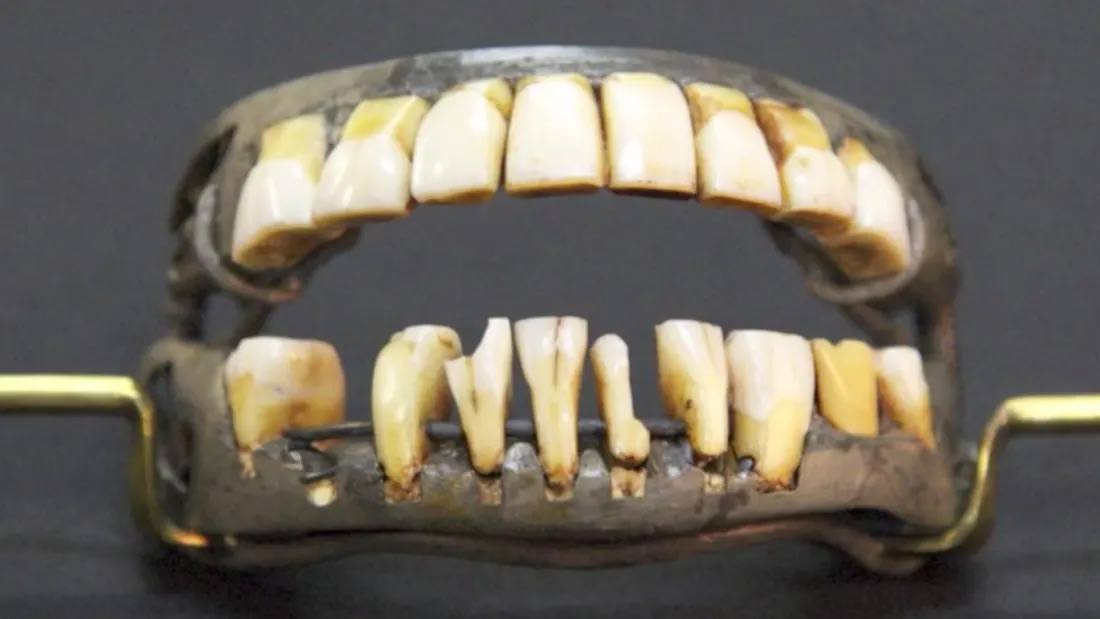
Washington’s false teeth, some of which were extracted from enslaved people. Photo: Mount Vernon.
[ad_2]
Source link
