
[ad_1]
In one of the scariest moments in modern history, we're doing our best at ScheerPost to pierce the fog of lies that conceal it but we need some help to pay our writers and staff. Please consider a tax-deductible donation.
By Shahad Ali
This article was originally published by Truthout
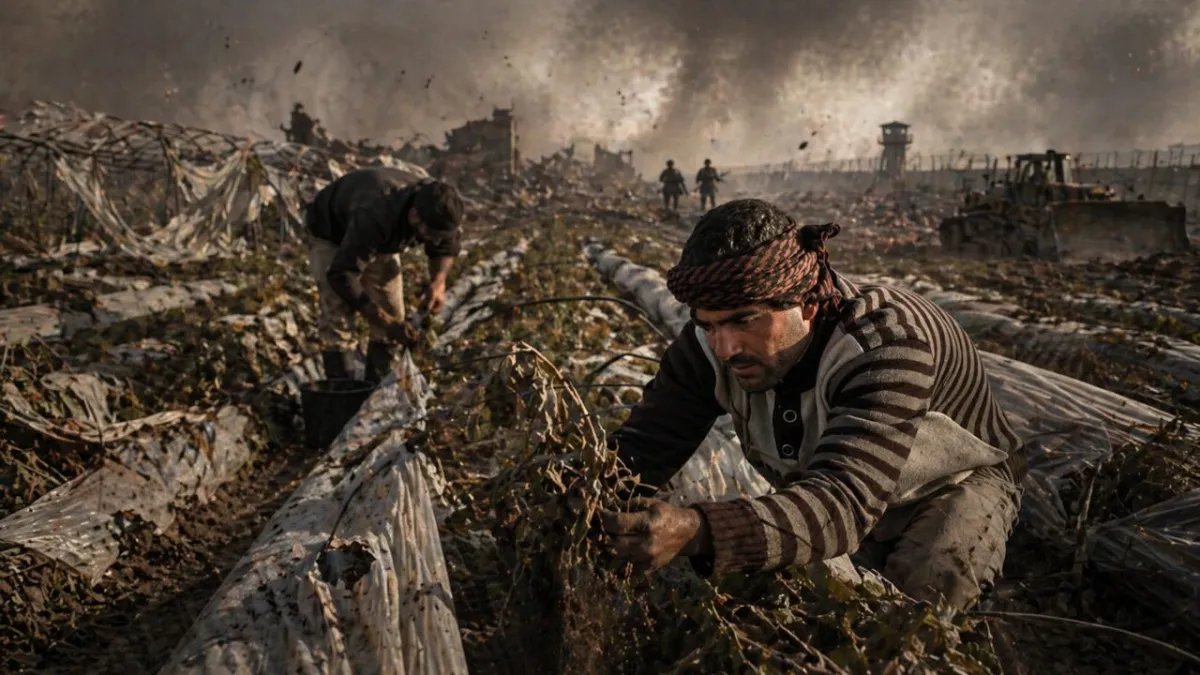
The majority of farmland is unusable due to Israeli bombing, bulldozing, or seizure within the so-called “Yellow Line.”
Before the Israeli war began, Gaza’s agricultural sector was known for its abundant production of fruits and vegetables and was often called the “food basket” of the Strip. Despite extensive Israeli restrictions that hindered the sector’s growth — including limits on the entry of agricultural inputs and the export of goods — farmers in Gaza were still able to produce 25 varieties of fruits and vegetables, meeting much of the local market’s needs, exporting part of their produce to Arab and European countries, and providing jobs to nearly 560,000 people.
However, the Israeli war has completely devastated this sector, leaving approximately 90 percent of farmland unusable due to bombing, bulldozing, or seizure within the so-called “Yellow Line.” Agricultural consultant and food security expert Omran Al-Khasawneh told Al Jazeera that intense bombardment leads to soil contamination with toxic chemicals from explosive remnants, such as lead, mercury, copper, and chromium — heavy metals that contaminate and accumulate in the soil. The buildup of these metals is toxic for plants, hindering their roots’ ability to absorb essential nutrients and reducing crop productivity.
Of the land outside Israeli control, only 5 percent remains suitable for cultivation. Production is falling far short of meeting the population’s needs. The crisis is further exacerbated by the widespread destruction of agricultural infrastructure — over 1,100 wells and 450,000 linear meters of irrigation networks have been destroyed, along with approximately 12,500 greenhouses. Adding to these challenges, Israel continues to block the entry of essential farming inputs, including fertilizers, seeds, pesticides, and spare parts for agricultural machinery, severely hindering any efforts to restore agricultural production.
Many Gazans view the destruction of agricultural land as a deliberate Israeli objective since the war on Gaza began on October 7, 2023, aimed at weakening food security in the Strip, undermining its ability to achieve self-sufficiency, and deepening economic dependence on Israel. According to specialized reports issued by the Palestinian Ministry of Agriculture, the total area of destroyed plant production due to the Israeli war on Gaza reached approximately 167,000 dunams (equivalent to about 41267 acres), including 78,000 dunams of vegetables, 14,000 dunams of field crops, and 75,000 dunams of tree cultivation. Losses in plant production are estimated at around 459,000 tons, valued at more than $325.5 million, while export losses reached approximately $67 million.
Raed Lubad, a 35-year-old agricultural engineer working with the Gaza City Municipality, told me that the impact of the latest Israeli war on Gaza’s agricultural sector has been unprecedented. However, efforts to revive even a small part of this devastated sector began as soon as the so-called ceasefire took effect in October 2025.
“The main reason for launching these rehabilitation projects is that we, as Palestinians, have always viewed planting as an irreplaceable part of our culture and identity,” he said. “Despite the widespread destruction, we still believe in our ability to create something out of nothing — to show that, despite everything, we can still rise from the ashes and start anew, like a phoenix.”
Lubad added that the Gaza City Municipality’s initial goal is to enhance food security by providing spaces for seedling production, as well as organizing extensive training sessions to promote agricultural awareness and advance this vital sector. So far, work has begun on three key projects.
The first project focuses on rehabilitating the largest plant nursery in Gaza City. Before the war, the nursery produced more than 30,000 seedlings across over 205 varieties of trees and ornamental plants, which were distributed for planting in parks, public facilities, and hospitals, according to Lubad. However, during a December 2023 ground operation in the Al-Tuffah neighborhood, Israeli forces completely bulldozed the site, leaving it entirely out of service.
Lubad clarified that they have now begun restoring this nursery with the aim of increasing green spaces across the devastated Gaza Strip. So far, they have managed to produce approximately 7,000 ornamental plant seedlings.
The second project is being carried out in collaboration with the municipality and private-sector farmers. It focuses on equipping nurseries with agricultural tools, fertile soil, and skilled labor to produce a wide variety of seedlings. These include vegetables such as tomatoes, peppers, zucchini, eggplant, and onions, as well as flowers and perennial crops such as citrus fruits and grapes — particularly the Sheikh Ajleen variety, which was once widely renowned in Gaza before the war.
Moreover, Lubad mentioned that they are currently working on another project supported by the Shawwa Family Fund, which aims to promote the concept of home gardening among residents. This initiative encourages people to cultivate the spaces they own — whether small plots of land or even their rooftops — in order to achieve a degree of self-sufficiency in vegetable production for their families.
Lubad also emphasizes the ongoing challenges farmers face in reviving Gaza’s agricultural sector:
Israel continues to block the entry of essential agricultural inputs, including seeds, fertilizers, pesticides, and seedlings. We are also facing a severe shortage of organic fertilizers, normally derived from animal waste, because the war has devastated the livestock sector. As a result, we are forced to rely on chemical fertilizers stored before the war — they are now nearly depleted, expired, and far less effective than organic fertilizers, which provide plants with the essential nutrients they need throughout their growth. Furthermore, farmers must rely on primitive methods to obtain seeds, and even the expanded polystyrene we use for growing seedlings is old and damaged.
The soil itself has been severely damaged, losing much of its fertility along with beneficial microorganisms and fungi due to bombardment, further reducing productivity. Moreover, extracting water from underground wells is difficult because of high diesel costs and the lack of effective solar energy systems, while operating agricultural machinery has become prohibitively expensive — running a bulldozer for just one hour to level land for cultivation can cost up to $400, according to Lubad. The shortage of arable land also remains critical, as Israel controls most of the areas that were used for farming before the war within the so-called Yellow Line, while over 2 million Gazans are crowded into just 48 percent of the Gaza Strip. Many have pitched tents on land that could otherwise be cultivated.
“These challenges have increased production costs while reducing output. Farmers also struggle to compete with Israeli imports, which enter Gaza’s market at significantly lower prices than local produce, threatening the viability of local agriculture. Efforts to revive the sector remain limited under Israeli restrictions,” Lubad concluded. “If the situation persists, Gazan farmers may be unable to sustain their work or achieve self-sufficiency. They urgently need access to basic agricultural inputs and machinery, the restoration of farmland, fuel for equipment, and the construction of wells and irrigation networks to strengthen the sector and enable it to achieve at least a basic level of self-sufficiency.”
This article was originally published by Truthout and is licensed under Creative Commons (CC BY-NC-ND 4.0). Please maintain all links and credits in accordance with our republishing guidelines.
Editor’s Note: At a moment when the once vaunted model of responsible journalism is overwhelmingly the play thing of self-serving billionaires and their corporate scribes, alternatives of integrity are desperately needed, and ScheerPost is one of them. Please support our independent journalism by contributing to our online donation platform, Network for Good, or send a check to our new PO Box. We can’t thank you enough, and promise to keep bringing you this kind of vital news.
You can also make a donation to our PayPal or subscribe to our Patreon.
Please share this story and help us grow our network!
[ad_2]
Source link
