
[ad_1]
Spring’s budding trees, blooming flowers and warmer temperatures beckon the winter weary back outdoors. But a tiny danger lurks in the season’s celebratory greenery: ticks.
These eight-legged, bacteria-carrying parasites are the No. 1 Lyme disease-spreader for humans. Scientists are working on a vaccine series to guard against the disease. Until then, people are vulnerable to this potentially serious tick-borne illness — and the risk of exposure is growing. Some antivaccine sentiment is propelling an online conspiracy theory linking the tick population with the vaccine.
So before you set out on that hike, picnic or beach day, know the facts about ticks, Lyme disease and the vaccine in development to prevent it.
What is Lyme disease?
Lyme disease is the most common tick-borne infectious disease in the United States. Named for the Connecticut town where it was first reported in the 1970s, Lyme is prevalent in the northeast and upper midwest. Its geographic distribution also includes the west coast and regions such as Canada, Europe and Asia — and it’s spreading.
Humans usually contract Lyme after they’re bitten by a deer tick carrying the borrelia bacteria that causes Lyme.
Untreated Lyme disease infections typically begin with a rash, fever, headache, fatigue, swollen lymph nodes or muscle and joint aches and stiffness. Infections progress in stages, moving to other parts of your body such as the heart, brain or spinal cord. Months after the tick bite, untreated infections can cause arthritis, brain fog, nerve damage and mental health issues.
Lyme disease can be treated with a complete round of antibiotics. Many people see improvement, but some people report long-lasting symptoms for months or years.
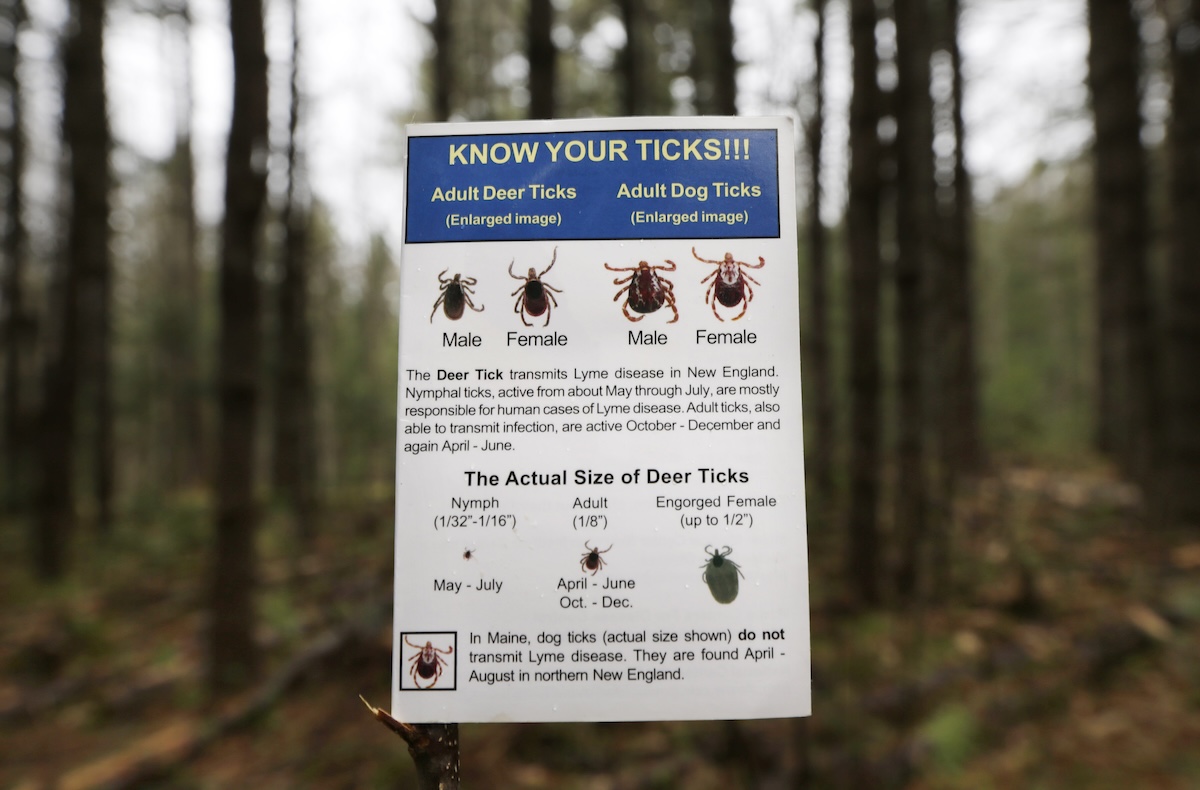
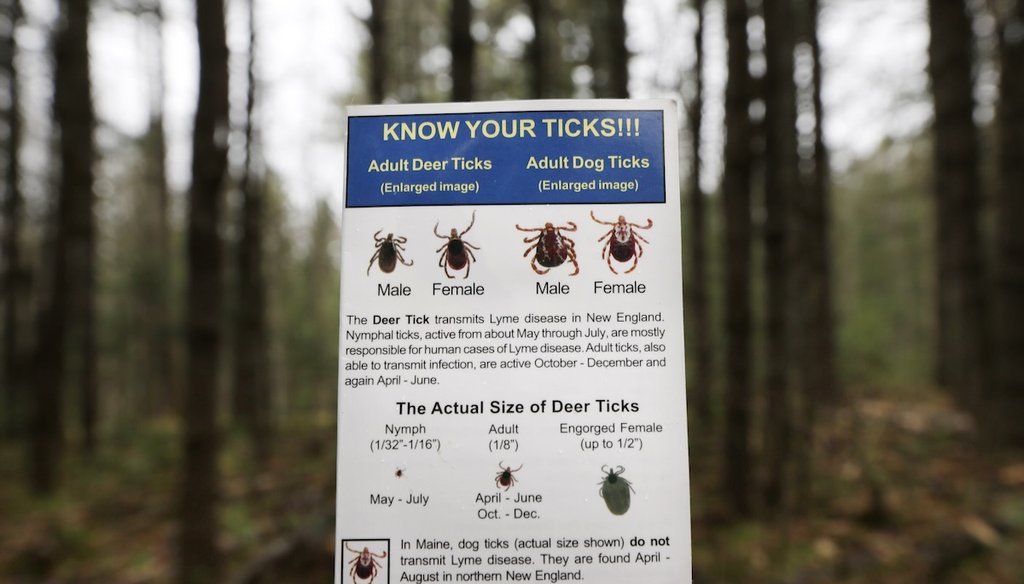
An informational card about ticks distributed by the Maine Medical Center Research Institute is seen in the woods in Freeport, Maine, May 9, 2014. (AP)
Why is Lyme spreading to new geographic areas?
Ticks are expanding their geographic range at the same time climate change’s warmer temperatures and higher humidity are prolonging tick season.
Suburban development broke up woodland areas and put large numbers of people right at the edge of ticks’ favored habitats, said Dr. Jake Scott, an infectious disease specialist and a Stanford University School of Medicine professor.
The result is more ticks, a longer tick season and more people living near tick habitats — and more Lyme disease cases.
In 2023, the most recent year for which data is available, state health departments reported more than 89,000 cases of Lyme disease. Lyme disease is likely even more prevalent, though. Using insurance claims data, researchers estimate that about 476,000 people annually are diagnosed with and treated for Lyme disease.
How does the latest proposed vaccine work?
Pfizer began researching a new Lyme disease vaccine because of the illness’ growing prevalence, its status as a global public health concern, and its potential for serious complications, the company said in a statement to PolitiFact.
Pfizer and Valneva, a European vaccine company, are working on a vaccine that would cause a person’s body to create protective antibodies against a protein found on the borrelia bacteria’s surface. If a tick bites a vaccinated person, it ingests blood that contains the antibodies that fight the Lyme disease by attaching themselves to the bacteria’s surface. This renders the bacteria inactive and unable to infect a human host.
The vaccine was tested in a large-scale clinical trial in which participants were randomly selected to receive either a placebo or an actual vaccine. The trial was conducted in areas of the U.S., Canada and Europe with high numbers of Lyme disease cases. It involved about 9,400 people, ages 5 and older. Participants received an initial three-dose vaccine series and then a booster shot about a year after completing the series, which was timed to fall just before peak Lyme disease season.
Compared with the placebo, early trial results show that four doses of the vaccine were about 75% effective at reducing the rate of confirmed Lyme disease cases on the day after the last dose and 73% effective in reducing the rate of confirmed Lyme disease cases 28 days later.
Pfizer said the trial saw fewer cases of Lyme disease than expected.
That means the results weren’t as statistically meaningful as the study’s goal. Still, 73% efficacy against a disease with no other vaccine is significant, Scott said.
Pfizer said the trial results established “clinically meaningful efficacy” and said the company plans to pursue regulatory approval.
If it were approved by the Food and Drug Administration, traditionally a CDC vaccine committee would establish recommendations for who should be vaccinated.
Health and Human Services Secretary Robert F. Kennedy Jr. has pledged to fight for Lyme treatment and prevention.
It’s unclear if U.S. public health agencies — led by Kennedy, a longtime antivaccine activist — would approve the vaccine.
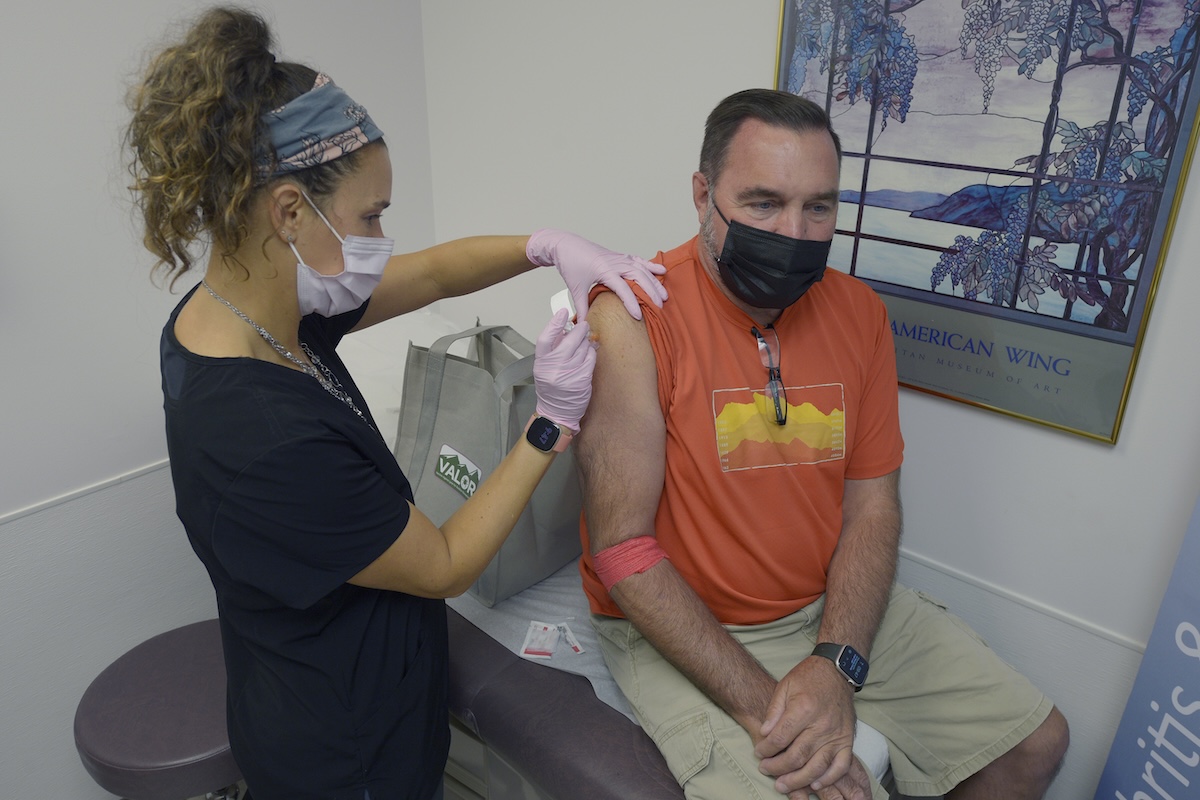
Robert Terwilliger, right, of Williamsburg, Pa., who is participating in a Lyme disease vaccine trial at the Altoona Center for Clinical Research, is injected with either the new vaccine or a placebo, by registered nurse Janae Roland, Aug. 5, 2022. (AP)
Wasn’t there another Lyme disease vaccine years ago?
Yes. The FDA approved a Lyme disease vaccine called LYMErix in 1998. LYMErix worked similarly to Pfizer and Valneva’s vaccine and showed about 75% efficacy in clinical trials. But where LYMErix targeted only one strain of bacteria, the vaccine currently in development targets six strains of Lyme bacteria.
LYMErix’s manufacturer withdrew the vaccine in 2002, citing low demand and poor sales following health officials’ lukewarm recommendations and amid antivaccine sentiment.
What’s behind social media posts about boxes of ticks being delivered to farms?
Both vaccines and Lyme disease have long been fodder for conspiracy theories.
Pfizer’s recent vaccine clinical trial results sparked social media posts promoting unsubstantiated conspiracy theories that boxes of ticks were being mailed to farmers throughout the U.S. and that the government would soon release “plague like levels of ticks” to incentivize people to get vaccinated.
Snopes investigated Missouri-specific tick rumors, and found no health or law enforcement officials in the state who’d received any reports of boxes of ticks being left on farms.

A woman walks a dog at Robert W. Crown Memorial State Beach Park in Alameda, Calif., Jan. 1, 2026. Conduct regular tick checks on pets that spend time outside. (AP)
Without a vaccine, what’s the best way to avoid Lyme disease?
Avoid tick bites. Use insect repellent and wear long, protective clothing when spending time outdoors. It also helps if that clothing is treated with permethrin, an insecticide that kills ticks. (Note: You can apply permethrin to clothes and outdoor gear, but you cannot apply it directly to the skin and it’s toxic to cats.)
These measures can protect you from other tick-borne diseases, too.
A tick has more time it has to transmit the bacteria that causes Lyme disease the longer it remains attached, so it’s best to remove ticks quickly if you’re bitten.
Conduct thorough tick checks regularly for yourself, your children and outdoor pets such as the family dog.
PolitiFact Researcher Caryn Baird and Senior Digital Research Analyst Jeff Cercone contributed to this report.
RELATED FACT-CHECK: Was Lyme disease spread as a bioweapon? No, that theory is Pants on Fire!
[ad_2]
Source link
