
[ad_1]
In one of the scariest moments in modern history, we're doing our best at ScheerPost to pierce the fog of lies that conceal it but we need some help to pay our writers and staff. Please consider a tax-deductible donation.
Joshua Scheer
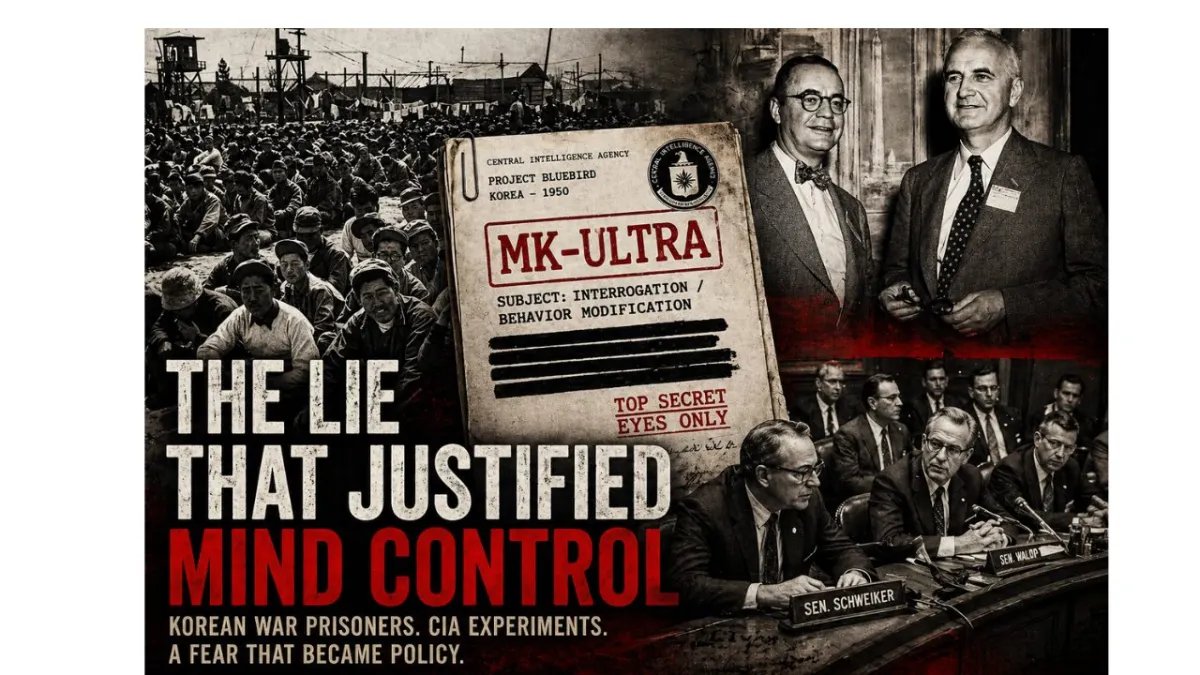
Declassified documents are blowing open one of the darkest chapters of the Central Intelligence Agency’s history — and confirming what was long dismissed as speculation: U.S. intelligence officials used prisoners of war as human test subjects in early mind-control experiments that would later become the infamous MK-ULTRA program.
Reporting by Garrett Kim for The Intercept reveals that newly declassified documents confirm the Central Intelligence Agency subjected Korean War prisoners of war to early mind-control experiments — exposing a program built not on defense, but on domination.
For decades, the mythology of Cold War “brainwashing” focused outward — on supposed enemy capabilities, on the specter of American soldiers turned into unwitting agents by foreign powers. But newly released records tell a far more disturbing story: the real experimentation wasn’t happening in enemy camps. It was happening under U.S. control.
According to reporting based on documents from the National Security Archive, early iterations of MK-ULTRA — then known as Project Bluebird — targeted North Korean prisoners held by U.S. forces during the Korean War. These prisoners were subjected to interrogation techniques designed not just to extract information, but to fundamentally reshape the human mind: inducing amnesia, manipulating behavior, even exploring whether individuals could be compelled to act against their most basic moral instincts.
Throughout the newly declassified records, a pattern emerges that cuts through decades of silence. The Korean War has long been labeled “The Forgotten War,” but as first reported by The Intercept, that label begins to look less like neglect and more like design — a form of intentional obfuscation. What was buried was not just memory, but accountability. These disclosures point to a deeper truth: history is not simply forgotten; it can be actively erased, its most damning details pushed out of public consciousness for generations.
For years, the only serious public account of Koreans being used in these experiments came from journalist John Marks in his 1979 book The Search for the “Manchurian Candidate”. Drawing on early CIA records, Marks traced the origins of MK-ULTRA back to its precursor, Project Bluebird — and to a chilling moment in October 1950, when 25 North Korean prisoners of war were selected for experimental interrogation. The objective went far beyond intelligence gathering. As described in the records, the goal was to achieve total behavioral control — to push a person to act against their own will, even against basic instincts of self-preservation. What was once treated as Cold War speculation now reads as documented policy — not an aberration, but a system.
The goal, as one memo chillingly put it, was nothing less than control — the ability to make a person “do our bidding against his will.”
This wasn’t fringe experimentation. It was structured, funded, and systematized. Teams composed of doctors, hypnotists, and polygraph technicians were assembled. Budgets were approved. Equipment was procured. And behind the bureaucratic language of “research” and “interrogation,” a more unsettling reality took shape: a government apparatus probing the limits of psychological domination over captive human beings.
Even more damning, the documents undercut the central justification long used to rationalize these programs — that the U.S. was merely responding to similar tactics by its adversaries. Internal testimony and intelligence assessments found no evidence that enemy forces had developed the kind of sophisticated drug-induced mind control the CIA claimed to fear.
In other words, the threat wasn’t driving the program. The program was driving itself.
What emerges from these disclosures is not just a story of Cold War excess, but a deeper pattern: a national security state willing to test the boundaries of human autonomy in the name of control, even when the underlying premise was built on myth. The Korean War, often called “The Forgotten War,” appears less forgotten than deliberately obscured — its most disturbing truths buried in classified archives for decades.
CIA Ran MK-ULTRA Experiments on Prisoners of War in U.S. Custody, Declassified Docs Confirm
During the 1977 Senate hearings on MK-ULTRA, a familiar justification surfaced — one rooted less in evidence than in fear. U.S. officials repeatedly pointed to North Korea and other Cold War adversaries as pioneers of “mind control,” suggesting that American programs were defensive, even necessary. Questioned by Sen. Richard Schweiker, CIA psychologist John Gittinger conceded that by the early 1960s, the idea of exotic, drug-fueled mind control — the kind popularized by The Manchurian Candidate — had no real basis in evidence. What had once been framed as a mysterious, near-magical capability possessed by foreign adversaries was, in reality, something far more mundane and far more disturbing: isolation, prolonged stress, and relentless interrogation. In other words, not science fiction — but systematic psychological breakdown. But as later records and testimony would reveal, that threat was largely speculative. The fear came first — and the policy followed. In effect, the idea that enemies were perfecting psychological control became a moral shield, one that allowed U.S. intelligence agencies to rationalize carrying out similar, if not more advanced, experiments on prisoners of war in their own custody. What was framed as protection against an external danger became a license for internal abuse — a feedback loop where imagined threats justified very real violations.
Yet even as that myth collapsed, its political function remained clear. Throughout the Korean War, U.S. officials pointed to alleged North Korean “brainwashing” as proof of an urgent and existential threat — a narrative that helped justify America’s own descent into behavioral experimentation. As senators acknowledged during the hearing, the fear of foreign methods became part of the motivation, embedding itself into a broader “behavior pattern” that extended well beyond any single agency or official. The result was a system where perceived enemy capabilities — whether real or exaggerated — provided the moral cover for very real abuses carried out in the name of national security.
Taken together, the declassified records and the 1977 Senate testimony expose a system built not on necessity, but on narrative — a self-reinforcing cycle where fear justified action, and action retroactively justified the fear. The myth of enemy “brainwashing” helped open the door to programs like Project Bluebird and MK-ULTRA, while the reality — as even CIA officials later admitted — was far less exotic and far more brutal: isolation, coercion, and psychological breakdown deployed under U.S. authority. What emerges is not a story of overreach in the fog of war, but of a deliberate architecture of control, one that blurred the line between defense and domination. And if the Korean War was “forgotten,” as these disclosures suggest, it was not because history failed — it was because it was made to.
Stephen Kinzer, an American author, historian, and former correspondent for The New York Times, has spent years tracing the hidden architecture of U.S. covert power — from regime change to psychological warfare. In his work on MK-ULTRA, Kinzer exposes not just a rogue program, but a mindset: the belief that the human mind itself could be broken down, dismantled, and rebuilt to serve state interests.
At the core of these experiments was a chilling premise — that before a mind could be controlled, it had to be destroyed. Kinzer details how CIA researchers pursued techniques designed to erase memory, fracture identity, and reduce individuals to psychological blank slates. Only then, they believed, could new thoughts, loyalties, or behaviors be implanted. It was less science than domination — an attempt to turn human consciousness into something programmable.
What emerges from Kinzer’s reporting is not just the story of MK-ULTRA, but a deeper warning about power unchecked. When institutions convince themselves that control justifies any method, even the most basic boundaries — of ethics, of consent, of humanity — begin to dissolve.
And the sad fact is that the United States used this fear — and as we now see in today’s disclosures — to brutalize and torture Korean POWs in a war that was itself was deeply unnecessary, if any war can truly be called necessary. In doing so, it practiced forms of torture it had only years earlier condemned during World War II. But when it comes to the furthering of empire, fear stops being a warning — it becomes a justification, reshaping how we see the “other”
Editor’s Note: At a moment when the once vaunted model of responsible journalism is overwhelmingly the play thing of self-serving billionaires and their corporate scribes, alternatives of integrity are desperately needed, and ScheerPost is one of them. Please support our independent journalism by contributing to our online donation platform, Network for Good, or send a check to our new PO Box. We can’t thank you enough, and promise to keep bringing you this kind of vital news.
You can also make a donation to our PayPal or subscribe to our Patreon.
Please share this story and help us grow our network!
[ad_2]
Source link
