
[ad_1]
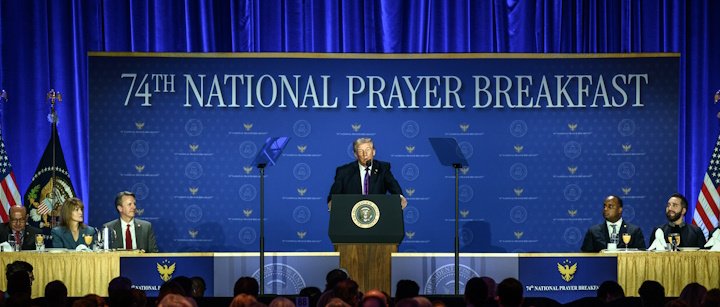
President Donald Trump said at a June faith conference that “religion is back in our country, bigger and stronger than it has been in many, many years” and “it’s going up.” The statement is misleading, as multiple surveys show lower religious affiliation and engagement than in past years — despite a recent rise in the perceived influence of religion in America.
The president made a similar claim during his February State of the Union address, in which he stated that, during both of his presidential terms, there had been “a tremendous renewal in religion, faith, Christianity and belief in God,” especially “among young people.” We wrote at the time that recent polling showed the opposite.
But Trump has continued to present religion as gaining strength nationally, including in remarks in April, for Easter, and in May, for the National Day of Prayer.
Then, at the Faith and Freedom Coalition Conference on June 26, he said: “America is back. It’s back. It’s back, I believe, better than ever before. And I’m especially pleased to say that likewise, religion is back in our country, bigger and stronger than it has been in many, many years. Been reading all of those reports. Religion’s really — it’s going up. If that were a stock, we’d be very, very rich, all of us. It’s been great to watch.”
We contacted the White House press office and asked which reports Trump saw that show increases in religious affiliation, beliefs or attendance. We did not receive a response.
On our own, we found little support for the president’s claim.
In late March, Ryan Burge, a political scientist and professor of practice at the John C. Danforth Center at the Washington University in St. Louis, posted October survey data showing that the share of Americans who are “nonreligious” dropped 3 percentage points from 34% in 2024, Joe Biden’s last year as president, to 31% in 2025. That was the lowest percentage since 2016, according to his numbers, which he attributed to the Cooperative Election Study, an academic survey partly funded by the National Science Foundation that interviews more than 50,000 U.S. adults.
The survey asked, “What is your present religion, if any?” It provided several religions as options, as well as “something else,” atheist, agnostic or “nothing in particular.” The “nonreligious” in Burge’s post included the latter three categories. Over Trump’s first term, the percentage of Americans who are nonreligious went up slightly, by 3 percentage points.
In addition, in late April, the Hartford Institute for Religion Research published the results of another 2025 poll that surveyed leaders representing 7,453 congregations in the U.S. It found that the reported attendance at religious services – which dropped to its lowest levels during the COVID-19 pandemic – had risen above pre-COVID levels. According to the study, the median size of U.S. congregations grew to 70 people last year – up from a median of 65 people just prior to the pandemic. (The median is the halfway point, meaning that half of congregations had more attendees and half had fewer.)
But the researchers said the survey results “should be interpreted with caution,” as the 2025 median of 70 attendees remained well below the median of 137 attendees in 2000. It’s also still lower than the more recent median of 80 attendees in 2015. “Therefore, this recent gain should be viewed within the much longer historical trajectory of a decline,” the researchers said.
What’s more, other surveys don’t show a religious resurgence as Trump described.
Gallup reported in March that 47% of U.S. adults in a 2025 survey said religion was “very important” in their lives. That’s down from 48% in 2024 and down from Trump’s first-term high of 51% in 2017. “The reading has been gradually declining from 58% in 2012 and was as high as 70% to 75% in the 1950s and 1960s,” Gallup said.
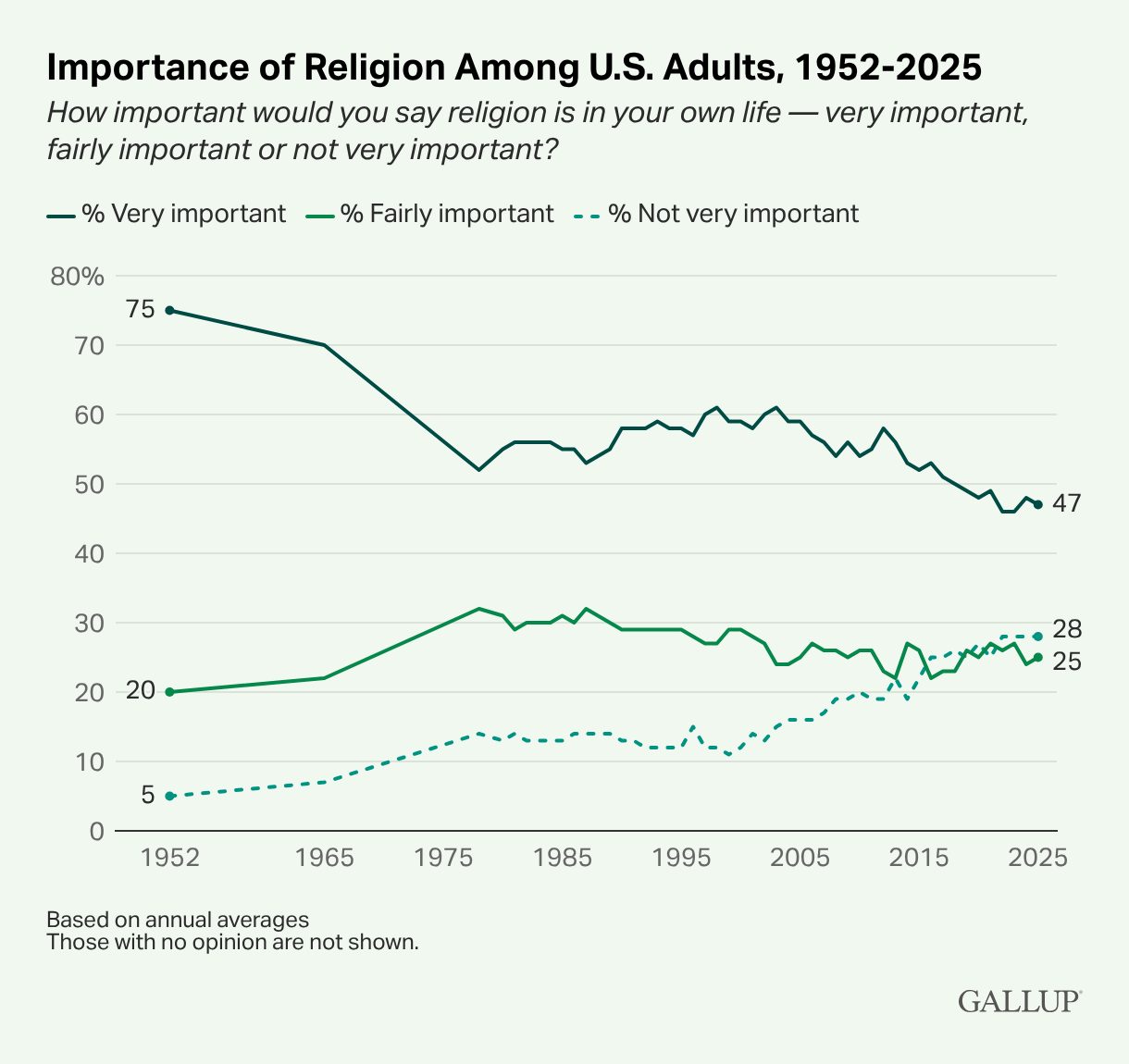
Its surveys also found that 28% of those polled have said religion is “not very important” to them each year since 2022, “the highest proportion in Gallup’s trend and more than double the rate seen as recently as the early 2000s.”
An additional 25% said last year that they considered religion to be “fairly important.” But that was up just 1 percentage point from 2024, and still below Gallup’s recorded high of 32% in the late 1970s and 1980s.
Meanwhile, 24% of people in 2025 said they had no religious affiliation at all, a new high. Gallup’s monthly 2025 polls surveyed in total more than 13,000 American adults.
Gallup found a similar pattern in religious service attendance.
Of the people surveyed in 2025, 57% stated that they seldom or never attend religious services, an increase from 55% in 2024. Also, 31% said they attended services weekly or almost weekly in 2025, a decrease from 33% the previous year.
The long-term trend “shows a steady decline in regular attendance alongside a sustained increase in nonattendance over the past two-plus decades,” Gallup reported. It added, “From the early 1990s to 2008, majorities of U.S. adults said they attended services at least monthly, but since 2018, majorities have said they rarely or never attend religious services.”
The Public Religion Research Institute’s 2025 religion census revealed similar trends.
In April, PRRI reported that “28% of Americans identify as having no religious tradition, similar to the previous year’s rate.” But it also said “the percentage of religiously unaffiliated Americans has steadily increased” over time; 21% said they had no religious tradition in 2013.
Likewise, PRRI said, “The share of Americans who seldom or never attend religious services has increased substantially, rising from 42% in 2013 to 53% in 2025.”
And the Pew Research Center has also found no general spike in religiosity.
It reported in December that consistently in its surveys going back to 2020, about 70% of U.S. adults have said they identify with a religion. “While the numbers have fluctuated a little, there has been no clear rise or fall in religious affiliation over the last five years,” Pew said.
It said similar patterns were observed when asking about the praying habits of Americans, the importance of religion in their lives, and the frequency in which they attend religious services. “There is some bouncing around from year to year, as is to be expected in survey research. But there is no clear trend of either increasing or decreasing religiousness since 2020,” Pew said.
What About Christianity?
If the president meant Christianity is “bigger and stronger” in the U.S. now – since he mentioned protecting Christians from attacks and bias in his faith conference remarks – the survey data we reviewed don’t corroborate that, either.
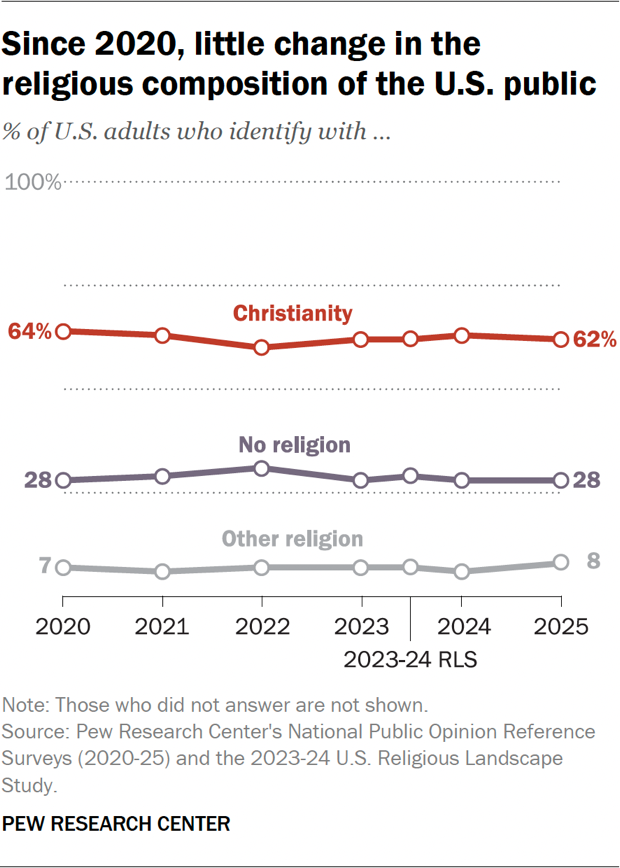
Pew Research Center’s 2025 National Public Opinion Reference Survey, conducted with 5,022 U.S. adults, found that 62% of people identified as Christians last year, including 41% as Protestant, 19% as Roman Catholic, 1% as Mormon and 1% as Orthodox. That was down from 63% who claimed Christianity in 2024 and 64% who did in 2020. The Christian share of the population was 78% as recently as 2007, according to Pew.
Gallup’s most recent figures were in the same ballpark.
Last year, a combined 64% of respondents identified as either Protestant, nondenominational Christian or Catholic, according to Gallup surveys. That was down from 67% who fell into one of those categories in 2024, and it was also much lower than the combined 82% who did in the early 2000s.
Burge, who is also a former pastor and whose research focuses on religion in America, has said that the percentages indicate that a religious “revival” is not occurring.
“I think we’re moving into a new era of what’s happening with American religion,” he said in a January podcast interview with the New York Times. “It was rapid secularization from 1991 to 2020. Now we’re in a period of stasis.”
The newspaper quoted him as saying that the nonreligious share of the U.S. population “has really stuck” at around 30% while the Christian share has been “in the low 60s” for five straight years.
“This is a plateau, not a reversal. This is not a revival. The directions are not reversing themselves. They’re just staying where they are right now,” Burge said.
What About Young Men?
Notably, in April, Gallup published survey data covering 2024-2025 that do show a sudden increase in religiousness among men between the ages of 18 and 29.
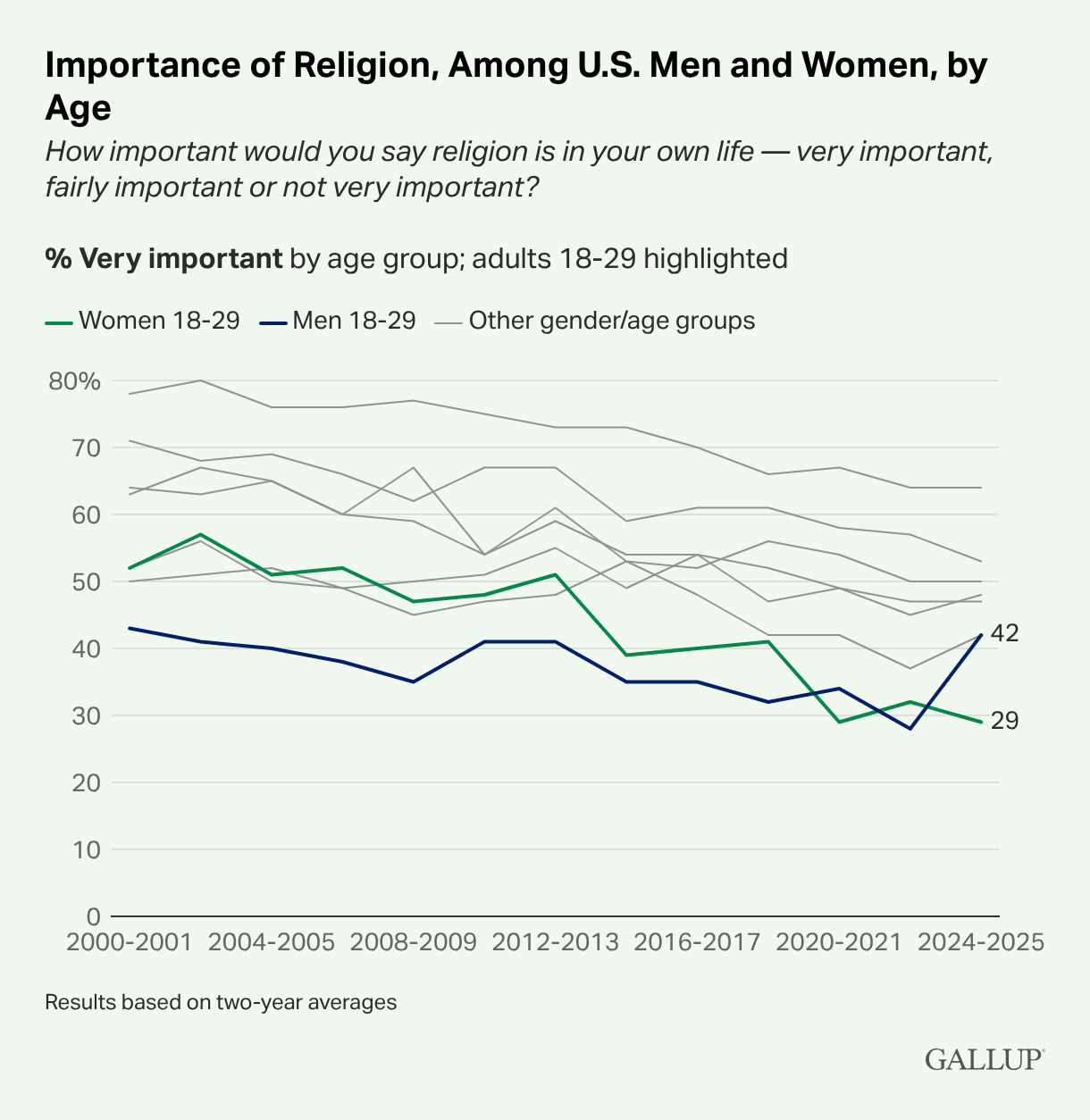
During that period, 42% of men in that age group said religion was “very important” in their lives, a 14-point increase from 28% in 2022-2023. That put young men back at nearly the same level as 2000-2001, when 43% said religion was very important to them. (Gallup says these “findings are based on biennial aggregates of Gallup’s religion data from 2000-2001 through 2024-2025, allowing for stable estimates across age and gender groups.”)
In addition, 40% of young men reported attending church or another place of worship monthly or more frequently in 2024-2025. That was the “highest level since 2012-2013,” Gallup said, and a 7-point increase from 2022-2023.
Gallup noted that much of the attendance growth was in young Republicans.
At the same time, Gallup said the data show that “women of all age groups and older men are at or near their historical lows” in terms of the importance of religion in their lives. And while young women also reported more regular attendance at religious services in 2024-2025 compared with 2022-2023, Gallup said that the attendance rates of older men and women remained “at or near their trend lows.”
Young men are “an emerging exception,” Gallup said, while noting that Americans’ overall religiosity “remains at a low ebb.”
Religion’s Perceived Influence
Finally, there is some evidence that more Americans now think religion is gaining influence in public life – if that’s what Trump was referencing.
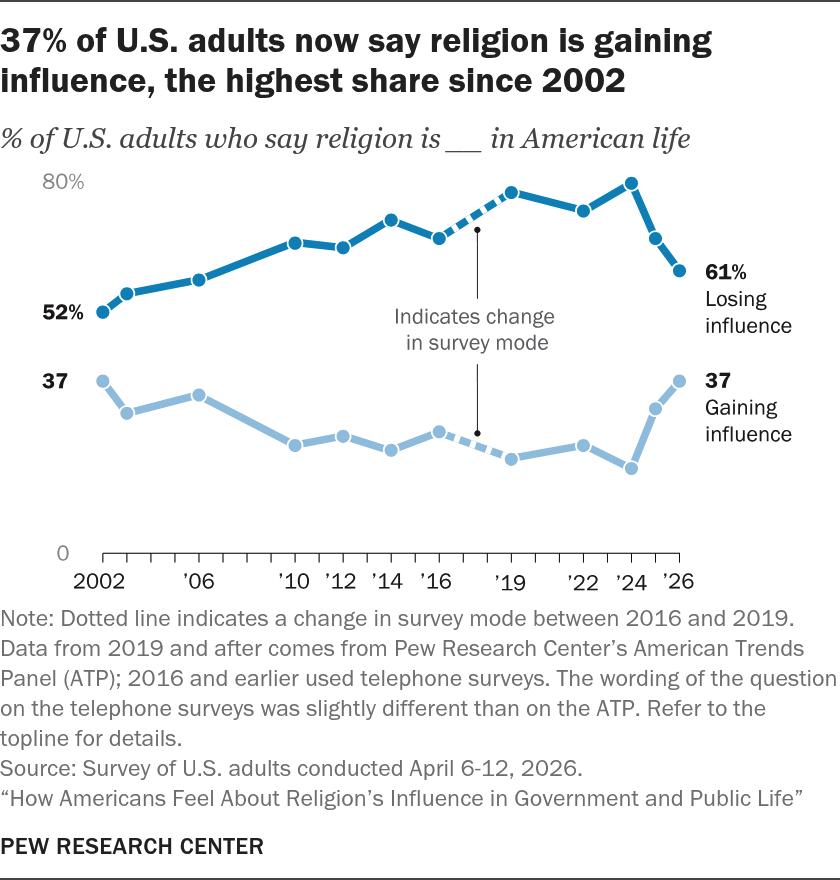
A Pew Research Center survey in April asked about the perceived role of religion in society, not people’s religious identification. It found that 61% of adults polled said that religion is losing influence in American life, while 37% said religion is gaining influence – up from the 18% who said so in February 2024.
“The share saying religion is gaining influence has risen 19 percentage points in the last two years and is now as high as it has been in Center surveys going back to 2002,” Pew said.
The researchers also noted that a majority see the perceived growth in the influence of religion as positive. They said, “Overall, 55% of U.S. adults express a positive view of religion’s role in American life – saying either that religion’s influence is growing and this is a good thing (21%) or that its influence is declining and this is a bad thing (34%).”
The 55% net positive view of religion in April is lower than the 59% in February 2025 but higher than the 52% in March-April 2019.
But perception doesn’t necessarily match reality. That data don’t mean that Americans are becoming more religious overall, as Trump suggested in his remarks.
Editor’s note: FactCheck.org does not accept advertising. We rely on grants and individual donations from people like you. Please consider a donation. Credit card donations may be made through our “Donate” page. If you prefer to give by check, send to: FactCheck.org, Annenberg Public Policy Center, P.O. Box 58100, Philadelphia, PA 19102.
[ad_2]
Source link
