
[ad_1]
Every aspect of artificial intelligence, from its economic impact to its societal and cultural consequences, is under a microscope. One topic of growing concern for consumers, local governments and environmental advocates is its energy demand.
President Donald Trump, who has encouraged aggressive AI development in the U.S., offered an estimate of how much electricity AI will require.
“They need, just as an industry, more energy than the entire country produces right now, when you think about it, which is incredible,” Trump said July 8 at the NATO summit in Ankara, Turkey. “So, take all of the energy that the United States produces, and that one industry — which is so big, so powerful — it needs more than that. In fact, some people say almost double.”
AI’s energy requirements have snowballed in recent years, and industry experts believe demand will likely grow.
However, the AI energy load is nowhere near as big as Trump said.
“I don’t see a pathway for data center demand to exceed total electricity demand in the U.S., or even approach anything close to that level,” said Brendan Pierpont, the director for electricity at Energy Innovation Policy and Technology LLC, an energy and climate policy think tank.
The White House did not respond to an inquiry for this article.
What the estimates show
AI requires “training” large language models, which involves running a large number of computers continuously for months. As a result, the data centers that process AI use a large amount of electricity.
It’s difficult to project future AI energy loads with certainty — estimates vary for how much electricity AI will require, how much electricity can be generated, and how economically it can be produced.
With this caveat in mind, we reviewed several studies from federal sources and energy-focused think tanks. None comes close to Trump’s estimate.
-
A December 2025 report by the Energy Department’s Lawrence Berkeley National Laboratory concluded that by 2028, the total power demand for data centers — the facilities that power AI — would account for 6.7% to 12% of that year’s total U.S. electricity consumption.
-
A report by the Electric Power Research Institute, a think tank, projects U.S. data centers could consume 9% to 17% of national electricity by 2030, up from up from 4% to 5% today.
-
Looking at a longer timeframe, an April report by the federal Energy Information Administration concluded that by 2050, electricity demand for data centers would account for a maximum of 15% of total electricity demand.
-
A report by the World Resources Institute, an energy and environment think tank, collected an additional half dozen additional governmental and private-sector projections for U.S. data center energy use. The highest one — a November 2025 report by the Boston Consulting Group — finds that data center needs would represent about a quarter of the 2023 level of all U.S. electricity generation.
These estimates of expected AI energy loads range from 6% to 25%. Some of these studies say AI’s energy use footprint in the U.S. could double from what it is now — but that’s not what Trump said.
“Trump’s estimate is very high relative to credible projections,” said Kenneth Gillingham, a Yale University economist who specializes in energy and environmental issues.
Our ruling
Trump said the AI industry needs “more energy than the entire country produces right now … In fact some people say almost double.”
Multiple federal and independent studies project that from 2028 to 2050, the energy needs of data centers will account for 6% to 25% of total U.S. electricity demand.
These are significant increases, but they are not 100% or 200% increases of overall U.S. energy production.
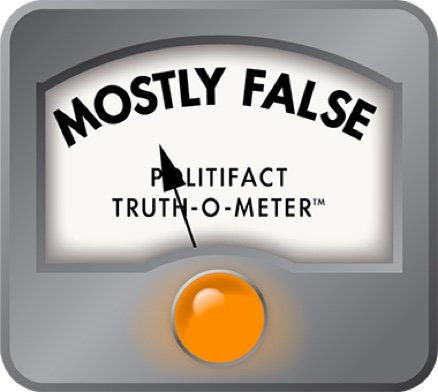
The statement contains an element of truth but ignores facts that would give a different impression, so we rate it Mostly False.
[ad_2]
Source link
