
[ad_1]
This article reflects key arguments from a debate hosted by the European External Action Service (EEAS) on 16 January 2026

Ukraine is central to European history
One of the most persistent distortions in discussions about Russia’s war against Ukraine is the assumption that Ukraine is historically marginal, an “edge case” recently pulled into European affairs. This assumption is not only wrong; it actively reproduces a Kremlin-centred view of history.
Ukraine has been a core space of European development from prehistory onwards. Some of the earliest known Ice Age dwellings in Europe were located on its territory. Early urban settlements older than those in Mesopotamia emerged there. The linguistic roots of Indo-European languages trace back to this region. Classical Greek culture was deeply connected to the Black Sea coast, while Goths, Huns, and Viking networks all moved through or originated in what is now Ukraine.
Ukraine’s geography is exceptional in European terms. It combines fertile soil, navigable rivers running north to south, and immediate access to the sea. This unique configuration has made the territory historically prosperous, but also uniquely vulnerable to imperial expansion.
For more than three millennia, this geography has attracted empires seeking control over agricultural production, trade routes, and access to maritime power. The current war is not an aberration; it is the latest manifestation of a long-standing imperial logic.
Understanding this is essential for countering disinformation that presents Russia’s aggression as defensive or reactive. The pattern is structural, not situational.
How historical myth enables power
Russian state ideology rests on a falsified vision of history: the claim of a direct line from early medieval Rus’ to today’s Russian Federation. This narrative imposes a deterministic story of continuity. It is not merely false; it is politically functional. Engaging with this narrative on its own terms – by merely correcting facts – still accepts the framework imposed by Moscow.
A more effective response begins by rejecting the premise itself. Ukraine’s past, like that of every European society, is layered, plural, and shaped by human agency. Once history is understood as contingent and human-shaped rather than inevitable, imperial claims lose their justificatory power.
Europe’s self-narrative
The European Union often describes itself primarily as a “peace project.” While politically comforting, this narrative is historically incomplete and strategically limiting.
Europe did not become peaceful because it discovered the moral value of peace. It became peaceful because its empires collapsed. The EU is, in practice, the world’s most successful post-imperial political project – an alternative way of organising power and prosperity without empire.
Failure to acknowledge this matters. When Europe frames itself only as pro-peace, it struggles to respond to actors that are explicitly pro-imperial. Russia is not seeking peace; it is seeking imperial restoration. Against such a project, peace rhetoric alone is insufficient. The defeat of Germany in 1945 resulted not from peace rhetoric, but from a coordinated military and economic coalition.
A post-imperial Europe must recognise that the defeat of imperial wars is not a tragedy, but a historical necessity and often a precondition for reform.
The persistent myth of “invincible” Russia
One of the Kremlin’s most successful disinformation achievements is the myth of Russian invincibility: the idea that Russia is endlessly strong, never loses wars, and can sustain conflict indefinitely.
History shows the opposite. Russia has lost wars repeatedly: against Japan, Poland, in Afghanistan, and the first war in Chechnya. Because of the First World War, the Russian Empire collapsed. Even in the Second World War, Soviet victory was inseparable from massive external support. Empires, historically, lose their final wars – and that loss is often what enables internal transformation.
Accepting the myth of Russian invulnerability does more than misinform – it disempowers European policy and prolongs the conflict by lowering expectations of change.
Nuclear weapons are not decisive – nuclear blackmail is the real risk
Nuclear weapons are often presented as a decisive factor in Russia’s position in its war against Ukraine. Historically, this assumption does not hold. States possessing nuclear arsenals lose wars with regularity. Nuclear weapons have not enabled Russia to win wars in the past.
The real danger in Ukraine lies elsewhere. If Russia were allowed to prevail through nuclear threats against a conventionally armed state, it would establish a profoundly destabilising precedent. Such an outcome would signal that nuclear intimidation is an effective tool of coercion and that acquiring nuclear weapons is the only reliable way to deter aggression.
The economic core of the war: hydrocarbons
The material foundation of Russia’s war effort is not ideological strength but hydrocarbon revenue. Oil and gas profits underpin both the Russian state and its military capacity.
If ending the war is a genuine objective, this economic base must be addressed seriously and consistently. Partial measures that leave core revenue streams intact only extend the conflict while reinforcing the illusion of Russian endurance.
Ukraine’s Resistance and Europe’s Strategic Moment
The full-scale invasion of Ukraine has now lasted longer than the German-Soviet war of 1941–45. Its significance is comparable, not only for Ukraine, but for Europe itself.
Ukrainian resistance has bought Europe time: time to rethink its security, its dependencies, and its strategic autonomy. Without that resistance, Europe would not have this opportunity. Ukraine is enabling Europe to confront realities that were long deferred.
This moment also creates a chance for Europe to mentally and politically emancipate itself from over-reliance on the United States, an adjustment that is increasingly unavoidable.
Conclusion: Ukraine as a choice about Europe’s future
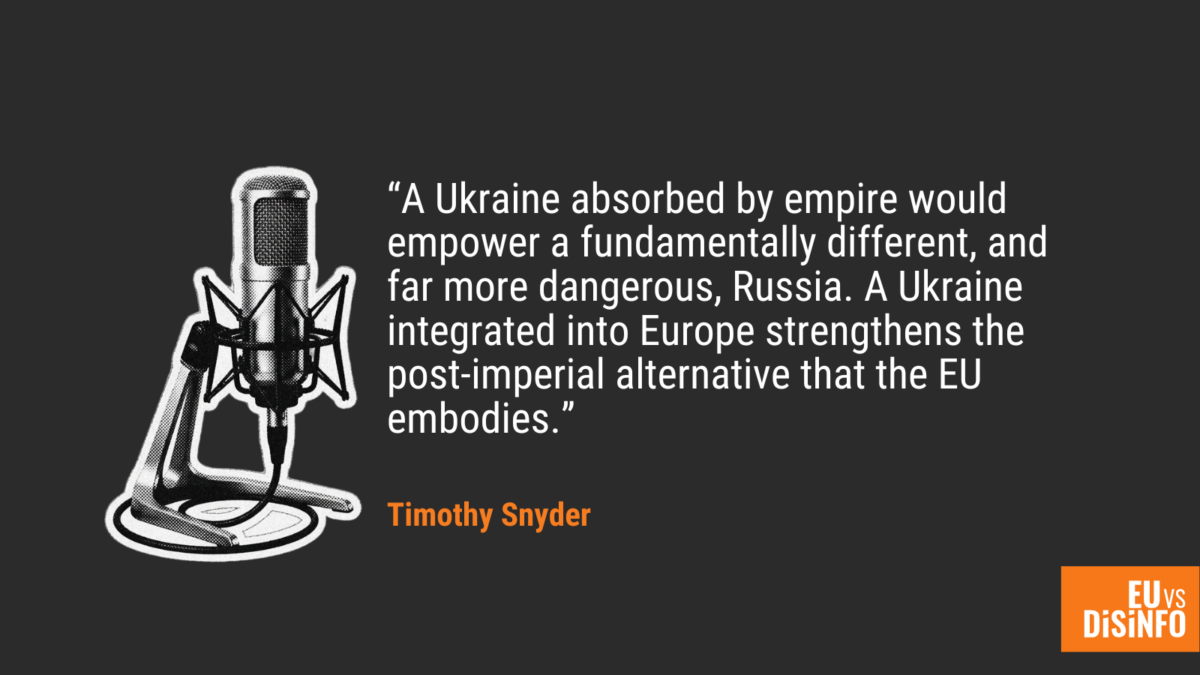
Ukraine represents a decisive fork in Europe’s future. A Ukraine absorbed by empire would empower a fundamentally different, and far more dangerous, Russia. A Ukraine integrated into Europe strengthens the post-imperial alternative that the EU embodies.
That outcome will not be achieved by abstract appeals to peace. It requires recognising imperial dynamics, dismantling myths of inevitability, confronting economic enablers of war, and accepting Europe’s own agency in history.
In that sense, the war is not only about Ukraine. It is about whether Europe understands what it is – and what it stands against.
[ad_2]
Source link
