
[ad_1]
One weapon in the hybrid arsenal Russia has deployed against Ukraine is the issue of religion. Russia has exploited the Orthodox Church to carry out various destructive actions on the ground, including through Foreign Information Manipulation and Interference (FIMI) campaigns.
Religion in Ukraine
Religion is a significant part of public life in Ukraine. According to the Kyiv International Institute of Sociology, about 70% of Ukrainians consider themselves Orthodox Christians. Two main Orthodox churches exist in the country. The Orthodox Church of Ukraine (OCU) was established in 2018 as an independent national church, uniting several previously separate Ukrainian Orthodox groups.The Ukrainian Orthodox Church (UOC), by contrast, has historical ties to the Russian Orthodox Church and has traditionally been subordinate to Moscow. The UOC rejects the legitimacy of the OCU, calling it schismatic. Since Russia’s full-scale invasion, many parishes have shifted their allegiance from the UOC to the OCU, accelerating a broader move towards religious independence from Moscow.
In 2022, the UOC attempted to publicly distance itself from Russia. However, these attempts proved unconvincing for both the citizens and the government of Ukraine. In August 2025, the State Service of Ukraine for Ethnopolitics and Freedom of Conscience confirmed that the UOC still maintained ties with the Russian Orthodox Church, whose activities in Ukraine were banned by law in 2024. According to Ukrainian legislation, the UOC was told to sever ties with the Russian Orthodox Church – but refused to comply with the order.
Hybrid actions on the ground
The history of cooperation between UOC clergy and Russian intelligence services began long before February 24, 2022. It was already commonplace and well known during the Soviet era. The Russian Orthodox Church and subordinate clergy in Ukraine operated under the supervision of the KGB. The secret services controlled the seminaries, influenced how the church hierarchy was formed, and forced clergy to break the seal of confession. After the collapse of the USSR, Moscow used the church both as a political tool at home and as an influence instrument abroad. In 2014, Crimean hierarchs of the UOC openly supported the Russian occupation of the peninsula. In the occupied territories of Donetsk and Luhansk regions, there are records of sheltering militants, blessing Russian weapons, cooperation with occupation administrations, or participation in persecution of representatives of other denominations.
In September 2022, at a ceremony in the Kremlin announcing the illegal annexation of four regions of Ukraine, three UOC hierarchs were present. In addition, a number of UOC figures fled to Russia and started openly cooperating with the Kremlin regime – they have all since been sanctioned by Ukraine. Altogether, from the beginning of the full-scale invasion in late February 2022 to November 2025, the Security Service of Ukraine has initiated 208 criminal proceedings against UOC representatives for anti-Ukrainian activities and other crimes.
The church and FIMI
Along with involvement in destructive kinetic actions in Russia’s interests, the UOC and organisations affiliated with it are involved in Russian FIMI. According to data from the Center for Strategic Communications, there is a system of information resources associated with the UOC interfering in Ukraine’s media space. These include both direct church resources and a system of formally independent ones, namely:
- The Union of Orthodox Journalists (internet sites, channels and pages on Youtube, TikTok, Telegram, Viber, Facebook, X, Instagram);
- net (internet sites, channels and pages on Telegram, Facebook);
- Myriany (channels and pages on Telegram, Facebook, Youtube)
- Pershyi Kozatskyi (channels and pages on Telegram, Facebook, Youtube, TikTok, X, Instagram);
- Telegram channels of Orthodox bloggers, anonymous Telegram channels.
The threat posed by these resources is obvious: they spread fakes and disinformation, provide manipulative interpretation of current events in Ukraine and the world, and promote propaganda masked as ‘religious’ narratives. The goal is to push a conspiratorial worldview in which a ‘church schism’ has occurred in Ukraine, and ‘Satanists controlled by the West’ in the Ukrainian government have began ‘religious persecution’ and unleashed a ‘fratricidal war’ against Russia. Accordingly, Russia is waging a ‘holy war’ to preserve true Christianity and to ‘reunify the triune Orthodox people,’ meaning Russians, Belarusians and Ukrainians.
Imposing such a paranoid worldview on the target audience fully corresponds with the Kremlin’s military-political goals. In particular, it is aimed at destabilising the internal political situation in Ukraine and encouraging ideologically motivated collaboration with Russia.
Changing the semantic field
In addition to traditional FIMI efforts, the media resources mentioned above have implemented a malicious strategy aimed at changing Ukraine’s semantic field, i.e. the related set of words grouped by meaning that refers to a specific subject (church and religion in this case). This is because they have ensured Russian terminology has infiltrated public discourse in Ukraine, with according Russian meanings. Information resources associated with the UOC have their own lexicon: stable, reproduced systematically and rooted in the corresponding narrative system and, deeper, in the concept of ‘Russkiy mir’ (‘the Russian world’). This ideology has long been used by Putin’s regime to justify external aggression, including against Ukraine. An important component of this ideology is Russian Orthodox messianism.
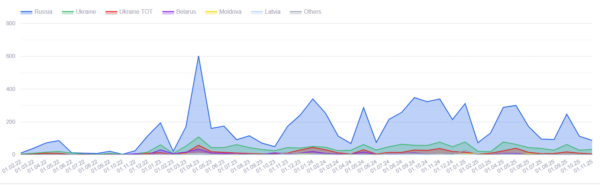
For example, as part of promoting the narrative about ‘church schism’ and ‘religious persecution,’ Russian FIMI calls parishioners and clergy of the OCU and other denominations ‘schismatics’ or ‘heretics’. This is clearly aimed at provoking religious conflict with Ukraine. Over 10,200 publications posted on 2,300 Telegram channels in Russian and Ukrainian between February 24, 2022 and November 1, 2025 have been identified, in which the term ‘schismatics’ was used regarding the OCU. The majority of the content (92%) was posted on Telegram channels that position themselves as Russian. The remaining 8% of the array were channels oriented toward a Ukrainian audience loyal to the UOC (Raskolam.net, Pershyi Kozatskyi, UOJ, Myriany, channels of ‘Orthodox bloggers’).

Intensity of use of the term ’schismatics’ regarding the OCU by Telegram channels between 2022 and 2025
This strategy is not only aimed at provoking internal conflicts in Ukraine, but also at dehumanising Ukrainians by using church terminology such as ‘demons,’ ‘demon-possessed,’ ‘Satanists,’ ‘antichrists,’ ‘godless,’ ‘sectarians’ in connection with the OCU. This vocabulary forms part of a component of the wider dehumanising/genocidal rhetoric targeting Ukraine and Ukrainians, used by Moscow.

Word cloud of dehumanising rhetoric in Russian and Ukrainian information spaces appearing in Telegram channels loyal to the ROC and UOC
From 60% to over 90% of identified cases of the use of this vocabulary over the specified period appear in the Russian segment of Telegram, the rest in resources oriented toward supporters of the UOC.

Intensity of use of dehumanising rhetoric regarding the OCU by Telegram channels between 2022 and 2025
This data confirms that resources connected to the UOC not only retransmit destructive narratives, but have also attempted to infiltrate Ukraine’s semantic field with hateful statements of Russian origin.
The bigger picture
The activities of the Russian Orthodox Church and organizations affiliated with it (both religious and secular) demand close attention. Ukraine is a kind of ‘testing ground’ where Russia has for years been exploring whether church structures could be used for hybrid interference, even in conditions of full-scale war.
At the moment, Russia is not expanding conventional combat operations beyond Ukraine. But the extremely high intensity of FIMI interference in the EU information space together with violations of the airspace of EU and NATO countries by Russian strike drones and the increase in sabotage activities in Europe, are all extremely alarming signals that cannot be ignored.
The church is a dangerous weapon in the hands of the Kremlin, as the issue of religious freedom is one of the fundamental values of the EU, protected by laws and customs. That is why it is vital not to allow Russia to exploit the church in its hybrid interference, to manipulate democratic values and principles.
The post How Russia weaponizes the church in Ukraine appeared first on EUvsDisinfo.
[ad_2]
Source link
