

Psychological science—particularly social psychology—is suffering an ongoing crisis of confidence. The field has endured a replication crisis stemming from the realization that many classic studies, when conducted again by different researchers, do not pan out. Similarly, I recently confessed that I no longer believe in research coming out of Harvard and several other top universities showing that doing a ritual improved performance on a subsequent skilled activity, such as karaoke singing or taking a math test (Vyse 2025). Two published studies in this line of research have subsequently been retracted; one because there was evidence the data had been fabricated—by whom, it is unclear—and in the other, the researchers discovered their positive results in one experiment were caused by a mistake in coding the data. Once the mistake was corrected, the positive results disappeared. Given the relatively meager literature on this ritual effect—most of it being done by many of the same people—these two blemishes were enough for me to return the effects of rituals to the “unproven” category. It was just another discouraging episode for the field.
Given this background, I was immediately intrigued when I spotted an article in The New Yorker titled, “Is Cognitive Dissonance Actually a Thing?” (Love 2025). The author’s conclusion seemed to lean in the direction of Betteridge’s law of headlines, “Any headline that ends in a question mark can be answered by the word no,” but as the title of this column suggests, I am here to say the answer should be, “yes.” Cognitive dissonance is still actually a thing.
The Boring Basics
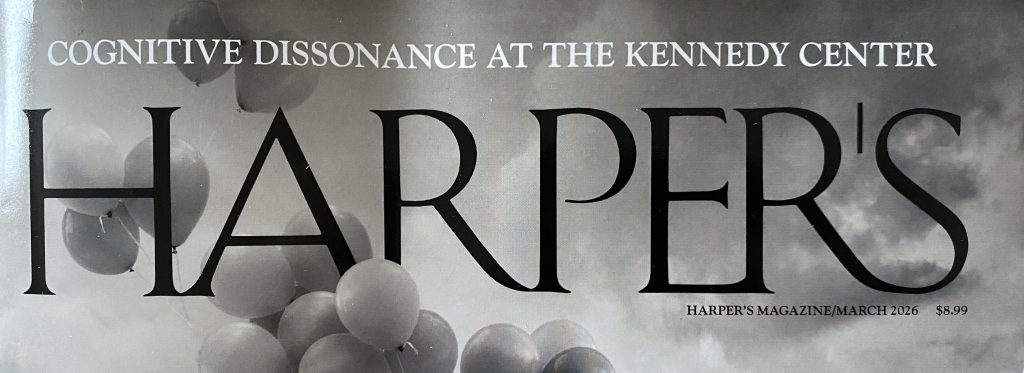
You have to admire Leon Festinger’s (1957) success in introducing the term cognitive dissonance. It has remained a popular phrase for almost seventy years, and it is hard to imagine anyone not having at least a vague sense of what it means. As I sat down to write this article, the latest issue of Harper’s magazine arrived with the banner “Cognitive Dissonance at the Kennedy Center” (see below). The phrase has come to represent any form of internal conflict, but Festinger’s theory is a bit more than that.
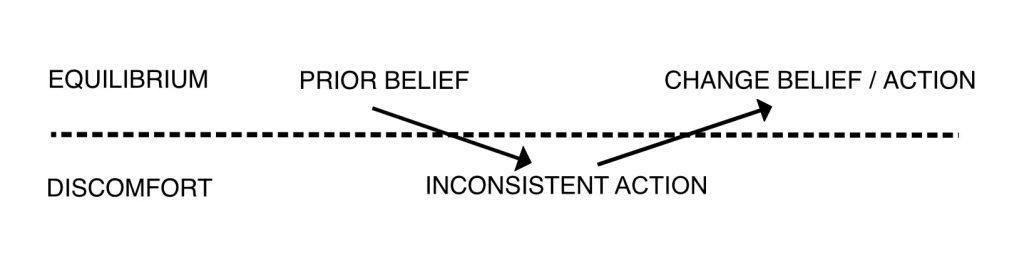
The theory of cognitive dissonance has been studied in several contexts, but in its most basic form, it is a three-stage process (see Figure 1). A person begins in a state of comfortable equilibrium with a set of prior beliefs, but due to coercion or some other circumstance, the person takes an action that is inconsistent with those beliefs. This conflict creates an internal state of discomfort—or dissonance—that the person resolves by changing their belief or, in some cases, reframing the action to make it less discrepant with their beliefs.
The classic experimental demonstration of cognitive dissonance was published by Festinger and James Carlsmith in 1959. Stanford university students were recruited to participate in an experiment that (unknown to them) was designed to be extremely boring. For example, given an array of blocks fastened to a board, the participants were asked to give each block a quarter turn. When all the blocks had been turned, they were asked to start again with the first block. Work on activities such as this continued for approximately an hour. After the task portion was completed, an experimenter asked the participant to go into the next room, where another student was waiting to start the experiment and, in exchange for some money, tell the new participant that the study was very interesting and they had really enjoyed it. The crucial variable was the amount of money paid to compensate for this lie. Some participants were paid $1, and others were paid $20. Finally, after they had completed their false advertising mission, they were asked some questions about what they really thought of the experiment. Figure 2 shows a diagram of this procedure.
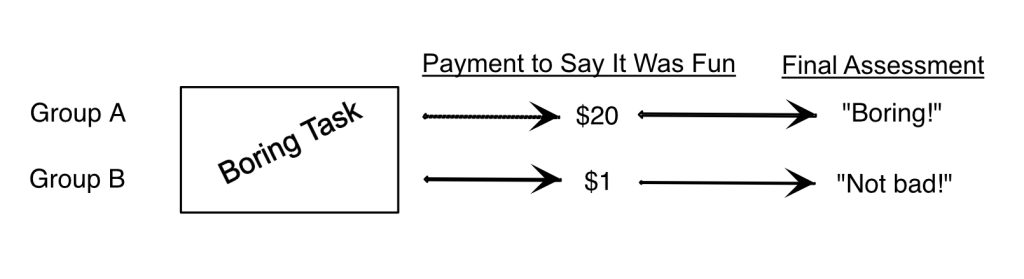
Based on the principle of reinforcement, one might expect the $20 group would have a more positive view of the study because they got a larger reward to say nice things about it, but in fact the $1 group rated the experiment significantly more enjoyable. According to the theory, the $1 group experienced greater cognitive dissonance because they were willing to say something that was inconsistent with their beliefs for a very small sum of money, and the best way for them to relieve their discomfort was to revise their opinion of the experiment upward: “It wasn’t that bad. In fact, I kind of enjoyed it.” In contrast, the $20 group had a greater justification for lying. They had been paid handsomely to do so.
In hindsight, this study had rather weak results, a small sample size, and somewhat casual methodology, but many other studies have found similar results (Harmon-Jones and Mills 2019). For example, in another classic study, researchers found that, when severe initiation process was required to join a group, people found the group more enjoyable (Aronson and Mills 1959). After all, why would you endure a difficult initiation process unless the group was worth it? Other researchers have questioned the mechanism behind the phenomenon. For example, Daryl Bem (1967) offered an alternative account in his “self-perception theory,” proposing that internal discomfort is not the mechanism involved. Instead, people might look at themselves as an outsider and come to the appropriate conclusion, either: 1) “I said I liked it because I was paid $20” or 2) “I was only paid $1, so I must have enjoyed the task.” Despite these questions about how cognitive dissonance works, until recently the basic phenomenon of updating your beliefs in the face of conflicting action has not been seriously challenged. Recently, however, two events have struck blows to cognitive dissonance theory.
Another Replication Failure
The first of these attacks was of a familiar form: modern researchers using updated methods attempted to recreate the results of a classic cognitive dissonance study and failed (Vaidis et al. 2024). This is the standard stuff of the replication crisis in psychology and other disciplines. The study in question had college students writing in favor of a policy—in this case banning alcohol from campus—that they personally opposed (Croyle and Cooper 1983, experiment 1). In this case, the crucial variable was the degree to which that choice to write in favor of the policy they opposed was freely made. This was accomplished by reminding one group of participants that their involvement in the study was completely voluntary and they could quit at any time. Another group performed the same exercise but was not given the free choice reminder in advance. As expected, the group that had been reminded their participation was voluntary showed a greater shift in their attitude in the direction of banning alcohol from campus.
The replication study failed to find a difference between the higher choice and lower choice groups, but the researchers also included a control group who wrote on a neutral, unrelated topic. In what might be considered partial support for cognitive dissonance, the groups who wrote in favor of the policy they disagreed with showed a greater movement toward that policy than those who wrote on a neutral topic. Nonetheless, the authors of the new study considered their findings a blow against the original study. To some degree it was, but there are several reasons to be dubious about this new study, as well. The methods used in the replication were quite different. For example, although they used a large number of participants (4,898), the study was conducted in thirty-nine different laboratories, nineteen different countries, and fourteen languages. The final publication had 107 authors. Such an enormous project raises many questions about quality control across laboratories. In addition, the overwhelming number of labs asked the student participants to write in favor of raising tuition, which seems to me to be a much less defensible topic than banning alcohol from campus. These and other choices made by the replication team raise questions for me. Two psychologists quoted in The New Yorker article also questioned the quality of the replication study.
When Narrative Fails
 The second recent blow to cognitive dissonance is of a different type. Even before he published his book on cognitive dissonance or the classic block turning study, Festinger and two colleagues published a remarkable book titled When Prophecy Fails, which quickly became a classic of psychological literature (Festinger et al. 1956). Festinger and his colleagues heard about Dorothy Martin (called “Marian Keech” in the book), the leader of a small UFO religious group who predicted the world would end by apocalyptic flood just before dawn on December 21, 1954, but that her followers would be spirited away to safety by aliens in flying saucers. Festinger and his two coauthors—Henry Riecken and Stanley Schachter—predicted that when believers were deeply committed to such a doctrine and had social support, they would cling to their belief system, even doubling down and seeking out more converts. Anxious to determine if their prediction would be supported, the authors and several paid research assistants joined the group without revealing that they were observers. The resulting book is very entertaining, and according to the authors, their predictions were largely confirmed. Like many psychology students, I read the book decades ago and found it fascinating.
Unfortunately for the story, new information has come to light, and it appears that things were not as presented by Festinger, Riecken, and Schachter. Using newly uncovered notes from the University of Michigan archives, Thomas Kelly (2026), an independent scholar, found evidence that, rather than merely observing, several members of the research team actually steered the events of the story and that the three authors seriously misrepresented what happened. For example, to accentuate the predicted burst in proselytizing after the failure of the apocalyptic prediction, Kelly showed that the authors underrepresented the degree of recruiting the group did prior to the appointed date. In addition, while undercover in the group, Henry Riecken told other members, including Martin, that he had received psychic messages from the space aliens. Finally, Kelly provided evidence that, contrary to the predictions of Festinger’s cognitive dissonance theory, most adherents did not stay faithful to group. Martin remained a Spiritualist but downplayed her prediction of the end of the world. Some members remained in touch with Martin and gave her personal assistance, but the evidence shows they quickly rejected the beliefs associated with the group.
As I suggested in a recent column, for a writer, the allure of a good narrative can be the death of truth (Vyse 2026). Furthermore, although participant observation is still a popular research method, particularly in sociology and anthropology, it brings many ethical and scientific problems (Musante and DeWalt 2010). In the case of When Prophesy Fails, it is now obvious that the authors and their research assistants were not mere observers. But Kelly does not indict participant observation as a methodology. Instead, he suggests “The real failure lies in mistaking vivid narratives for accuracy, and confident, theatrical performances for reliable observation” (Kelly 2026, 13). Unfortunately, this is far from the only classic narrative in psychology to fall victim to embellishment or fabrication. The Kitty Genovese story of failed bystander intervention during an emergency and the story of John B. Watson’s conditioning experiment with “Little Albert” were both substantially altered in light of new information (Harris 1979; Manning et al. 2007). Now When Prophesy Fails can be added to the list of classic psychology narratives that were more fiction than reality.
Cognitive Dissonance about Cognitive Dissonance
So, shall we update our beliefs about cognitive dissonance or, like the fictionalized characters of When Prophesy Fails, cling to or even double down on our belief in cognitive dissonance? Doubling down is not a good idea, but despite these two blows to the theory, there is plenty of evidence that the basic pattern of adaptation shown in cognitive dissonance research is real. There is now a research literature spanning several decades, and in 2019, the American Psychological Association published the second edition of a book summarizing and evaluating the cognitive dissonance research to date (Harmon-Jones 2019). As mentioned above, there is still considerable debate about the mechanism underneath the behavior. Is it caused by a sense of discomfort, as suggested by Festinger (1957), by self-observation, as proposed by Bem (1967), or by one of several other alternative explanations? There is enough intellectual fuel here to occupy many academic careers.
One of the ways we judge the usefulness of a theory is to see whether it leads to new research. Somewhat remarkably, after almost seventy years, cognitive dissonance theory continues to inspire new areas of investigation. For example, researchers are currently using cognitive dissonance theory to study consumer behavior that comes with moral burdens, such as eating meat or buying products whose manufacturing involved unfair labor practices (Loughnan et al. 2014; Kim et al. 2025). Many of us experience these dilemmas every day. So, despite the revelations about When Prophesy Fails and a failure to replicate a classic experiment, cognitive dissonance continues to be a useful concept. As a result, in my view, the answer to the New Yorker magazine’s question seems clear: “Yes, cognitive dissonance is still actually a thing.” In the world of journalism, it would be a more exciting and clickable narrative if the answer were “no,” but that’s the problem with narrative. Sometimes the truth—like turning blocks one quarter of a turn—is just boring.
References
Aronson, Elliot, and Judson Mills. 1959. The effect of severity of initiation on liking for a group. Journal of Abnormal and Social Psychology 59(2): 177–181.
Bem, D.J. 1967. Self-perception: An alternative interpretation of cognitive dissonance phenomena. Psychological Review 74: 183–200.
Croyle, R.T., and J. Cooper. 1983. Dissonance arousal: Physiological evidence. Journal of Personality and Social Psychology 45(4): 782–791.
Festinger, L. 1957. A Theory of Cognitive Dissonance. Stanford, CA: Stanford University Press.
Festinger, Leon, and James M. Carlsmith. 1959. Cognitive consequences of forced compliance. Journal of Abnormal and Social Psychology 58: 203–210.
Festinger, Leon, Henry W. Riecken, and Stanley Schachter. 1956. When Prophecy Fails. New York, NY: Harper Torch‐Books.
Harmon-Jones, E. (ed.). 2019. Cognitive Dissonance: Reexamining a Pivotal Theory in Psychology (2nd ed.). Washington, DC: American Psychological Association.
Harmon-Jones, E., and J. Mills. 2019. An introduction to cognitive dissonance theory and an overview of current perspectives on the theory. In E. Harmon-Jones (ed.), Cognitive Dissonance: Reexamining a Pivotal Theory in Psychology (2nd ed.). Washington, DC: American Psychological Association, pp. 3–24.
Harris, Ben. 1979. Whatever happened to Little Albert? American Psychologist 34(2): 151–60.
Kelly, Thomas. 2026. Debunking “When Prophecy Fails.” Journal of the History of the Behavioral Sciences 62(1): 1–15.
Kim, Jiyoung, Kiseol Yang, and Jihye Min. 2025. Exploitation of Third World labor and consumer moral response: Investigating the attitude‐behavior gap through cognitive dissonance and moral disengagement. Journal of Consumer Behaviour 24(6): 2931–2947.
Loughnan, S., B. Bastian, and N. Haslam. 2014. The psychology of eating animals. Current Directions in Psychological Science 23: 104–108.
Love, Shayla. 2025. Is cognitive dissonance actually a thing? The New Yorker (December 17). Online at https://www.newyorker.com/culture/the-lede/is-cognitive-dissonance-actually-a-thing.
Manning, Rachel, Mark Levine, and Alan Collins. 2007. The Kitty Genovese murder and the social psychology of helping: The parable of the 38 witnesses. American Psychologist 62(6): 555–562.
Musante, Kathleen, and Billie R. DeWalt. 2010. Participant Observation: A Guide for Fieldworkers. Lanham, MD: AltaMire Press.
Vaidis, D.C., W.W.A. Sleegers, F. van Leeuwen, et al. 2024. A multilab replication of the induced-compliance paradigm of cognitive dissonance. Advances in Methods and Practices in Psychological Science 7(1): 1–26.
Vyse, Stuart. 2025. Maybe, do stop believing—in rituals. Skeptical Inquirer 49(2) (March/April): 33–35.
———. 2026. Will narrative defeat reason? Skeptical Inquirer 50(3), 12–14.
