
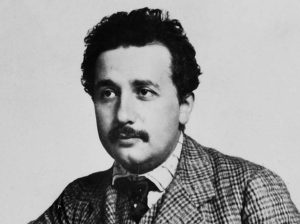
 In May 2025, a new gospel was preached on the internet. Albert Einstein supposedly had endorsed Buddhism in a 1954 interview, claiming he had scientific proof of a kind of afterlife with reincarnation. Over fifty versions of this gospel appeared, many of them resembling AI-generated memes.
The YouTube channel “Secrets of the Beyond” has attracted almost a million views with their version. Almost half the others just paraphrase this version. The others are wildly different, some even including the Men in Black. I won’t even address the ludicrous double bottom of Einstein’s friend’s safe or how an interview that lasts until dawn results in less than fifteen minutes of text.
Alexious Fiero (2025) gave reasons these stories are bogus. However, the most damning thing is that the fake Einstein says things that a physicist would never say. For example, he compares human life to a wave in the sea. When the wind stops, the wave disappears, but the water remains. And the wave actually still is there because of conservation of energy. Rubbish, nonsense, and poppycock. Waves, once created, continue. Waves in water eventually do disappear by friction, the ones with short wavelengths first. They convert to heat. This new gospel of Einstein seems to entertain the New Age idea that the lifeforce or consciousness is some kind of energy, hence it cannot be destroyed. Any real physicist would know that entropy always goes up. Life is a low entropy state, maintained through lavish energy expenditure, and at death entropy irreversibly wins. Not only at our own death but at every death since the first living cell on earth.
Then “Einstein” talks about his own equation, which supposedly shows that mass and energy are equivalent. Einstein knew better than anybody that mass is merely one property of matter, namely the fixed ratio between force and acceleration. His famous formula comes from a thought experiment showing that for an atom with a bit (E) more electromagnetic energy this ratio necessarily must be a tiny bit more, namely E/c2, than for an ordinary atom.
When the fake Einstein said that he arrived at his convictions not by studying physics but by examining the mathematical structures of time and space, I cringed. Examining the mathematical structures of time and space is one of the things theoretical physicists do.
The real Einstein was a realist: the Moon is there even when you don’t look at it. That conscious observers are necessary for doing quantum mechanical experiments is nonsense. In fact, all this observing is done by complicated machines. But the fake Einstein says that the observers create reality. The fake Einstein also thinks entanglement means that particles that have been in contact remain connected. But no physicist—let alone Einstein—would think that communication faster than light is possible, and bluntly asserting that entanglement proves that consciousnesses also communicate instantaneously is even more absurd.
The fake Einstein proposes that brains are just antennas that receive “consciousness” from the ocean of consciousness. Certainly the real Einstein would know that consciousness, whatever it is, involves awareness of both actual sensory input and memory of past input. The analogy offered (of a radio station that keeps broadcasting when one receiver is broken) is fundamentally flawed.
The fake Einstein talks nonsense about physics. That by itself proves all these different stories are just misinformation made up by writers with a religious agenda. That’s because we know what the real Einstein thought.
Reference
Fiero, Alexious. 2025. Einstein’s “banned afterlife interview”: Separating myth from reality. Intellectual Enlightenment Magazine (May 10). Online at https://magazine.intellectual-enlightenment.com/einsteins-banned-afterlife-interview-45f2e900d5c2.
