
[ad_1]

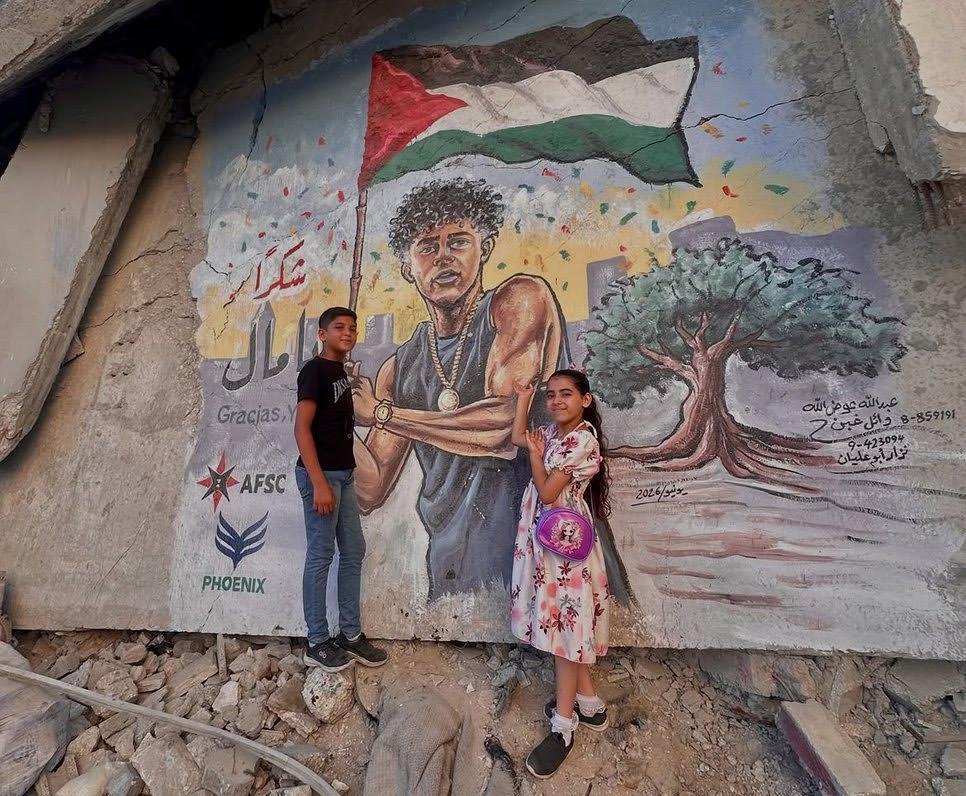
Photograph Source: Creative Commons of Gaza
In memory of Mohammed al-Wahidi and the countless aid workers murdered by the genocidal Israeli Occupation Forces.
As billions tune in to the 2026 FIFA World Cup, co-hosted by the United States, Canada, and Mexico, the beautiful game has once again exposed the ugly truth of global power. While FIFA and its corporate sponsors desperately try to keep the spectacle “apolitical,” fans, players, coaches, and public figures have turned stadiums and streets into platforms of defiance. Palestinian flags wave, “Free Palestine” echoes through the stands, and Israel’s ongoing genocide in Gaza remains impossible to ignore.
The message from the terraces is unmistakable: sport cannot be separated from politics when children are being slaughtered and entire families erased. Spain has distinguished itself as one of the strongest European voices for Palestine. The country has imposed sanctions on Israel and broken diplomatic ties in response to the genocide in Gaza. This principled stance has made the Spanish team a clear favorite among Palestinian supporters as they face Argentina in the final of the 2026 World Cup.
Oscar-winning actor Javier Bardem created one of the tournament’s defining images when a Palestinian supporter handed him a flag during Spain’s match against France. Bardem held it high, declaring “Existence is resistance,” “Free Palestine,” and “Spain stands with Palestine.” Spain’s teenage superstar Lamine Yamal added to the symbolism. The Barcelona phenom previously went viral for waving a Palestinian flag during his club’s La Liga victory parade. Other Spanish players have also expressed solidarity with Palestine and opposition to the genocide.
In response, Israeli officials — including the defense minister — launched a vicious smear campaign against the 18-year-old Yamal, accusing him of “inciting hatred” and trying to turn global opinion against Israel. The spectacle of a powerful state bullying a teenage football prodigy only made Israel look more diabolical and unhinged in the eyes of the world.
Egyptian coach Hossam Hassan has been outspoken in his solidarity with Palestine and against the genocide in Gaza. He waved a Palestinian flag after his team’s penalty-shootout victory over Australia, dedicating the win to “the Egyptian people, the Palestinian people, and the Arab people.” In Gaza, Palestinians celebrated the result as their own. Hassan has repeatedly used his platform at press conferences to highlight the humanitarian disaster in Gaza and urge global football to do more for the Palestinian cause.
In Gaza, these moments of celebration were cut short. Palestinians turned out in large numbers to pay their respects to Mohammed al-Wahidi, a senior member of Egypt’s main aid organisation (the Egyptian Relief Committee) who had set up public World Cup screenings on the rubble of Gaza, allowing residents to gather amid the destruction and watch the matches together. On the eve of Egypt’s match against Argentina, Israel carried out a targeted killing of al-Wahidi — himself a Palestinian — striking the taxi he was in. The attack also killed three others, including two young passers-by (siblings aged 10 and 8) in the Sabra neighbourhood of Gaza City. His murder stands as a grotesque reminder of the daily brutality Palestinians endure even as they seek moments of collective humanity through the game.
Bosnia and Herzegovina supporters have delivered some of the tournament’s most passionate displays of solidarity. Drawing on their own traumatic history of surviving the Srebrenica genocide and the ethnic cleansing of the 1990s — in which over 8,000 Bosniak men and boys were massacred in a single week — fans from Bosnia and Herzegovina have been among the most vocal and visible contingents waving Palestinian flags and chanting in support.
Norway has gone further than most with concrete action. In October 2025, ahead of a World Cup qualifier against Israel, the Norwegian Football Federation donated all ticket revenue from the sold-out match (which Norway won 5-0) to emergency medical aid in Gaza via Doctors Without Borders. They supplemented this with additional funds from the federation and a sponsor, bringing the total donation to approximately 4.5 million Norwegian kroner (around $420,000). That principled stand has resonated throughout the 2026 tournament, where Norwegian fans continue chanting “Free Palestine.”
This outpouring of solidarity — with fans and teams from more than a dozen countries including Spain, Egypt, Bosnia and Herzegovina, Norway, Türkiye, Morocco, Algeria, Senegal, Iran, Scotland, and others — comes amid deepening controversies surrounding FIFA and the tournament itself. Accusations of match-fixing, biased refereeing favoring teams from the Global North and clear FIFA favorites like Argentina, and the terrible treatment of Iran have circulated widely, with many in the Global South claiming the deck is stacked against them. Adding to the cynicism is the heavy shadow of Donald Trump’s influence over the U.S.-hosted event, including reported interference in visa decisions, politicization of the tournament, and even the successful overturning of a red card after his direct request.
Despite these power plays, the solidarity extends far beyond individual nations. Supporters from Türkiye, Morocco, Algeria, Senegal, Iran, Scotland, and elsewhere have filled stadiums and public squares with Palestinian flags and protest. FIFA’s attempts to police “politics” have proven futile against this organic wave from below. Israel, meanwhile, finds itself increasingly isolated on the world stage as global public opinion turns sharply against its genocidal campaign in Gaza.
While the final between Spain and Argentina remains to be played, the real victory already belongs to those refusing silence. From Bardem and Yamal to Hassan, Bosnia and Herzegovina fans, Norwegian organizers, and thousands of ordinary supporters — including the memory of Mohammed al-Wahidi — the 2026 World Cup has shown that solidarity with Palestine is loud, visible, and unstoppable.
In the shadow of genocide, the world’s most popular sport has become yet another arena where the Palestinian struggle asserts its humanity. Existence is resistance — and in these stands, that resistance is prevailing.
[ad_2]
Source link
