
[ad_1]
In one of the scariest moments in modern history, we're doing our best at ScheerPost to pierce the fog of lies that conceal it but we need some help to pay our writers and staff. Please consider a tax-deductible donation.
The USDA’s cancellation of a $300 million grant program has stalled land purchases, training programs, and local food projects intended to support young, first-generation, and underserved farmers
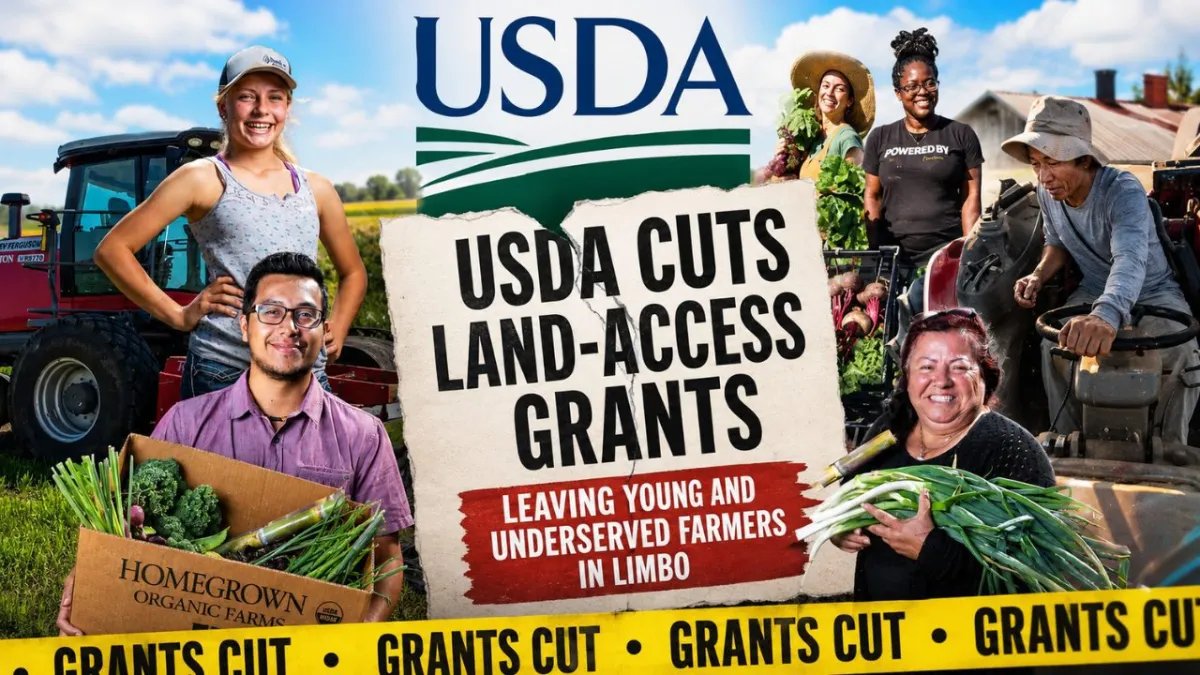
The U.S. Department of Agriculture (USDA) has slashed a $300 million grant program designed to help underserved farmers access land, capital, and training, putting roughly 50 projects across 40 states and territories at risk of collapse.
For young, first-generation, and community-based producers, the cuts threaten planned farmland purchases, training programs, and the local food networks those projects were meant to build. The terminated program—Increasing Land, Capital, and Market Access Program (ILCMA)—funded farmer associations, nonprofits, tribal governments, and universities planning to distribute support directly to producers in their communities.
The decision comes as U.S. farmers face mounting financial pressure from trade disputes, stalled Farm Bill negotiations, and proposed USDA budget cuts. Meanwhile, the average American farmer is approaching 60 years old, and American Farmland Trust has estimated that one-third of U.S. farmland will change hands over the next two decades.
USDA and the Farm Service Agency did not respond to requests for comment in time for publication.
“Every community struggles with land access, access to capital, access to market, but it all shows up differently,” said Amanda Koehler, an urban farmer who served as land policy associate director for the National Young Farmers Coalition at the start of the grant. “That is why this program was so important: They were community-based programs that matched their local, regional needs.”
Koehler, who runs an urban farm in St. Paul, Minnesota, said projects included down payment assistance, low-interest farmland loans, incubator farms, and training programs for early-career farmers. The termination, she said, leaves no clear replacement.
“We are seeing so many young people and first-generation producers essentially begging to farm, but the barriers are almost insurmountable,” Koehler said. “Young people like me cannot compete with developers or well-established farmland owners for the cost of land, which will almost certainly exacerbate farmland consolidation and farmland loss.”
Local projects stall in Miami
One affected project is The Commons Network, an initiative housed under the Urban Oasis Project in Miami. The collective of farmers, agriculture educators, and food system stakeholders designed a program that included apprenticeships, public workshops, shared tool libraries, marketing support, and microgrants ranging from $500 to $2,500.
“It was going to build entrepreneurship in Miami around local food and food security that not only benefits disadvantaged people, but everyone in Miami,” said Katrina Morris, one of 18 board members with The Commons Network.
The project received only about 16% of its $2.5 million allocation for their five-year plan before funding was cut, according to Art Fraser, executive director of Urban Oasis Food Project.
“We’ve been trying to create a local food movement in Miami for the last 16 years,” said Fraser. “Our original plan was to buy some land, have a couple of anchor farms established, and create an apprenticeship program which would lead into a land lease program.”
But the project was delayed from the start. The grant was awarded in fall 2023, but funding was not released until November 2024, according to Fraser. During that year, project leaders developed plans, completed federal training requirements, and prepared to launch without knowing when the money would arrive.
“We were on pins and needles the whole time,” Fraser said. “My two co-directors were supposed to be hired for 20 to 30 hours a week; they had to be ready to quit their jobs and jump into this as soon as the money was released.”
It’s like we’re seedling plants, and now they’ve plowed the field and said it’s not going to happen.Art Fraser, executive director of Urban Oasis Food Project
When the funds were finally released, work began quickly, Fraser said, only to stall again in January 2025, when the program was frozen following the start of the Trump administration. What followed was a series of funding freezes, delayed payments, red tape, and bureaucratic delays leading up to the program’s termination in March. The program’s website has since been deleted.
“One of the biggest reasons they’ve cited for canceling [the grant] was preventing waste,” Fraser said. “But this is the biggest waste: to have all of us spend four years putting all the structures in place, doing all the groundwork, and then it’s like we’re seedling plants, and now they’ve plowed the field and said it’s not going to happen.”
Apprenticeships left unfinished
A central component to The Commons Network was a paid apprenticeship program that weaved small-scale farms from Homestead to Broward County into a structured training system for new farmers. The program included six months of agriculture curriculum, reporting systems, and hands-on farming experience at various farms throughout South Florida. A pilot partnership with Dunn’s Overtown Farm was designed to train young and emerging farmers in an urban setting.
One of these novice farmers is Daniel Colson, 32, who interns with Dunn’s Farm.
“I’ve been learning about plant cycles … construction, administrative work, plant identification, soil types,” Colson said. “It’s the soil that’s interesting to me, how it works, and how difficult it can be sometimes.”
Dunn’s Overtown Farm specializes in crops unique to South Florida, from jalapeños and sugarcane to fruit trees like mangoes, coconut, and banana. But without the funding, Colson said the resources to continue his agriculture education are limited.
“The termination of this policy reduces the entire economic development of the whole sector,” said Giovan Barthole, a Commons Network board member and volunteer coordinator at Dunn’s Overtown Farm. “You can’t build a life when [the funding for] your five-year plan and your 10-year plan … can be terminated.”
Barthole said that without a similar apprenticeship opportunity, he would not be where he is today. Without this program, agriculture students and early-career farmers lost internships and access to training from growers and producers experienced at navigating South Florida’s food systems.
Despite the setback, the project’s leaders responded to the cut with resilience.
“It’s a bait and switch, and unfortunately a lot of us are already used to that,” said Chrys Salmon, founder, chef and farmer at Dunn’s Overtown Farm. “[But] we haven’t missed a beat. It shows how strong communities can build together.”
DEI attacks stunt growth
In March termination letters, Farm Service Agency’s Associate Administrator Steven Peterson said the program “involved discriminatory preferences based on Diversity, Equity and Inclusion,” also known as DEI.
The decision mirrors broader efforts by the administration to eliminate federal programs tied to DEI initiatives. However, grantees say the impact extends beyond race-focused programs and extends to migrant, poor, and veteran farmers.
“There are some organizations now that won’t work specifically with farmers like me in the communities we are in because we won’t compromise on our verbiage,” Salmon said. “I don’t care how much money you have, I’m not going to say that I’m not Black and I’m not serving Black people. That’s exactly what I’m doing, that’s why I’m here.”
A lawsuit filed by 21 attorneys general argues that the USDA’s new funding conditions violate constitutional spending rules and unlawfully target DEI, gender, and immigration issues by attaching ideological strings to basic federal support.
Grantees say they were awarded with pride and excitement from the Biden administration. Many program officers assigned to projects were laid off early in the current administration, leaving applicants without guidance or support.
“The irony is that the whole premise of them creating this program is to do exactly what we were doing; we followed every single rule to the T,” said Salmon. “Now they’re telling us, ‘Oh, you did all these things? Well now you’re disqualified.’”
Uncertain future for land access
Advocates say these projects are desperately needed in a country where farmland has become more expensive.
“Producers are suffering real consequences right now,” said Koehler, the urban farmer in Minnesota. “They were relying on the program for farmland downpayment assistance, low-interest loans, technical assistance, and many important services. Folks were finally ready to roll out the biggest parts of their program and then terminated.”
While a goal of purchasing farmland sounds good on paper, The Commons Network argues that the brilliance of the grant was that it recognized the need for more resilient food systems that shift away from industry-dominated supply chains, monocrop culture, and excess pesticide use. Instead of funneling resources into the agriculture industry, the grant directly empowered socially disadvantaged farmers at the core of these communities.
“The government has a very tight control over who owns land and who does not own land, and unfortunately a great majority of farmers in this country are not landowners,” said Salmon. “My hope is that one day we can continue to mend that bridge [and] allow other communities to see that they need to be as resilient as we are. We cannot depend on the government.”
Editorial Team:
Alexandra Martinez, Lead Editor
Lara Witt, Top Editor
Rashmee Kumar, Copy Editor
Kat Grimmett is a writer, educator and herbalist. As a South Florida native, her work explores community-based solutions to issues regarding the food system, environment and urban development.
Editor’s Note: At a moment when the once vaunted model of responsible journalism is overwhelmingly the play thing of self-serving billionaires and their corporate scribes, alternatives of integrity are desperately needed, and ScheerPost is one of them. Please support our independent journalism by contributing to our online donation platform, Network for Good, or send a check to our new PO Box. We can’t thank you enough, and promise to keep bringing you this kind of vital news.
You can also make a donation to our PayPal or subscribe to our Patreon.
Please share this story and help us grow our network!
[ad_2]
Source link
