
[ad_1]
Each year, the Census Bureau publishes population estimates for all municipalities in the U.S. with a population of 20,000 or more. Last week, it released last year’s estimates, reporting population changes for nearly 2,000 municipalities.
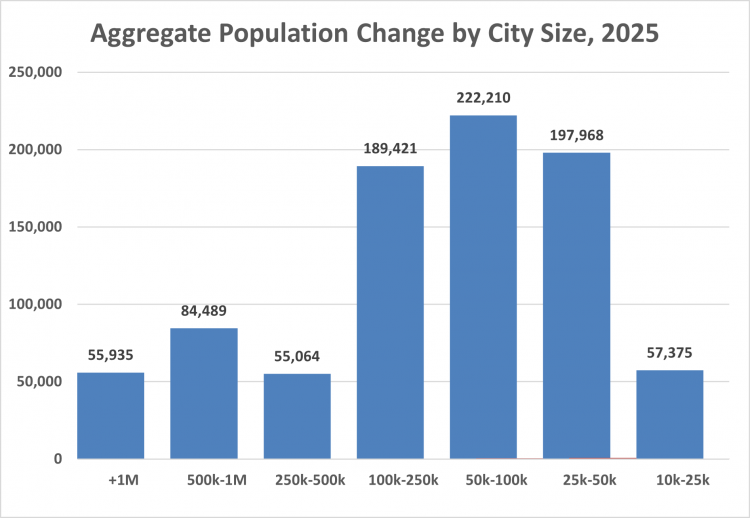
According to the Census Bureau, the US population grew by 1.8 million last year, mostly due to international immigration. The twelve U.S. cities with populations over one million grew by only 55,000 people last year, or about two-tenths of one percent (0.2%). They contributed less than 3% of the total growth in the U.S. last year. The diminutive contribution of urban cores to total U.S. population growth is nothing new and has remained at about 3% since 2020.
According to the same data, only about half of last year’s total population growth occurred in cities with populations over 20,000. However, that does not imply that half the growth occurred in rural areas, although rural areas have experienced a net migration inflow since the pandemic. The bulk of the growth has occurred in smaller cities and unincorporated areas either adjacent to or in close proximity to larger cities.
The census data showed that the bulk of growth occurred in cities with populations between 25,000 and 250,000.
Bill King
For roughly the last 10,000 years, the basic logic of cities has been rooted in the advantages of concentration. As agriculture produced food surpluses, people no longer needed to live spread across the land to survive. This trend was greatly accelerated in the U.S. during the first half of the 20th century by the mechanization of agriculture. Living close together reduced transportation costs, improved security, facilitated trade, and allowed for specialization of labor. Cities became places where merchants, craftsmen, rulers, soldiers, scholars, and later industrial workers could interact more efficiently than if they were dispersed. The density of people and activity also accelerated the exchange of ideas, innovation, and culture.
However, many of the traditional advantages of cities have begun to wane because the technologies that once made physical proximity essential have steadily reduced the importance of location. Automobiles, highways, air travel, telecommunications, and now high-speed Internet and remote work allow people to access jobs, goods, services, entertainment, and information without living in dense urban centers.
The pandemic accelerated this shift by demonstrating that many jobs could be performed remotely with surprisingly little loss of productivity. Millions of workers and employers discovered that daily proximity to downtown offices was often less necessary than previously assumed. The modern economy increasingly rewards digital and knowledge-based work that can often be performed from almost anywhere, weakening the historic link between economic opportunity and urban density. The result has been a centrifugal force that has spun growth out from the urban cores to the suburbs and, increasingly, the exurbs.
The long-term trend probably favors continued decentralization, though not the complete abandonment of cities. The underlying technological forces reducing the need for physical proximity will continue to advance. Remote and hybrid work technologies are improving, broadband access is expanding, and many businesses have adapted their operations around distributed workforces. Artificial intelligence and digital collaboration tools may further weaken the advantages of geographic concentration for many occupations.
At the same time, affordability and quality-of-life concerns remain significant pressures pushing people and businesses outward. Most urban core cities also face aging infrastructure, fiscal pressures, and governance challenges.
That said, cities are unlikely to disappear because they still retain important advantages in certain sectors and activities. Innovation, finance, entertainment, higher education, medicine, and entrepreneurial ecosystems still benefit from face-to-face interaction and dense professional networks. Large cities also offer cultural amenities and social opportunities that cannot be fully replicated online. The more likely outcome is not the death of cities, but a gradual erosion of the dominance of the largest and most expensive urban cores, accompanied by growth in smaller cities, suburbs, exurbs, and lower-cost metropolitan regions. In that sense, the trend is less about the end of urbanization than about the weakening of the historic premium attached to extreme urban density.
[ad_2]
Source link
