
[ad_1]
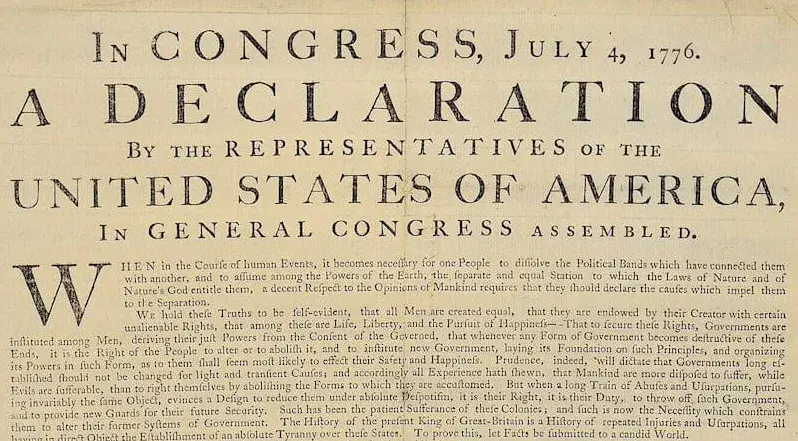
On the 250th year since U.S. independence was declared, many are thinking of new forms of independence. This piece proposes a Declaration of Moral Independence from Empire, naming empire as the enemy and the fundamental struggle as moral. It leave open the possibilities for different political outcomes, including a post-imperial U.S. and autonomy of bioregions and states, either in confederation or fully independent.
“A whole civilization will die tonight, never to be brought back again.”
Position the imperial death star, commands the demented emperor.
Fortunately, Trump almost immediately did a TACO from his April 7 message, pulling back with announcement of a two-week ceasefire with Iran. No doubt, the implications of an apocalyptic attack on that nation would have been destruction of much Persian Gulf oil and gas infrastructure. It would have disrupted supplies for months and years in a way even more devastating that the current Hormuz bottleneck.
Trump’s words recall that famous statement by George Lucas to fellow director James Cameron that when he conceived the Rebel Alliance in Star Wars, he had the Viet Cong in mind. If the Rebel Alliance was the Viet Cong, who was the Evil Empire?
In the 60s and 70s, the U.S. mercilessly bombed Vietnam and neighboring countries. It was the act of an Evil Empire as sure as any. But in those days, outside of a lefty fringe, it was still beyond the boundaries of polite conversation to refer to the U.S. as an empire. Later, in the “unipolar moment” of the 1990s and 2000s, it became more acceptable, even celebrated.
“We’re an empire now, and when we act, we create our own reality,” George Bush advisor Karl Rove said in 2004. “And while you’re studying that reality — judiciously, as you will — we’ll act again, creating other new realities, which you can study too, and that’s how things will sort out. We’re history’s actors . . . and you, all of you, will be left to just study what we do.”
The reality that the U.S. is an empire is now a commonplace, a terminology widely used across the political spectrum. A declining empire, perhaps, but a globe-spanning hegemon nonetheless. Yet many U.S. of Americans have assumed it is overall still a force for good in the world. That illusion has been shattered in recent years, first by the complicity in Israel’s genocide of Gaza, then by the preemptive U.S.-Israel war against Iran, a clear violation of international law. The evils of empire are out in the open now.
But the U.S. as an empire perpetrating many great evils goes back a long way, even to its precursor stages as English colonies on the Atlantic coast. The wars to seize lands from native tribes began almost from first settlement. The occupation of many of those lands by slave-based agriculture revved up not too long after.
The creation of the U.S. in the revolution of 1776 is surrounded by a mythology of freedom from a tyrannical king. Certainly democratic sentiments were rising from the population. But the leaders were a colonial ruling class that, in truth, wanted to build their own empire free of constraints Britain was putting on them. In 1763 it barred settlement on lands west of the Appalachians, directly cutting into the interests of land speculators such as George Washington. Slaveowners, who made up the greater proportion of that class, were also terrified of rising abolitionist sentiment in Britain.
Victory unleashed the tide of western colonization and near continuous wars on the tribes. Wars continued into the late 1800s, when Sioux and Comanche rule over much of the interior west was finally displaced. The Wounded Knee massacre of 1890 culminated the wars.
Once the continental empire was consolidated, it was less than a decade before it went global. In 1898 U.S. conquered a strategic set of islands held by Spain to create naval bases from Atlantic to Pacific. The massacres continued with the deaths of at least 200,000 Filipinos in the Philippine Insurrection, when the U.S. went back on promises of self-government. U.S. Army veterans of the wars on the natives translated their skills in genocide to those islands across the Pacific, wiping out native villages much the same as they has in the west.
The pattern has continued since. By one count, 12 million have died in U.S. wars since World War II, including 4 million in Korea, 5.5 million in Indochina, and 3 million in Iraq. Even more deadly is the toll from the economic warfare of sanctions. U.S. and EU sanctions killed 38 million from 1970-2021, a recent study shows. Meanwhile, covert wars of all sorts have marked the era. The encyclopedic Killing Hope by William Blum documents government overthrows and election manipulations in dozens on nations.
If the evils of the U.S. empire are only becoming evident to many, for others they have been long known. Historian William Appleman Williams was the dean of the revisionist school that began in the 1950s and 60s to deconstruct the myth of the U.S. as exceptional. It behaved much as any empire, as they demonstrated in their writings. Williams called it “empire as a way of life” and documented its emergence from colonial roots. It was the title of his final book.
The historian made a modest proposal for a post-imperial future in one of his latter works, America Confronts a Revolutionary World 1776-1976. I’ve written about it before. It’s appropriate to review it here.
Williams maintained that the Constitution created the foundation for empire. It turned a decentralized system of 13 states into a centralized apparatus capable of suppressing domestic revolt and advancing continental conquest while preserving the interests of wealthy classes. Here the University of Wisconsin historian was travelling the path set out by an earlier history professor at the school, Charles Beard, author of An Economic Interpretation of the Constitution of the United States.
While the centralization of power created by the Constitution may have been necessary for the early survival of the United States, it came, wrote Williams, “at the price of institutionalizing domestic and global empire, and internalizing empire as a way of thought and life (italics Williams) . . . “ To move away from this and back to a future grounded in democracy, Williams had a modest proposal, lined out in the book’s conclusion.
“We must return . . . to the Articles of Confederation. That document offers us a base from which to begin our voyage into a human future; a model of government grounded in the idea and the ideal of self-determined communities coming together as equals when and as necessary to combine forces to honor common values and realize common objectives.” We must “create an American commonwealth of regional communities.”
By this time Williams has moved to Oregon State University. He included a vision for a regional community called Neahkahnie, named after the tallest mountain on the Oregon coast. Its contours are remarkably similar to the modern map of the Cascadia bioregion.
Today, many are sharing a similar vision, not only for Cascadia, but for a post-imperial order in the U.S. The thought is that the fundamental problem is concentrated power in oligarchic wealth, corporate monopolies and government bodies under control of powerful interests. The Trump Administration demonstrates all this in extreme form, propelling support for starkly different visions. A more decentralized order that spreads wealth and power out more widely, that returns power to places and communities, is seen as the answer. That was Williams’ view, when he called for regional communities, constituted as cooperative commonwealths, joined in a continental confederation. Would it even still be called the United States?
Today my long-term friend Lansing Scott has a substack to stir discussion among West Coast states about creating an independent nation of Pacifica. Andrew Geller has made his Cascadia Journal a vehicle calling for independence, which he specifically defines as for Oregon and Washington. Christopher Armitage, in his widely read Existentialist Republic substack, has detailed paths to what he calls soft secession in which states and cities can follow their own tracks against a federal government captured by the right-wing. (Armitage lives in Spokane. It seems independence-oriented thinking in strong in my corner of the U.S.) Secession movements with a left-wing orientation are also active in California and New England. A right-oriented movement is strong in Texas.
But for the moment, actual independence of states and regions still seems politically infeasible. Though polling shows a surprising level of support for regional independence, it still is a minority view. In this year when the 250th anniversary of the Declaration of Independence will be celebrated, the idea will certainly be coming to the foreground.
Independence advocacy will balloon if the 2026 election results are contested, causing a national legitimacy crisis to break out. Trump and the Republicans are playing all sorts of games to avert what looks like an electoral blow-out. Trump is a cornered animal who has said an election loss will lead to his impeachment. So we can expect he will do anything he can to muck with the results.
A middle path – A Declaration of Moral Independence from Empire
I would like to introduce a middle path, one which opens the door to political independence but leaves open other possibilities. I propose a Declaration of Moral Independence from Empire to say we no longer can morally affiliate with an order which does such evils to the world. In it, we call out the force we are fighting. It is empire, the one whose leader can threaten the destruction of a civilization, and which has killed tens of millions over its course. The moral declaration leaves open the possibility of different political pathways. For a post-imperial United States that has come together on terms of justice and peace, that is no longer the warmonger it has become. That has tamed to domestic forces of oligarchy and concentrated corporate power that are behind the drive for empire. But if that is impossible, it sets out another path, that very much envisioned by Williams and current thinkers, toward bioregional and state autonomy as either fully independent or in confederal form.
As bioregions and states are the natural venues for independence, the declaration should be organized on this basis. In reality, it should probably be many declarations, lining out how the specific abuses of empire ramify to bioregion and state. Though national coordination should emerge, it will be a lot easier to start declarations in specific places such as Cascadia, California and New England.
Here we also place the struggle on the ultimate grounds where it is to be fought, the moral dimension. For this question manifests in political form, but is at its root moral. We need to express our repugnance at the actions our government takes in our name without consulting us. We need to declare independence from the evils of empire, and look to a different order, one which allows us to live and work together on a planet that will be increasingly troubled by climate chaos and ecological deterioration.
We must recognize, as people who live in the central state of a global empire, that we have benefitted unjustly from its depredations around the world. Of course, some have benefitted disproportionately, while many have fallen behind under globalized economics. Nonetheless, the system is rigged in favor of the U.S., and much wealth flows in as a result. In declaring independence from empire, we must declare independence from empire as a way of life, and develop economies that do not systematically abuse people or the planet on which we all rely.
Five years ago, when I started this publication, I gave it the theme, “Beyond Empire.” I have long sought another way, and spelled it out in the subsequent theme, “Building the future in place.” I believe a more bioregional order is the alternative to empire, one which moves us into a sustainable future not wracked by wars and uncontrollable climate chaos, in which power is decentralized, and resources are democratically managed. In this year when we will note a quarter millennium of U.S. existence since independence was declared, and when the evils of empire are more evident than ever, we have an opportunity to bring concepts for a post-imperial future to the foreground. In declaring moral independence from empire, we open the way to a different U.S. or a post-U.S. order altogether. This is the call of the moment.
This first appeared on Patrick Mazza’s Substack page, The Raven.
[ad_2]
Source link
