
[ad_1]
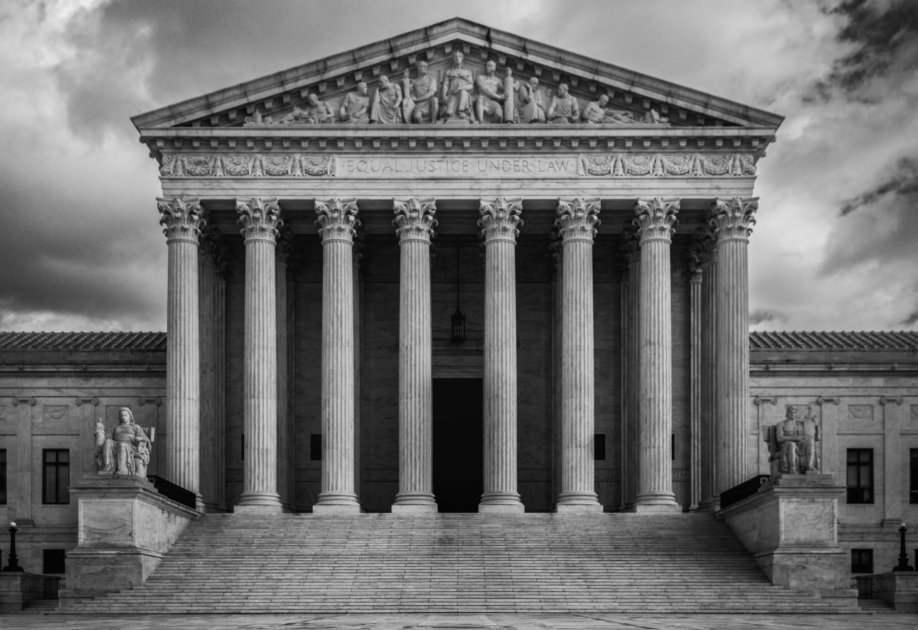
Photo by Tim Mossholder
A king is a study in absolutes. His word is final, the law of the land, and he is accountable to no one, possibly excepting God.
Isn’t that a credible description of our Supreme Court? Its word is final, the law of the land, and its justices serve for life, unaccountable even to the presidents who appoint them.
Limitless in power, totally isolated, the Court can inflict great harm to the nation. It has for example eviscerated the Voting Rights Act of 1965 in two subsequent decisions, Shelby County v. Holder in 2013 and Louisiana v. Callais just this year. And now the former Confederate states are Jim-Crowing their black citizens all over again, kneecapping the impact of their votes. Discriminating against black voters in the South is once again, incontestably, the law of the land.
The Supreme Court can do such things by declaring laws or parts of laws to be unconstitutional and therefore invalid. The Court can do this because today it holds a power known as judicial review. It can tell the makers of laws—an elected Congress and an elected President—“You were wrong and we are right in saying so.” How absolute is that? Supreme Court justices were never elected, but they nullify laws emplaced by people who were. How anti-democratic is that?
This is not remotely what the Framers of the Constitution intended.
Article III Section 2 specifies what the Supreme Court can do. It functions all but exclusively with appellate jurisdiction. In street language that means the Court can do either of two things: it can uphold a lower court decision, or overturn it. Nothing else. That’s it. The Court is empowered to sit in judgment of law cases. Nowhere is it empowered or even obliquely allowed to sit in judgment of the laws. The Constitution simply does not grant the Supreme Court the power of judicial review.
The Framers meant the Court to be subordinate. In Federalist 78 Alexander Hamilton said this:
“The Judiciary is beyond comparison the weakest of the three departments of powers…it can never attack with success either of the other two [branches]…”
And in Federalist 81 he was explicit:
“…there is not a syllable in the plan under consideration [i.e. the Constitution] which directly empowers the national courts to construe the laws according to the spirit of the Constitution…”
Today’s Supreme Court invalidates laws without a speck of Constitutional authority, and it has done so for 223 years.
That takes us back to 1803 and the infamous Supreme Court case of Marbury v. Madison.
Federalist President John Adams in the last days of his term appointed 16 new lower court judges—all of Federalist persuasion. Among them was one William Marbury. Their commissions were to be delivered by the Secretary of State, as specified in the Judiciary Act of 1789, but in the scurry of a departing Administration they were not. In March Democratic-Republican Thomas Jefferson was sworn in as President. Intending to appoint judges of his own party instead Jefferson ordered his Secretary of State James Madison not to deliver the commissions. Marbury sued for his, citing the 1789 law. John Marshall’s Supreme Court found Madison guilty but—wait for it—also saw the Judiciary Act as slightly askew of the Constitution. It was the skinniest technicality, but on that basis the Court dismissed the case.
Chief Justice Marshall said in the Court’s written decision, “It is emphatically the duty of the Judicial Department to say what the law is…a law repugnant to the Constitution is void.” So said John Marshall, but nobody else, certainly not the writers of the Constitution.
Marshall’s Supreme Court claimed judicial review simply by fiat and vaulted from the weakest branch of federal governance eventually to kinglike supremecy.
Note where our Supreme Court is today: by neutering the Voting Rights Act (and, incidentally, encouraging gerrymandering) it is up to its enrobed necks in rigging the upcoming elections, the mid-terms and the general election in 2028.
Judicial review was initially benign. It wasn’t invoked again for 57 years, and might have remained tolerable had not the Court paired it with another irresponsible decision.
In the 1886 case of Santa Clara County v. Southern Pacific Railroad the Supreme Court set a precedent with devastating consequences. It simply declared chartered corporations are persons as defined in the 14th Amendment, with rights guaranteed by the Constitution: free speech, equal protection under the law, and others. By a technical error of the Court the precedent is legally flawed, but later Courts cited it anyway. And now corporate personhood, prima facie preposterous, is the law of the land.
Think about corporate personhood for a moment. If corporations have Constitutional rights and if they can prove in court those rights are violated by a law, they can sue to have the law overturned. They can use judicial review as a weapon.
And after Santa Clara County they did.
The 14th Amendment was meant to grant citizenship to black Americans, freed from enslavement by the Emancipation Proclamation, and to guarantee their equal treatment under the law. But now, after Santa Clara County, corporations became citizens, too.
377 cases based on the 14th Amendment were heard by the Supreme Court over the 27 years following Santa Clara County. 19 of them dealt with black Americans seeking equal protection. 288 were initiated by corporations claiming Constitutional rights—primarily to invalidate irksome laws.
As the centuries turned corporations succeeded in overturning minimum wage laws, child labor laws, laws limiting the workday, workmen’s compensation statutes, laws limiting corporate lobbying, and laws regulating utility companies. They sued for and won additional Constitutional rights, those granted by the 4th, and 5th Amendments—rights of privacy and the freedom from unreasonable search and seizure. Between 1905 and the mid-1930’s the Supreme Court found some 200 laws and regulations to be unconstitutional.
As the 20th century progressed the toxicity grew. The caustic combination of judicial review and corporate personhood would prove in time to be fatal to democracy. In a 1976 case, Buckley v. Valeo, the Supreme Court found unconstitutional the 1910 Corrupt Practices Act. It placed parsimonious limits on how much political candidates could spend on their campaigns. No, the Court said, spending money is a form of free speech, and the Congress cannot “abridge” that right. Dollars are words? Isn’t that also prima facie preposterous? Two years later in First National Bank of Boston v. Bellotti the Court overturned the 1907 Tilman Act, prohibiting corporations from spending money on political campaigns—because corporations have free speech rights, too. In seeming contradiction a law limiting how much corporations could spend remained in place. (The law was FECA, the Federal Election Campaign Act of 1972.)
In 2010 Citizens United v. FEC removed the contradiction. If corporations could not be restrained at all from spending for political purposes, then how much they spent was immaterial. Section 441b of FECA was unconstitutional. Out with it. Corporations can spend as much as they please.
But not to worry, Justice Anthony Kennedy wrote for the majority:
“…independent expenditures, including those made by corporations, do not give rise to corruption or the appearance of corruption…..The appearance of influence or access will not cause the electorate to lose faith in democracy.”
Prima facie preposterous?
A tsunami of corporate money flooded expeditiously into the political campaigns of both parties (protected by the right of free speech) and lobbying activities as well (protected by the right of petition).
Corporations today outspend citizen interest groups in lobbying Congress and executive agencies by a factor of 86:1. In the 2024 election cycle corporations contributed 71% of the total of campaign donations, about $10.65 billion. Closely allied billionaires contributed another $2.85 billion, 19% of the total. Small individual donations came to $1.5 billion, about 10%.
By any measure, corporate citizens are the dominant influencers of federal governance today. Their financing of political campaigns renders elected officials into indentured servitude, amiably open to corporate requests. Then corporate lobbyists specify the details.
Public policy today routinely favors not the public interest, but the preferences of corporate America.
Oligarchs are commonly thought to be men and women of immense wealth with close ties to governments. We have those: Elon Musk gave $250 million to the Trump campaign in 2024. But the oligarchs dominating us today are corporate. It is not inaccurate to say our democracy was displaced by corporate oligarchy—after judicial review, after Santa Clara County, after Buckley, after Bellotti,after Citizens United. All thanks to a Supreme Court emulating royalty.
And then Donald Trump showed up, and overrode corporate oligarchy: Trump made himself a king.
The Supreme Court, the stand-in, stepped up to help. First the Court empowered Trump to ignore the rule of law: in Trump v. United States presidents became immune from prosecution for breaking laws while in office, if they do so in “official” actions. Then the Court fell into lockstep with the Republican Party, to tilt the elections of 2026 and 2028 to favor Donald Trump.
If Trump wins a third term, we will still have a king.
If he doesn’t, we’ll still have the stand-in.
This article is drawn from a book the author is completing, The Triumph of Corporate Oligarchy: How It Defeated Democracy, Normalized Fraudulent Warfare, Devastated a Thriving Nation, and Brought Forth Donald Trump.
[ad_2]
Source link
