
[ad_1]
In one of the scariest moments in modern history, we're doing our best at ScheerPost to pierce the fog of lies that conceal it but we need some help to pay our writers and staff. Please consider a tax-deductible donation.
It took 60 years for Black Americans to get representation in Congress proportionate to their numbers. Now we’re likely to backslide.
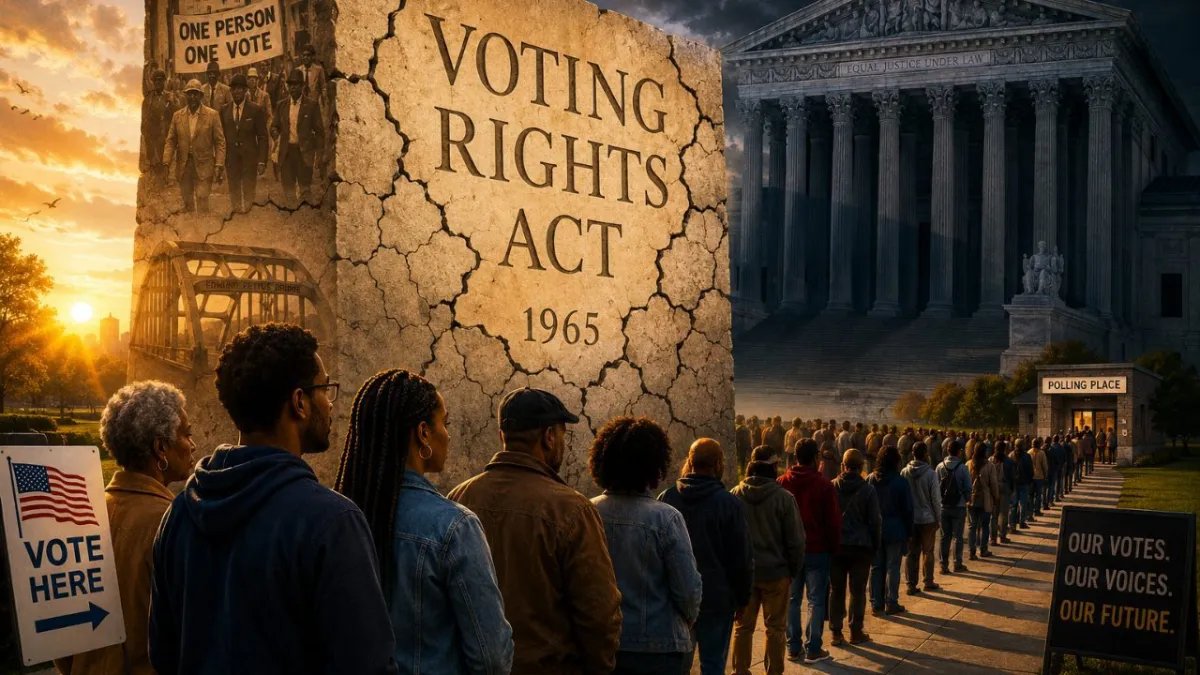
The United States took a decisive step toward democracy with the passage of the Voting Rights Act of 1965. At the time, Black political representation was not just limited — it was nearly nonexistent. African Americans made up more than 10 percent of the population but held less than 2 percent of seats in Congress and none in the Senate.
By dismantling formal barriers to voting, the Voting Rights Act opened the door for Black political participation — and over time, representation. That progress was neither immediate nor inevitable, but it was real.
It was in this context that the Joint Center for Political and Economic Studies, the organization I lead, was founded in 1970. Our mission is to support the growth of Black political leadership and ensure that increased representation translates into meaningful policy outcomes.
More than five decades later, that mission remains urgent.
Black representation in the House has grown from fewer than 10 members in 1965 to more than 60 today, reaching roughly 14 percent of members — finally approaching parity with the Black share of the U.S. population. But it took nearly 60 years to reach this point.
That underscores a critical truth: representation requires sustained protection and intentional policy.
Even now, the progress is incomplete. Even with a record high five Black senators — just 5 percent of the total — Black representation in the Senate remains far below the Black population share.
Today, even these gains are under threat. Recent Supreme Court decisions have weakened the Voting Rights Act, reducing federal oversight and making it more difficult to challenge discriminatory voting practices.
The Court’s most recent ruling gutted regulation designed to ensure Black representation, permitting what amounts to racial gerrymandering under the guise of partisan gerrymandering — a practice which itself badly undermines democracy for Americans of all races.
The result is a system increasingly driven by political advantage rather than fair representation. And Black representation is likely to suffer because of it.
Gerrymandering is often discussed as a partisan tactic, but it has broader structural consequences. When districts are drawn to maximize political control, they can dilute the voting power of communities of color — even without explicitly referencing race. For Black communities, whose political gains have often depended on fair districting, the erosion of these protections is particularly consequential.
This is not simply about who wins elections. It is about how policy is shaped and whose interests are represented in decisions that affect economic opportunity, education, healthcare, and wealth. Representation alone does not guarantee equity — but without it, inequity is almost certain.
The current moment demands clarity. The expansion of Black political representation over the past half-century was the result of deliberate policy choices, sustained advocacy, and legal enforcement. As those protections are weakened, the risk is not just stagnation — it is regression.
At the Joint Center, our goal is clear: to ensure that the gains of the past are protected and that the path toward equitable representation remains open.
Nearly 60 years after the Voting Rights Act, Black Americans have come closer than ever to achieving representation in Congress that reflects their share of the population. But progress at this level is not self-sustaining. Without strong protections and continued commitment, it can be reversed.
The work of building a representative democracy is ongoing. And at this moment, it is clear that the work must continue.
Dedrick Asante-Muhammad is an associate fellow of the Institute for Policy Studies and president of the Joint Center for Political and Economic Studies, America’s Black think tank. This op-ed was distributed by OtherWords.org.
Editor’s Note: At a moment when the once vaunted model of responsible journalism is overwhelmingly the play thing of self-serving billionaires and their corporate scribes, alternatives of integrity are desperately needed, and ScheerPost is one of them. Please support our independent journalism by contributing to our online donation platform, Network for Good, or send a check to our new PO Box. We can’t thank you enough, and promise to keep bringing you this kind of vital news.
You can also make a donation to our PayPal or subscribe to our Patreon.
Please share this story and help us grow our network!
[ad_2]
Source link
