
[ad_1]
In one of the scariest moments in modern history, we're doing our best at ScheerPost to pierce the fog of lies that conceal it but we need some help to pay our writers and staff. Please consider a tax-deductible donation.
Burying your child is a nightmare from which no parent ever fully wakes. Burying your child who died in prison is something worse than a nightmare
Kwaneta Harris for Prism
This essay was co-published with Solitary Watch and contains mentions of child sexual assault, self-harm, and suicide.
It is against the laws of nature for parents to bury their children. The universe coded it into our marrow: Elders go first, and children carry the grief forward into lives still unfinished. Burying your child is a nightmare from which no parent ever fully wakes. But burying your child who dies in prison is something worse than a nightmare. It is a wound that festers inside a deliberately manufactured silence, inside locked doors and unanswered calls and the particular cruelty of being told, when you finally reach the hospital, that you cannot confirm whether your own baby is there because she belongs to the state.
I am writing this from a prison cell. I know what these walls do. I know what they take.
And because I know, I carry Jennifer Rodriguez with me. I carry Brooklyn Hogrell.
Brooklyn came into the world five weeks early, already fighting. She grew into a girl loud with joy and fierce in her protection of anyone weaker than herself. She wore her worst grades without shame and laughed in a way that her mother, Jennifer, said could reach you even from inside a phone. At 8 years old, a 56-year-old man took something from Brooklyn that no child should lose. When Jennifer brought her to the police, Brooklyn sat in her mother’s lap and answered every officer’s questions by whispering to her mother first, who then repeated her answer softly to the room. Brooklyn’s one refrain was simple: “I want my mom.” She was already telling the world exactly what she needed to survive.
The world did not listen. Instead, it gave her more violence, more violation.
Jennifer did not stop fighting for her daughter. That is what I need you to understand about this woman—about all these mothers—before you read further. When Brooklyn stopped sleeping after the assault, Jennifer enrolled her in counseling for child rape survivors and sat beside her at every session for five years. When a second man molested Brooklyn at 11, Jennifer filed a police report the same day. When she found out that Brooklyn was cutting at a basketball physical at age 12, she applied Steri-Strips to the wounds with her own hands. She learned that Brooklyn needed a reason behind every rule because her body had been used without her consent, and once Jennifer gave her a reason, Brooklyn followed. That was not defiance. That was a child protecting the last thing she owned.
The system looked at all of this and found a way to call it a behavioral problem.
At 13, a marijuana arrest placed Brooklyn on probation in a small town where everyone already knew her name. When a teacher physically blocked a bathroom door and Brooklyn pushed past, the school filed a felony charge. A teacher blocking a bathroom is not a peace officer. It is an adult weaponizing control over a body that had already been violated twice by adult control. Brooklyn was sent back to juvenile detention at the police station, where physical restraints triggered the memory of her abuse. Every time she was held down, she fought. Every fight became a new charge.
She entered her court date with 15 additional counts and was sentenced to nine months in the custody of the Texas Juvenile Justice Department (TJJD).
Jennifer drove to visit her every single weekend. Nine months stretched to 15. Brooklyn was hospitalized more than five times for suicide attempts—and those were only the attempts that produced paperwork. In 2021, the U.S. Department of Justice opened an investigation into TJJD following staff arrests for physical and sexual abuse of incarcerated minors. Brooklyn had endured those conditions for years. The state called her the aggressor. The institution designated its own staff the victims.
At 17, Brooklyn was classified as a violent offender. At 18, she was transferred to Lane Murray Unit, a women’s prison.
I want to stop here, because I live inside this logic every day, and I want you to feel what it means.
At every stage, the system examined Brooklyn’s behavior and assigned it blame without once examining what produced it. At every stage, it looked at Jennifer and found new methods to block the only intervention that had ever worked: a mother’s presence.
The system incarcerated a child who had been sexually assaulted twice. It placed her in environments where adults physically restrained her against her will. When her body responded to those restraints exactly the way every trauma-trained clinician would predict, it added more time to her sentence. When she aged out of juvenile detention, the system placed her in an adult facility with adult dangers and adult indifference. At every stage, the system examined Brooklyn’s behavior and assigned it blame without once examining what produced it. At every stage, it looked at Jennifer and found new methods to block the only intervention that had ever worked: a mother’s presence.
When Brooklyn was put in solitary confinement, Jennifer could not hold her hand. She could not sit across a table and watch her daughter’s shoulders drop the way they always did when they were together. Solitary is where mothering becomes structurally impossible.
Another incarcerated woman launched a daily campaign of harassment, chanting for hours at Brooklyn to kill herself, writing to Jennifer using Brooklyn’s name and threatening both their lives. Jennifer called the prison and reported every threat. She begged them to keep the two women separated. The mental health counselor’s last notation read: Follow-up in one week.
The prison eventually transferred Brooklyn—and her aggressor—to a new facility, placing them in cells directly across from each other.
Then the prison restricted Brooklyn’s tablet, which she used to make phone calls and send messages, after the other woman reported her for a minor infraction. Before that, Brooklyn had called Jennifer at least 10 times a day from 2 in the afternoon until 8 at night. Those calls were not a luxury. They were the architecture of her survival. Jennifer’s voice was the one thing that made Brooklyn laugh from inside a box. When the tablet was gone, that architecture collapsed. There was no clinical justification. There was no safety rationale. There was only the ordinary indifference of a system that had never once treated the connection between a mother and her daughter as something worth protecting.
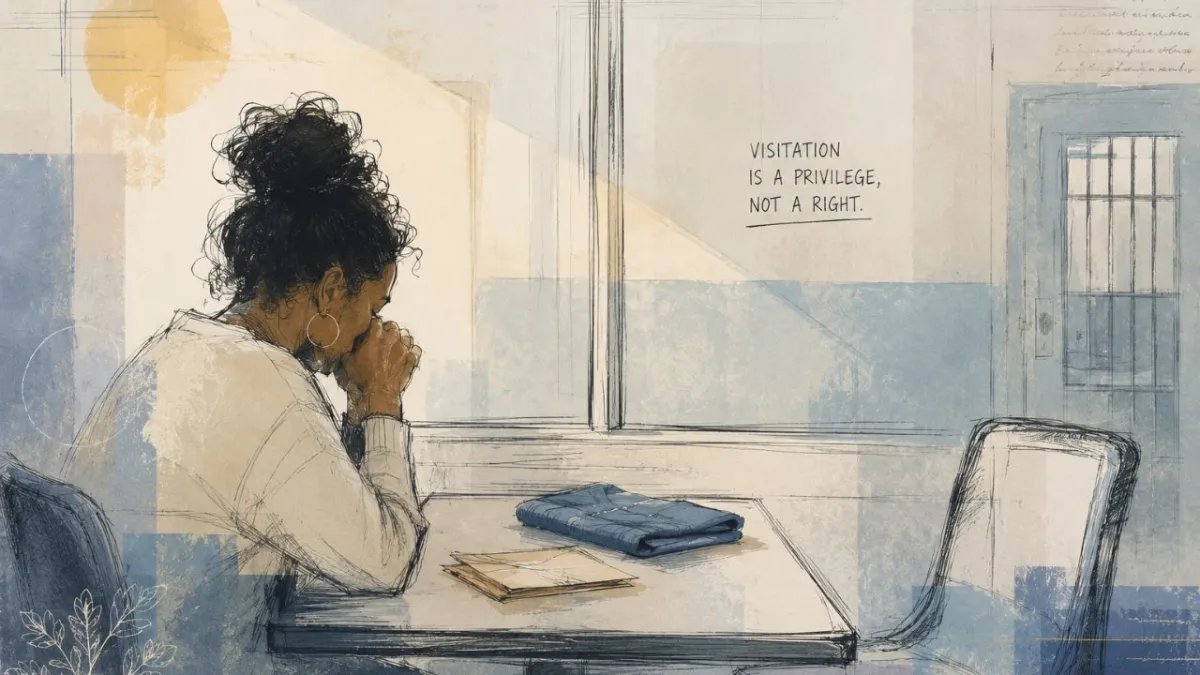
The last time Jennifer saw Brooklyn alive was April 5, 2024, through a pane of plexiglass.
About two weeks later, a neighbor in solitary called Jennifer to say Brooklyn had attempted suicide, and it did not look good. Jennifer called the prison. The warden confirmed the attempt but was hesitant at first to give her the name of the hospital where Brooklyn was taken. At the hospital, staff refused to confirm or deny Brooklyn’s presence because she was incarcerated. Jennifer told them that she would go room to room until she found her baby. They relented.
She stayed at Brooklyn’s bedside for six days. Guards remained in the room the entire time, even after Brooklyn was pronounced dead, watching Jennifer grieve her child. When officials from the Office of Inspector General came to photograph Brooklyn’s body, Jennifer asked about fresh cuts she noticed. She asked why no one had responded to the warnings.
That question has no acceptable answer because the warnings were not invisible. They were reported, documented, and ignored.
Jennifer did not fail her daughter. She drove hours every weekend. She applied bandages to her cuts. She filed the police reports. She called the prison. She showed up every single time the system allowed her to, and she fought every time it tried to block her. The system placed Brooklyn in solitary, placed her tormentor in a cell facing hers, stripped her of counseling, restricted the calls that were her only lifeline, and then, allowed a pen to exist in a suicide watch cell the day after Brooklyn, when in that cell, had stabbed herself in the throat with one.
Solitary confinement does not rehabilitate. It does not protect. What it does, with quiet efficiency, is remove every person who loves an incarcerated human being from their reach, and then, when that person dies, it turns to the mother and asks what she could have done differently.
I write this from inside the same system that swallowed Brooklyn. I know what it feels like when a phone call is your only proof that someone still loves you. I know what it costs a mother to drive hours to sit behind glass and call it a visit. I know what it means to watch a woman who has done everything right be told, again and again, that the rules do not accommodate her love.
Jennifer Rodriguez is still here. She is still asking the questions no one wants to answer. She is still saying her daughter’s name so the world does not forget it. Brooklyn Hogrell deserved the conditions that promoted survival. Instead, she was given conditions that promoted death.
So tonight, if your child is within reach of your arms, hold them. Hold them if you understand that somewhere, a mother is sitting with the memory of plexiglass between her hand and her child’s hand, and a phone pressed to her ear, listening to a voice she will never hear again. Hold your child because Jennifer Rodriguez cannot hold hers. Hold your child because the most ordinary miracle in the world is a child who comes home, and some of us know too well what it looks like when they don’t.
Written in honor of Jennifer Rodriguez, and every mother whose child has died in state custody.
The Right to Write (R2W) project is an editorial initiative where Prism works with incarcerated writers to share their reporting and perspectives across our verticals and coverage areas. Learn more about R2W and how to pitch here.
Editorial Team:
Rikki Li, Lead Editor
Lara Witt, Top Editor
Rashmee Kumar, Copy Editor
Kwaneta Harris is a former nurse, business owner, and now incarcerated journalist from Detroit. Her writing has appeared in a wide range of publications including This American Life, Rolling Stone and Teen Vogue. She writes on Substack at Write or Die and is working on a book about the teenagers from juvenile who were her neighbors in adult solitary confinement.
Editor’s Note: At a moment when the once vaunted model of responsible journalism is overwhelmingly the play thing of self-serving billionaires and their corporate scribes, alternatives of integrity are desperately needed, and ScheerPost is one of them. Please support our independent journalism by contributing to our online donation platform, Network for Good, or send a check to our new PO Box. We can’t thank you enough, and promise to keep bringing you this kind of vital news.
You can also make a donation to our PayPal or subscribe to our Patreon.
Please share this story and help us grow our network!
[ad_2]
Source link
