
[ad_1]
The political parties are currently at war over redistricting. Red states are shaping district maps to become redder. Blue states are entrenching themselves more deeply blue. Legislators, party operatives, and lawyers are battling over the lines. The conversation largely revolves around control of Congress, and which political party will come out on top; however, there is an overlooked category of citizens in this process – political independents.
A staggering 45% of Americans identify as political independents, yet, due to the electoral systems in the United States and the dominance of the two-party system, they must watch from the audience as the parties duke it out over political control. Now, independents can hardly be grouped as all believing the same political ideology; rather, they usually lean left or right politically but have enough of a philosophical divergence from the party platform that they don’t feel comfortable registering with that party, or they are fed up with the status quo of either side and just want something different. Or they don’t feel sure which side they believe.
Gerrymandering (the partisan drawing of districts during redistricting) leaves independent voters out of the equation. For independent voters, the prospect is especially difficult, because the entire exercise is designed around a world they reject: one divided into rigid red and blue camps.
More blue, more red
The redistricting wars are simply pushing states further apart on the political lines. When a state becomes more politically leaning, it often loses accurate representation of the political electorate residing within. In the past two years, a handful of red and blue states have pushed various gerrymandered maps, with mixed results, and more states are now in process as well. This tug-of-war still ends up generally balancing congressional representation, because both political sides are participating rather than just one. But the unseen consequence is that as states become more partisan, they leave behind the vast segment of the electorate that rejects standard party platforms.
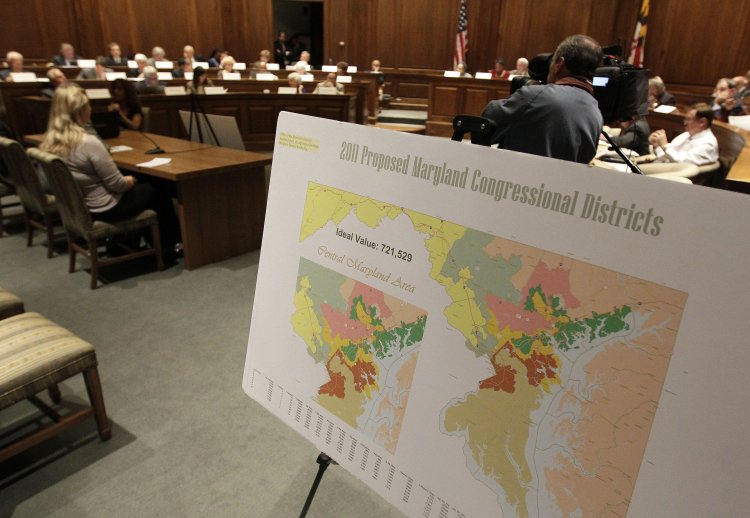
My parents are registered independent voters in Maryland. The state of Maryland has just over 4.3 million voters, with 51% Democrat, 23% Republican, and 24% Independent/Other. That’s almost a quarter of the state’s voters who don’t fully align – or don’t align enough to register – with one of the two main political parties. Maryland has eight congressional districts, with one Republican and seven Democratic representatives. Just this past legislative session, the state legislature sought to redistrict in a way that would gerrymander even further, completely eradicating the Republican seat.
Maryland is a blue state trying to become even more blue, reducing representation for the ideology to which my parents hold, because the result of gerrymandering is that independents in heavily gerrymandered districts often find themselves represented by legislators who have little incentive to appeal to the political middle. Safe-seat lawmakers answer primarily to their most partisan primary voters, not to the independent swing voters who might otherwise hold them accountable in a competitive general election.
In a fairly drawn district, an independent voter wields real power. Close elections force candidates to earn votes across ideological lines and to appeal to independent voters. Gerrymandering eliminates that dynamic. When a district is drawn to guarantee one party an untouchable majority, the general election becomes a formality. The real decision happens in the primary, where independents in many states cannot legally participate.
The party entrenchment that gerrymandering feeds is precisely what drives many voters toward registering as independents in the first place. They leave the parties because they are frustrated with the status quo, only to find that the maps drawn by those same parties have made the status quo structurally inevitable.
Independent voters are the largest and most rapidly-growing segment of the American electorate, yet redistricting processes are almost universally controlled by the two parties that do not fully represent them. At the very least, policymakers on both sides of the aisle would do well to actually listen to independent voters, whether or not they represent a gerrymandered district. Gerrymandering has been in place for decades and probably is not leaving anytime soon. In the meantime, it is absolutely incumbent upon policymakers to consider the independent constituents who have been sidelined. As states move rapidly toward partisan entrenchment, independents are the ones bearing a disproportionate cost.
[ad_2]
Source link
