
[ad_1]
When I began my PhD studies around 2000, I carried a clear, romantic vision of what it would mean to be a researcher. I imagined long hours in the lab, the hum of centrifuges and classical music from an old radio my constant companion. I pictured myself making careful observations, formulating novel hypotheses, and designing elegant experiments to unravel nature’s most stubborn secrets. As a pharmacologist, I dreamt of the unique thrill of discovery—that electrifying moment when disparate data clicks into a coherent pattern, revealing a medicinal (or harmful) effect of a drug no one had ever observed before.
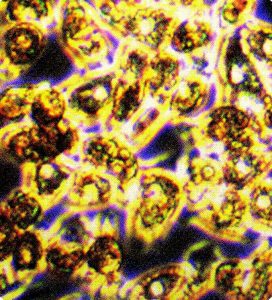
“golden nuggets.” (Photo supplied by the author.)
In 2008, that dream became a visceral reality. I ran out of the lab, my heart pounding, screaming all the way to my supervisor’s office: “I see golden nuggets!” I was referring to the dazzling color and shine of lipid-filled fat cells I had observed under the microscope—a shimmering field of gold that represented a breakthrough. This discovery—that blocking cannabis receptors could trigger the transformation of bone marrow cells into fat cells—became the cornerstone of a career-defining paper. A year later, I was awarded tenure, and my greatest hope was to pass on this sacred tradition of hands-on inquiry to the next generation.
My vision was not an idle fantasy; it was rooted in the timeless practice of science as a craft, honed over millennia. It was also shaped by the simple yet profound wisdom of my late father, a man of practical intellect. He often said, “Carpenters make furniture, and scientists perform experiments.” To him, the essence of a researcher’s work was as tangible as an artisan’s—both required passion, skill, patience, and a deep physical engagement with their materials.
For a while, I lived that ideal. Even after gaining the security of tenure, I spent five more years toiling at the lab bench alongside my students, immersed in the messy, unpredictable, and exhilarating process of experimentation. I insisted they call me by my first name within the lab’s walls, hoping to dismantle hierarchy and convince myself I was still the basic researcher I once was. But gradually, inexorably, the demands of modern academia pulled me away. The lab bench gave way to the desk; test tubes were replaced by spreadsheet cells; the intimate scrawl of lab books was supplanted by the sterile prose of grant applications. The immediacy of discovery was overtaken by the bureaucracy of publication quotas, endless funding cycles, and a ceaseless tide of administrative duties.
The Erosion of Scientific Craftsmanship
This shift is not merely a personal grievance; it is a systemic ailment. Recently, I spoke with academics from the Global South about the role of basic scientific research in their countries, and their shared experience left me unsettled. They articulated a quiet global crisis, one that extends far beyond Western universities. They lamented the decline of fundamental, curiosity-driven research in favor of hyperspecialized output-driven projects designed to satisfy funding bodies and the media rather than human wonder. Their stories forced me to confront a daunting question: Will they ever know the firsthand joy of seeing their own “golden nuggets” and thinking, “No one has ever seen this before”?
Of course, some argue that this romantic view of the past is a privilege, a historical anomaly. An early-career researcher recently pointed out, “Darwin had status, wealth, network, and time.” He noted that most postdocs today struggle simply to secure their own wages, never mind assembling the resources for self-directed, exploratory experiments. This is a crucial and sobering point. Will their youthful idealism, that initial spark of curiosity, be crushed under the weight of modern academia’s demands? Or will they, empowered by their collective frustration, demand change?
A Generation Robbed of the Bench
This systemic shift has created a deep well of frustration and quiet grief among many of my colleagues. The very path to a stable academic career is now structured to divorce scientists from hands-on work. This is not just an inconvenience; it is a fundamental barrier to participation. When the cost of entry is a decade or more of financial precarity and existential uncertainty, and the ultimate reward for success is a desk job, we risk losing a generation of talented, hands-on experimenters before they even begin.
The postdoctoral position, once a protected formative time for deepening one’s experimental expertise and intellectual independence, has been transformed into a precarious purgatory—a grueling test of endurance with no guarantee of a faculty position at its conclusion. This reality has fostered a profound sense of loss among a generation of brilliant, hands-on postdocs. They see the craft they love slipping through their fingers, replaced by the relentless pressure to become a professor—a role that increasingly feels more akin to being the CEO of a small, perpetually struggling startup than a scholar immersed in nature’s mysteries.
And for the fortunate few who do secure a permanent role, the reward is often a lifetime chained to a desk: writing papers about experiments and techniques you barely understand, perfecting the “art of grant capture,” and managing personnel, budgets, and research narratives rather than conducting research oneself.
I was struck by a heartbreaking confession from a recently tenured professor who had just secured the coveted position so many strive for. She said, with a tone of genuine loss, “I wish I could be a postdoc for life.” This statement is a damning indictment of the current system. Here was a “success story,” someone who had ostensibly won the academic game, yet she longed for the very role defined by its precarity and low pay. Why? Because it was the last time she was allowed to be a scientist at the bench, fully engaged in the hands-on work she loved.
From Natural Philosophers to Desk-Bound Managers
To understand the profundity of this loss, we must look to the very origins of modern science. The great figures we revere were not managers of science; they were practitioners, often referred to as “natural philosophers.” Galileo ground his own lenses and built his own telescopes to observe the heavens. Marie Curie processed tons of pitchblende residue with her own hands in a leaky shed, her fingers likely burned by the radium she painstakingly purified. Rosalind Franklin’s iconic “Photo 51,” which revealed the helix of DNA, was the product of her own meticulous skill with an X-ray crystallography machine. Did I mention Charles Darwin and his pigeons?
These pioneers were not distant administrators; they were intimately acquainted with their tools and materials. Their discoveries emerged from a direct, tactile interaction with the physical world. They understood, as my father did, that scientists are defined by the experiments they perform. The modern system, with its emphasis on managerial efficiency, has severed this vital connection. We have created a culture that celebrates the paper—the polished end product—while devaluing the skilled, often frustrating, physical labor that produces it.
A Note to the Next Generation
To the aspiring scientists just setting foot on this path, their hearts alight with curiosity, I offer both a lament for what has been lost and a warning for what is to come: The modern academic system, as it stands, will try its utmost to mold you into a manager of science, not a practitioner of it. Your value will be measured in impact factors and h-indices—the cold calculus of publication metrics. You will likely spend more time writing grant proposals than conducting experiments and more hours in compliance meetings than in lab meetings brainstorming results.
You will be pulled from the bench to the desk, from the experiment to the application. You will be judged not by the depth of your curiosity but by the quantity of your outputs, pressured to chase “hot,” trendy topics rather than the fundamental hypotheses and difficult questions that may not yield immediate returns.
My caution is this: Do not quit quietly. Resist where you can, as I did for an extra five precious years. Do not let the machinery of modern academia entirely rob you of the hands-on craft that defines true scientific inquiry. Guard your time at the lab bench ferociously. Protect your capacity for unstructured tinkering, following hunches, and learning from glorious, instructive failure. The “golden nuggets” of discovery are almost always found not in the crowded, well-trodden paths of trending topics but in the patient, hands-on, often lonely interrogation of the natural world. Remember the essence of our craft: experimentation.
And when your time comes to lead—when you secure your own lab, your own grant, your own voice—do not perpetuate the system that stifles curiosity. Do not become the CEO who forgets the feel of a pipette or the smell of agar plates. Instead, use your hard-won influence to rebuild an ecosystem that celebrates the hands-on craft at its heart. Champion blue-sky research. Protect your postdocs and students from the administrative creep. Measure their success not just by papers but by their growth as skilled, independent experimentalists.
The future of science depends not on more efficient managers but on a new generation of carpenters, builders, and explorers who are willing to get their hands dirty in the glorious, unending pursuit of knowledge.
It is time to reclaim the bench.
[ad_2]
Source link
