
[ad_1]
Last Thursday, President Donald Trump gave a phone call to new Iraqi Prime Minister-designate Ali al-Zaidi to congratulate him on his nomination for the post—a call that came after Trump had publicly opposed former Prime Minister Nouri al-Maliki’s bid in objection to the close ties that he enjoyed with Iran.
In a Truth Social post following the call, Trump said he wished Zaidi success in forming “a new Government free from terrorism that could deliver a brighter future for Iraq.”
“We look forward to a strong, vibrant, and highly productive new relationship between Iraq and the United States,” he added. “This is the beginning of a tremendous new chapter between our Nations.”
Over two decades after the U.S.-led invasion of Iraq, it is difficult to understand what the precise relationship is between Baghdad and Washington. Economic, political, and cultural ties between the two countries are weak—mostly reflecting in-built structural dependence by Iraqi institutions on the U.S. financial system—while a legacy of suspicion and hostility has outlived the war.
This alienated relationship will be strange to those who remember the justifications for the U.S. invasion of Iraq, which was depicted as another step in an unstoppable march of liberal democracy after the end of the Cold War, intended to benefit not just Iraqis but Americans themselves.
“The survival of liberty in our land increasingly depends on the success of liberty in other lands. The best hope for peace in our world is the expansion of freedom in all the world,” President George W. Bush stated in his second inaugural address, given days before what was supposed to be a landmark 2005 parliamentary election in Iraq. Bush was far from alone in claiming the importance of Iraq to American domestic concerns, justifying the thousands of lives and billions of dollars spent at war there.
“Iraq is the centerpiece of the defining challenge of our time,” claimed then-U.S. ambassador to Iraq, Zalmay Khalilzad. “What happens in Iraq will affect the region, and what will happen in that region will affect us all.”
Two decades later, the domestic politics of Iraq are an issue that barely registers with American voters, few of whom can be expected to be able to name the new prime minister of that country, let alone describe its present political landscape.
For those seeking to catch up, after surviving years of civil war, state collapse, and extremism, Iraq never truly became a democracy in the image that U.S. politicians described—a pro-U.S. satellite state like Germany or Japan—instead establishing what is essentially a majoritarian Shia government under the sway of neighboring Iran. Meanwhile, notwithstanding Trump’s conciliatory comments upon the nomination of al-Zaidi, a wealthy businessman with little political experience, the U.S. military is increasingly attacking the same Iraqi regime that the 2003 invasion put into power.
In recent weeks, amid a broader war against Iran and pro-Iranian Shia militias, the U.S. has carried out waves of deadly airstrikes in the country. In some cases, these attacks have killed dozens of ordinary conscripts or security force members who had no part in attacks on the U.S., infuriating many Iraqis, including those who are part of the otherwise pro-American civil society in the country. Iraq has been the site of widespread protests over the past month denouncing those attacks as well as the U.S. war against Iran.
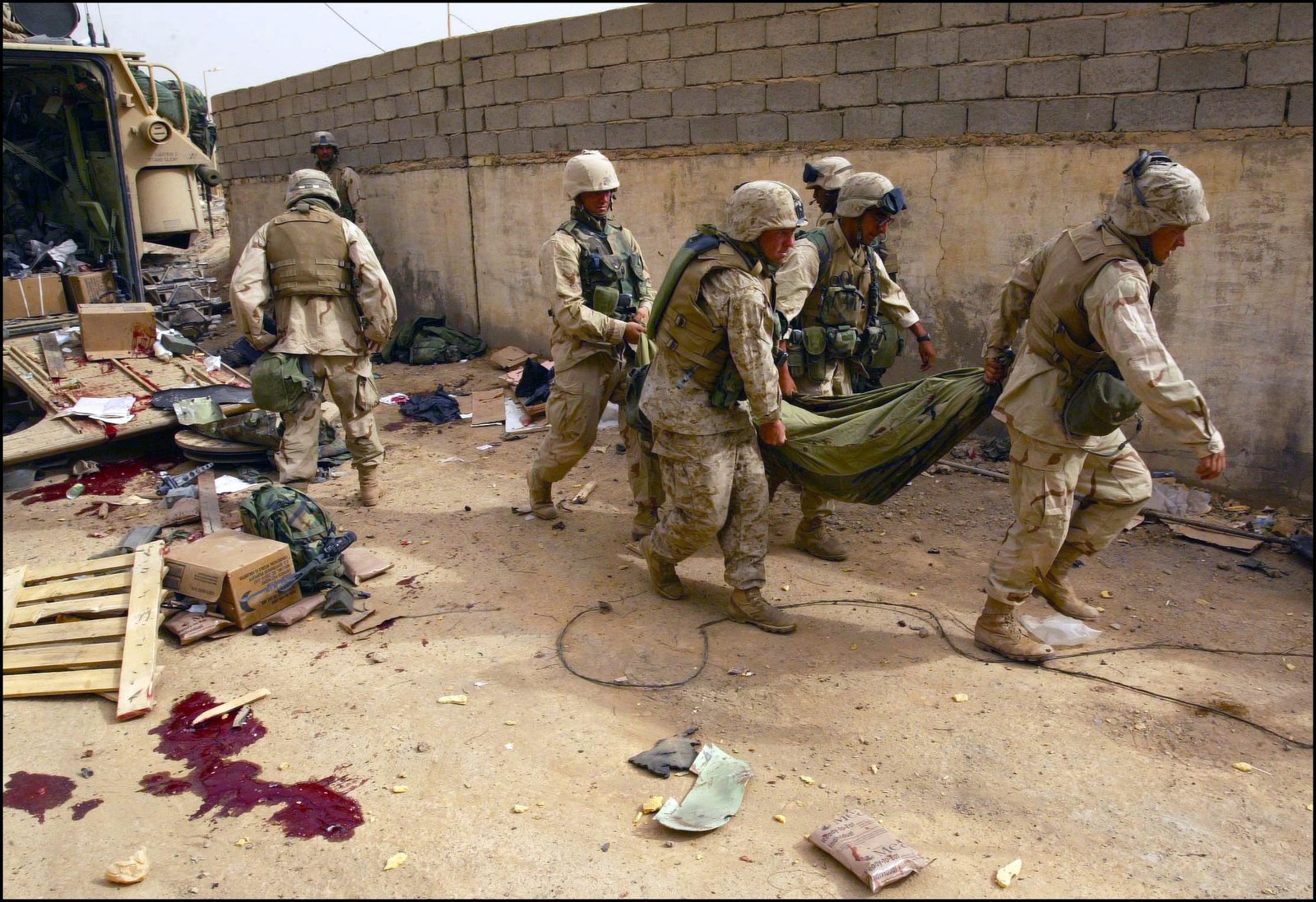
The U.S. bombing attacks against Iraqi forces came after weeks of missile strikes on U.S. positions in the country by Shia militias in sympathy with Iran. Those attacks forced the evacuation of the sprawling U.S. embassy compound in Baghdad and resurfaced questions as to what exactly Washington achieved by invading that country at great cost so many years ago—and why the U.S. elites who justified and waged that war never faced real accountability.
Ancient Hatreds
If not entirely a client state, Iraq today is undeniably under the heavy influence of neighboring Iran, which enjoys preferential access to its political elites and even economic system. The special relationship now enjoyed by Tehran is something that many American politicians and security officials claimed Washington itself would enjoy at the end of the war. Yet, in the end, the conflict more logically wound up benefitting a neighboring power that shared a religious and historic relationship with many Iraqis.
A 2019 leak of classified cables from Iranian intelligence that I reported on and that was later published by the The Intercept and the New York Times laid out in remarkable fashion the degree to which the 2003 invasion had effectively served Iraq to Iran on a platter. The cables showed a remarkable degree of penetration of Iraq at all levels by not just Iranian intelligence and security officials, but even business contractors and religious authorities who had essentially turned the country into an extension of their own.
Both Iran and Iraq are majority Shia countries, but this shared religious affinity had never translated into a political alliance in the years before the U.S. occupation. After the 1979 revolution, Iraqi Shias declined to respond to a call for revolution by Ayatollah Ruhollah Khomeini. Instead, they joined with their compatriots in fighting a brutal war against Iran throughout the 1980s, laying down their lives in the hundreds of thousands to defend what was still a secular Ba’athist state.
It was only with the U.S. invasion that Iraq’s Shias, along with Sunnis, Christians, and the smaller minorities that made up the kaleidoscope of Iraqi society, were forced to confront a new reality where religious and tribal identity superseded all other concerns.
The sudden dissolution of the Iraqi state with no plan to replace it set the stage for a classic security dilemma. This vacuum led to a sectarian civil war of tremendous ferocity. Over the years, as Iraqi society unraveled, this would give birth to Sunni extremist groups promising revenge and redemption like the Islamic State, as well as the hardline Shia militias that exert influence over the country today.
“By destroying the Iraqi state but not replacing it with any effective entity capable of enforcing order, the United States compelled ordinary Iraqis to find affiliations with groups that would protect them from harm,” wrote Noah Feldman in his 2020 book The Arab Winter. “As it turned out, ethnic and denominational identities were the closest ones to hand for Iraqis, as they had been in the Balkans after the collapse of Yugoslavia.” Feldman continued:
The sectarian divisions that became the basis for civil war did not emerge because they were ‘ancient hatreds’ driving present animus. Rather, they were the most salient features of affiliation that made people believe there was a credible chance that they could be protected by their fellows. There was no lack of organizational entrepreneurs to convince people that this was so.
The current government in Iraq is the product of an environment in which the security dilemma caused by the U.S. invasion was solved by apportioning power to the majority Shia population. This was done with the support of neighboring Iran, which, once an enemy, now began to seem like a lesser evil to many Shias.
Sunni Iraqis, meanwhile, wound up being the losers of the new order after perceiving early on that the U.S. invasion would disadvantage them, facing attacks by Shia-led death squads supported by the U.S. and then, fatefully, rallying to extremist groups like ISIS in an attempt to defend themselves and hold onto authority in a corner of the country. Iraqi Christians, who lacked a powerful outside patron and made up an even smaller minority of the population, fared even worse, suffering violent attacks that triggered a large-scale exodus of this ancient community from the country.
What any of this tragedy had to do with U.S. interests was never clear. While the war did not benefit ordinary Americans in any appreciable way, it did fulfill the dreams of many Iranian officials who spent years fighting against Iraq, only to be gifted the ability to visit cities like Karbala and Baghdad thanks to the efforts of George W. Bush and the neoconservatives who graciously did the hard work of removing their most hated foe from the region forever.
“Why have the Americans attacked us?”
Despite the recent fighting between militia groups and U.S. forces in Iraq, the two countries do maintain a relationship—a largely unbalanced one where the U.S. dictates political terms to Baghdad and maintains the ability to halt its oil revenue. Since the 2003 invasion, Washington has held effective custody over that revenue through the Federal Reserve Bank of New York — a financial chokehold that has repeatedly given the U.S. decisive leverage over Baghdad’s political decisions.
The architecture was established in the immediate aftermath of the 2003 invasion, when the Coalition Provisional Authority created the Development Fund for Iraq at the New York Fed and President Bush issued an executive order — renewed by every administration since — protecting the funds from lawsuits tied to the Saddam era. What began as a reconstruction mechanism has become a quiet form of permanent leverage, allowing successive U.S. administrations to threaten the suspension of Iraqi access to its own oil revenues whenever Baghdad has moved in directions Washington opposes.
This unequal relationship has predictably not endeared many Iraqis to their supposed liberators. The situation has only gotten worse in recent weeks after a number of deadly attacks on Iraqi security forces, including those ostensibly allied to the U.S. and not Iran. After a deadly attack against an Iraqi military base by U.S. aircraft in March that killed several soldiers, the Iraqi government, pressed by public outrage, warned that it reserves the right to respond to the attack.
Subscribe Today
Get daily emails in your inbox
“This is a U.S. attack because we identified the aircraft, an A-10, which only they use,” an Iraqi general told local journalists, asking in exasperation, “Why have the Americans attacked us?” The Iraqi Ministry of Defense later said that it “fully reserves the right to take all necessary measures to respond to this aggression in accordance with approved legal frameworks,” while the U.S. charge d’affaires was later summoned for a protest.
Today, as Washington wages war against Iraq’s neighboring Iran, U.S. leaders are again struggling to convince Americans that such a campaign is important to their lives, this time downplaying the growing economic blowback by falsely claiming the alternative is nuclear annihilation. If things turn out poorly, a similar lack of accountability in the aftermath may also be expected.
The congratulations by Trump sent to another would-be Iraqi leader should be seen in the context of the generally confused, unhappy relationship between Iraq and America today—a legacy of a war that few people in either country had asked for, but which has marked both countries and the broader region indelibly.
[ad_2]
Source link
