
[ad_1]
The Kremlin’s intention to control its digital environment is not new. Even Russians’ most widely used messaging app, Telegram, was not spared from it. However, a failed 2018 effort to block the app exposed the limits of direct restriction. Despite regulatory pressure, the platform continued to operate, creating a ‘grey zone’ where even pro-government voices could express limited forms of dissent.
In 2026, this phase appears to be ending. Besides blocking external platforms, the Kremlin is increasingly restructuring the Russian domestic digital environment itself. The ‘national messenger’ MAX, whose creation was ordered by Russian president Vladimir Putin himself, grew from around 2 million users in mid-2025 to over 55 million by November. This rapid growth coincided with the Kremlin deliberately disrupting platforms such as Telegram and WhatsApp. Together, these developments point to a shift from reactive control toward the construction of a managed communication infrastructure.
This transition is supported by recent legislation. In April 2025, the use of foreign communication by state institutions was restricted, while in June 2025 the concept of a national ‘multifunctional information exchange service’ was introduced. MAX was subsequently designated as such a platform. Formally, these measures are framed in terms of security, convenience, and accessibility. In practice, however, they narrow the range of platforms available for institutional communication and create conditions in which domestic solutions – and increasingly MAX – become the default channels.
From platform to infrastructure
To understand the significance of MAX, it is not enough to look at its user growth. What matters is how the platform is officially defined and designed. According to its user agreement and technical documentation, MAX is not simply a messaging service. It is defined as a multifunctional platform enabling interaction with state information systems (GIS), including services connected to Russia’s official government services portal (Gosuslugi) and Russian e-government system (ESIA).
Technical materials further describe MAX as a ‘specialised software complex’ comprising web, desktop, and mobile applications, supported by servers and databases.
Taken together, these descriptions suggest a platform designed not only for communication, but for integration – linking messaging, identification, and access to digital services within a single environment.
Identity, verification, and data integration
A central feature of this architecture is the integration of communication with verified identity.
The platform requires registration through a mobile phone number and may process additional personal data, including information obtained – with user consent – from state systems such as ESIA and other GIS databases.
For users of Digital ID functions, MAX enables the creation of a verified digital profile linked to the account. Actions performed through this profile are treated as actions carried out personally by the user.
At the same time, the platform collects technical and behavioural data, including device information, IP address, and user activity within the interface. Individually, these features are not unique. However, their combination within a platform explicitly designed to operate alongside state information systems creates a setting in which communication, identity verification, and data exchange increasingly overlap.
From recommendation to everyday necessity
The political significance of MAX lies not only in its technical design, but in how that design is being implemented in practice.
Formally, Russian legislation does not require parents, students, or teachers to use a specific messenger. However, educational institutions across Russia have increasingly shifted communication to MAX, often presenting it as the primary or most practical channel.
Teachers describe being instructed to move communication with parents and students to the platform, while those who do not register may face practical difficulties – from missing important updates to increased administrative pressure. In some cases, internal communications referenced participation targets and monitoring of activity levels.
This does not amount to universal legal coercion. Instead, it reflects a different mechanism: the gradual conversion of a recommended platform into a de facto requirement through institutional routines and administrative expectations. In this sense, MAX is emerging not as a formally mandatory system, but as a default infrastructure that organisations are increasingly standardising around.
A managed communication environment
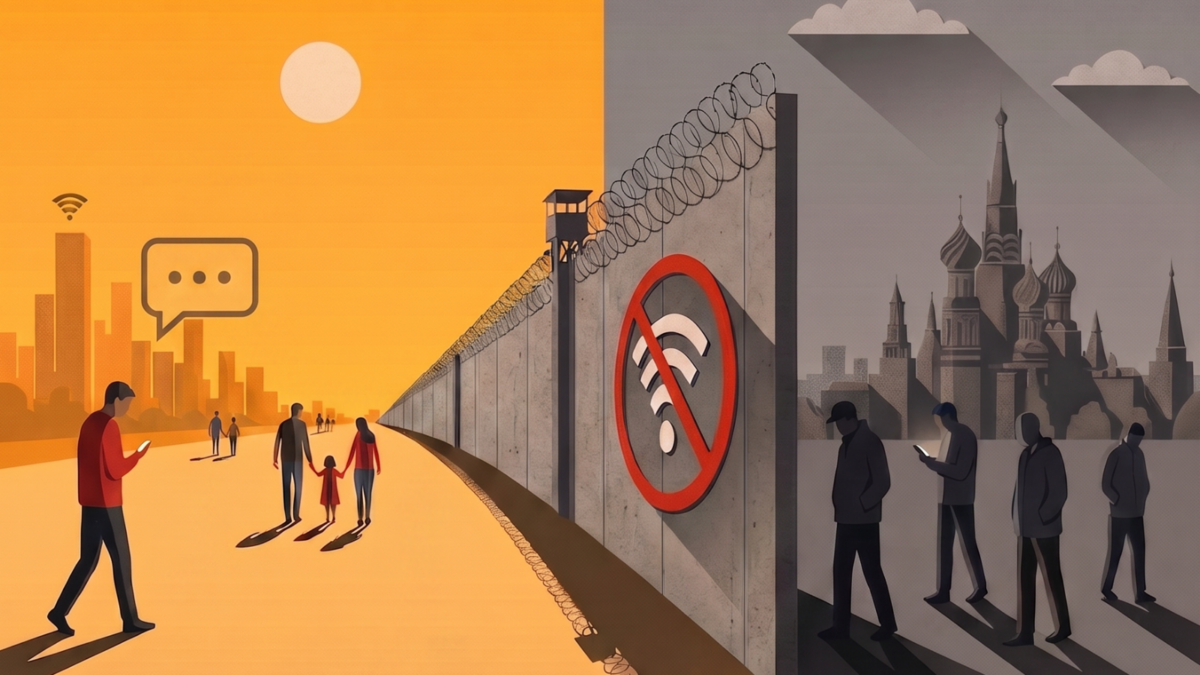
The development of MAX illustrates a broader shift in Russia’s approach to digital control. Rather than relying solely on blocking or restricting access to external platforms, the state is building a domestic ecosystem designed to integrate communication, identification, and service provision.
This approach does not eliminate alternatives outright. Instead, it changes the conditions under which digital communication takes place. When institutional communication, administrative processes, and everyday interactions converge within a single platform, opting out remains formally possible but becomes increasingly impractical.
This matters because control over information is no longer exercised only through content regulation or censorship, but through the design of the communication environment itself.
[ad_2]
Source link
