
[ad_1]
Article Metrics

0
CrossRef Citations
There is a growing expectation for individuals to challenge misinformation, especially as platforms alter their governance processes around false content, shifting towards community-flagging approaches. While research on how individuals respond to exposure to information is developing, findings often taker a broad-brush approach, treating receivers as a single, undifferentiated category, identifying overarching barriers, motivations and coping mechanisms relating to challenging misinformation as opposed to highlighting how these differ between groups of individuals. In this paper, we draw on empirical findings from interviews and surveys with U.K. residents to develop a set of five behavioural archetypes that allow us to identify how different types of individuals behave when exposure to misinformation.
Research Questions
- How do receivers behave when exposed to misinformation?
- How does the spreader-receiver relationship influence the receiver’s behavior?
Research note Summary
- This work was conducted through interviews (n = 10), and two surveys (n = 100, n = 61) with U.K. residents.
- We developed five distinct behavioral archetypes, influenced by spreader-receiver relationship proximity, normative expectations, and the medium-specific constraints where misinformation is spread.
- We detail these archetypes so that they can be used by educators, designers, and researchers to support more targeted interventions that address the needs of specific receiver types and their barriers.
- By conceptualizing receivers as differentiated actors rather than a single category/type, the study reframes individual responsibility and support mechanisms in misinformation governance by unpacking how different groups behave when exposed to misinformation.
Implications
Previous work exploring inter-personal misinformation correction has uncovered a range of motivations and barriers to discussing misinformation (Malhotra, 2020, 2023; Malhotra & Pearce, 2022; Pearce & Malhotra, 2022; Scott, Cecchinato, et al., 2023; Scott, Coventry, et al., 2023; Scott et al., 2025), but has largely treated receivers as a single, undifferentiated category. While research identifies qualities affecting misinformation susceptibility (Sultan et al., 2024; Brashier, 2024), these remain unexplored in misinformation correction research. In contrast, we propose a differentiation of receiver archetypes, synthesizing behavioral patterns across interviews and surveys into five archetypes. This redefines peer correction as a heterogeneous practice shaped by relational proximity, normative expectations, and medium-specific constraints.
Consistent with prior research, we confirm and extend that relational proximity (Scott, Cecchinato et al., 2023), cultural norms (Malhotra & Pearce, 2022; Scott, Cecchinato et al., 2023), and medium affordances (Scott, Coventry et al., 2023) shape how individuals respond to misinformation. Using a constructivist approach, we developed five behavioral archetypes based on patterned combinations of relationship strength, normative expectations regarding politeness and responsibility, and comfort with specific communication media. Of these, two are archetypes of individuals who choose to challenge misinformation, and three prefer not to challenge.
Challenger archetypes illustrate how corrective intent interacts with relational and technological context. The Face-to-Face Challenger reflects existing findings that synchronous, in-person conversations are preferred for addressing misinformation due to non-verbal cues and opportunities for relational repair (Pearce & Malhotra, 2022; Scott, Coventry, et al., 2023). In contrast, the Digital Challenger demonstrates that medium constraints are not universally inhibiting. Where communication is digitally mediated, online correction is not perceived as inappropriate, particularly within close ties (Scott, Cecchinato, et al., 2023).
Receiver archetypes reflect distinct logics of non-intervention, either because they may challenge at a later date or never. The On-the-Fence Receiver embodies uncertainty about whether correction is socially or relationally appropriate, echoing previous findings (Malhotra & Pearce, 2022; Scott, Cecchinato, et al., 2023; Scott, Coventry, et al., 2023). The Conflict Avoidant Receiver aligns with prior findings on hierarchy, respect, and cultural expectations, where explicit correction may be seen as impolite or inappropriate, particularly in family contexts (Malhotra, 2023; Malhotra & Pearce, 2022). Finally, the Can’t Be Bothered Receiver is characterized less by cultural constraints and more by relational distance and effort calculation: they do not challenge at all, nor can they be convinced to, as the effort is just too great. These archetypes demonstrate that non-challenging behavior does not reflect a single attitude or lack of awareness, but emerges from different relational, normative, and contextual configurations.
In synthesizing behavioral patterns into archetypes, we demonstrate that peer-to-peer correction is not a uniform practice, but instead a relationally and contextually contingent one. This challenges prevailing assumptions that individuals can be treated as a homogeneous corrective audience and suggests interventions must be tailored to distinct profiles. Consequently, platform features that rely on generic misinformation correction prompts risk overlooking relational constraints and effort calculations that shape whether individuals act, and policies focusing on society as a whole overlook nuances between groups. For example, if some receivers perceive correction as normatively inappropriate (Conflict Avoidant Receiver), educational interventions must address social norms, not just factual literacy.
Implications for design
Our findings highlight distinct design needs across five archetypes. For Face-to-Face Challengers, tools that can detect and contest misinformation in real-time conversations could support their motivated but relationally cautious approach, whilst better-designed spaces for seeking support should prevent inadvertent adoption of misinformed beliefs. On-the-Fence Receivers may benefit from messaging features that reduce conversational pressure and tools that make online communication feel more personal/natural. For Conflict Avoidant Receivers, automatic content warnings and platform-level flags could do corrective work without requiring explicit confrontation, aligning with their preference for talking around rather than directly about misinformed beliefs. Can’t Be Bothered Receivers would benefit most from timely alerts and nudges that lower the effort required to act. Finally, Digital Challengers would benefit from richer online communication features and better support for involving trusted others in these conversations. The limitation of a “one size fits all” approach to misinformation correction points to opportunities for platforms to incorporate a range of correction mechanisms, each designed around the needs and constraints of a given archetype. Yet in doing do, platforms should consider broader demographic factors such as race and gender that may influence how users interact with corrective mechanisms and how these interactions are further shaped by the context of the misinformation.
Evidence
From the analysis, five behavioral archetypes were developed. They are: Face-to-Face Challenger, Can’t be Bothered Receiver, Conflict Avoidant Receiver, On-the-Fence Receiver, and Digital Challenger. Although all archetypes are a type of receiver, some did choose to challenge misinformation, which is reflected in their name. Each archetype is presented with a short description, accompanied by a graphic representing key characteristics including name, group size, details of the spreader, motivations and barriers, strategies used, and coping mechanisms (what individuals do to support/manage their wellbeing).
Finding 1: Face-to-Face Challengers are willing to challenge misinformation shared if they can conduct that challenge in a face-to-face conversation.
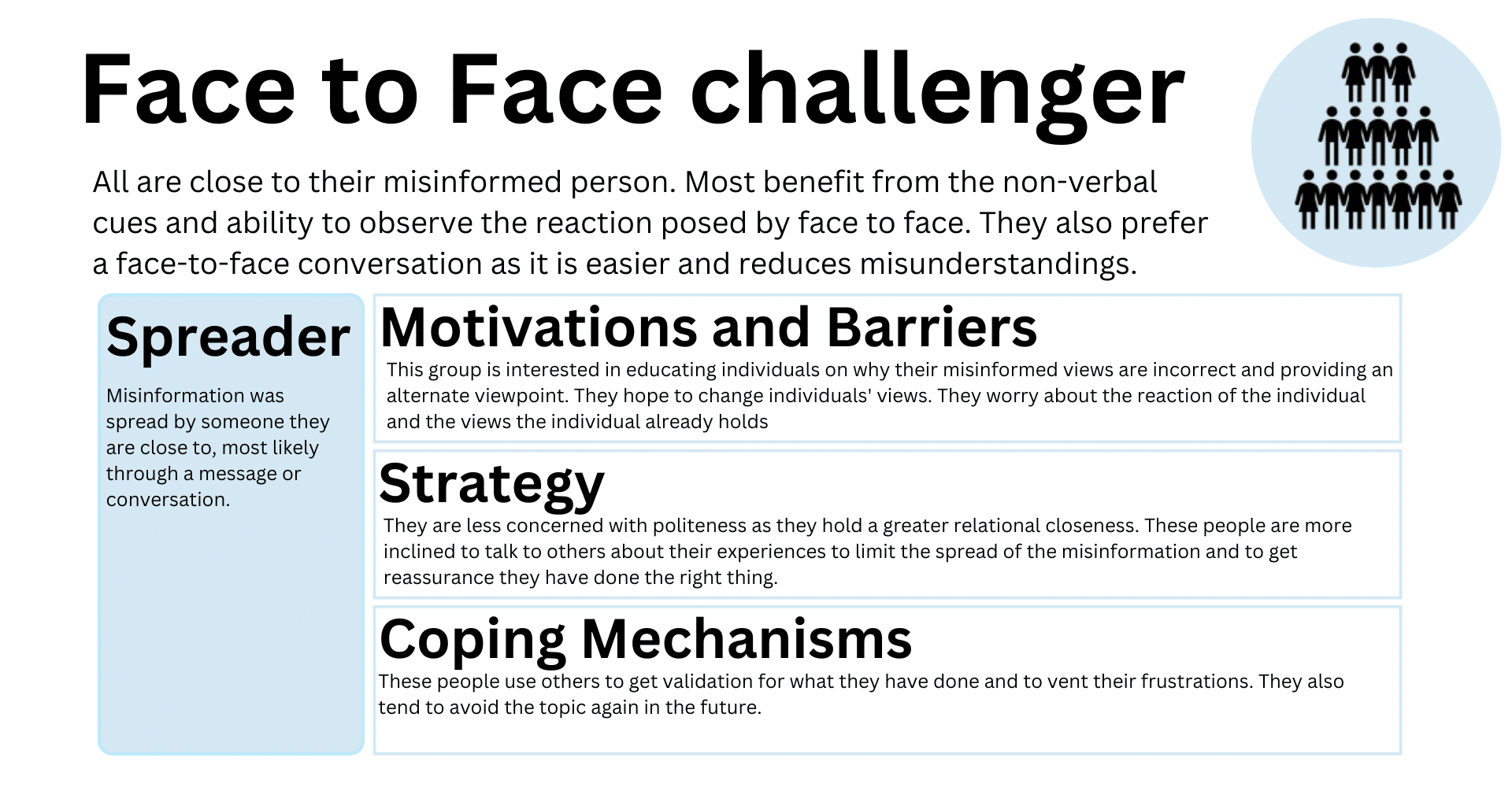
The Face-to-Face Challenger is the largest group (Figure 1). They are close to their spreader and find the environment of a face-to-face conversation to be the most appropriate setting for a challenge. They are motivated to educate spreaders on why their beliefs are wrong but worry about the reaction of the spreader, mostly from a place of concern about long-term relational impacts. They vent their frustrations and seek validation from those who share either an existing relationship with the spreader or are of the same opinion as themselves to cope with the conversation.
Finding 2: On-the-Fence Receivers do not always think it is right to challenge, but when they do they engage in a strategic process, aiming to maintain relationships.
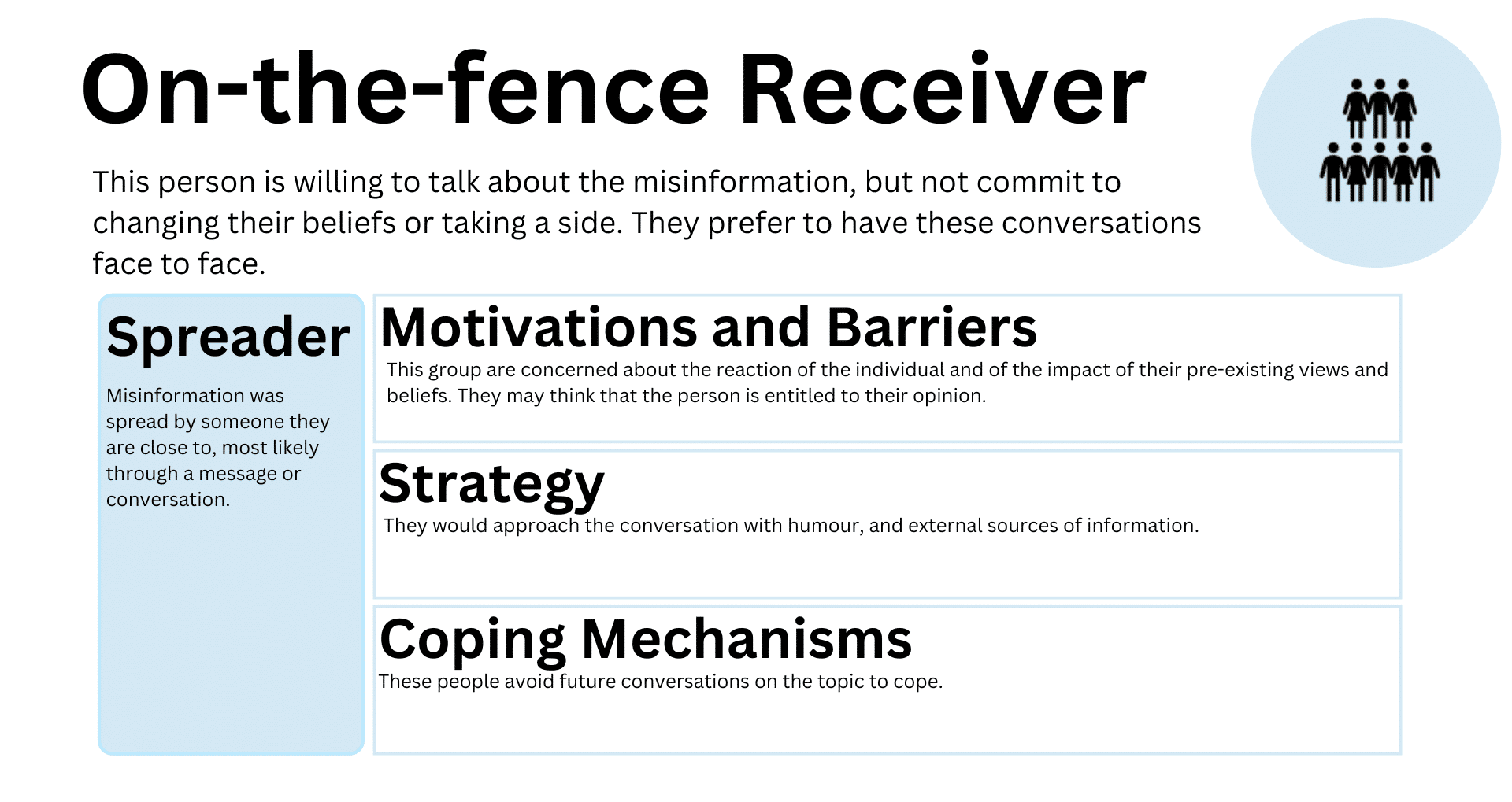
The On-the-Fence Receiver (Figure 2) is the second largest group, characterized by uncertainty about whether to challenge. This group is characterized by a close spreader-receiver relationship, with the receiver being reluctant to challenge due to their view that people are entitled to their opinion. However, where they do challenge, their approach is strategic, using tools like humor to lessen concerns of them being seen as attempting to force a change of opinion. Prior to the challenge, this group avoids future conversations on the topic with the spreader as a coping mechanism to both prevent the escalation of tensions and avoid risks of harming the relationship. Although both the On-the-Fence Receiver and the Face-to-Face Challenger would choose to challenge face-to-face, the On-the-Fence Receiver does not commit to changing beliefs or opinions, which the Face-to-Face Challenger does.
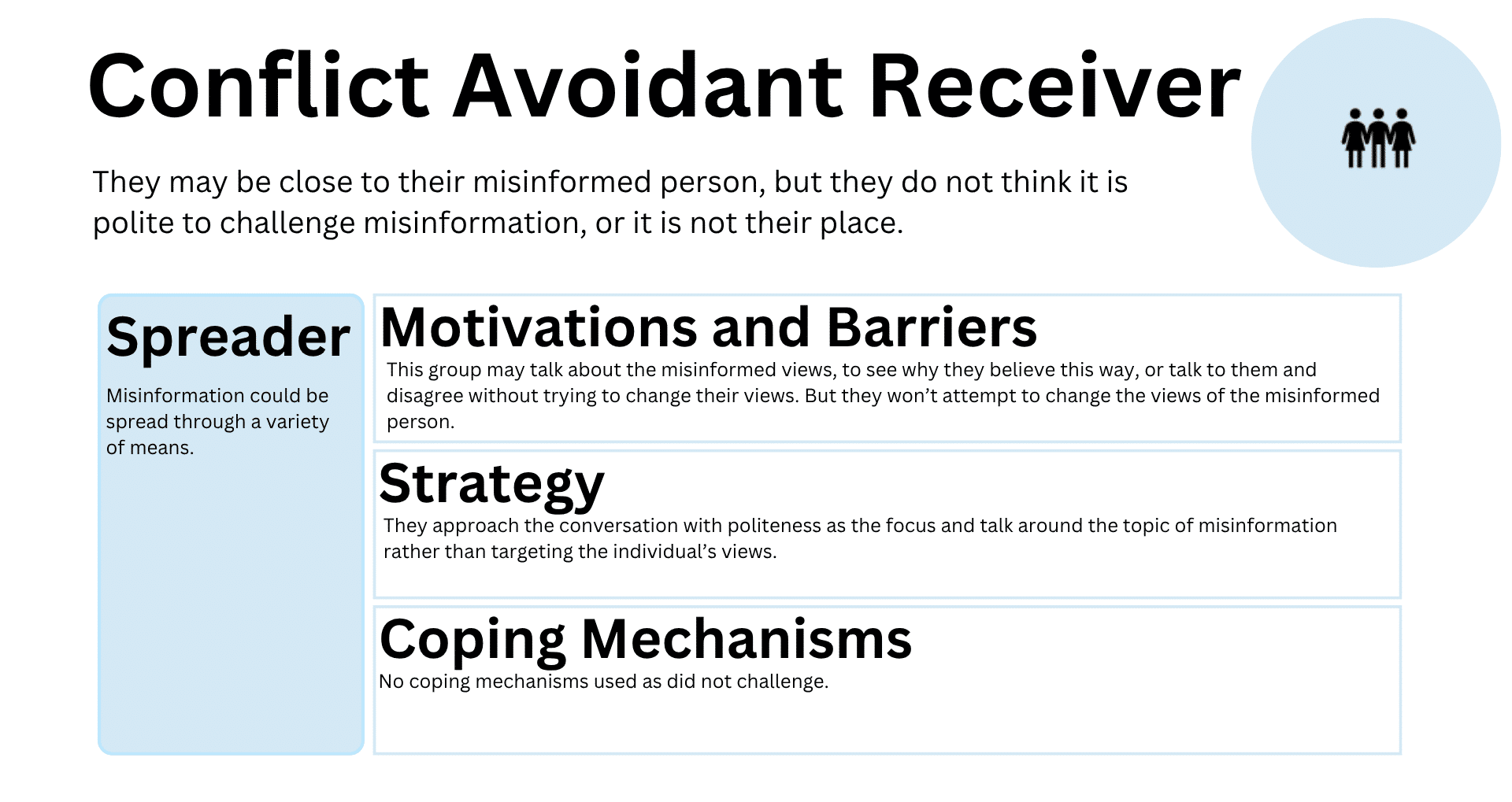
Finding 3: Conflict Avoidant Receivers do not think it is polite to challenge, avoiding the challenge by talking around the topic of misinformation.
The Conflict Avoidant Receiver describes someone who does not think it is polite to challenge misinformation; and this group receives misinformation from a range of sources. As shown in Figure 3, the Conflict Avoidant Receiver may talk about misinformed views with the spreader to understand them, as they do believe that changing the views of the misinformed person is their responsibility. As a result, they prefer to talk around the topic of misinformation rather than about it explicitly (e.g., talking about an illness and its vaccinations rather than stating that an individual must get vaccinated), and are less likely to challenge than the On-the-Fence Receiver group.
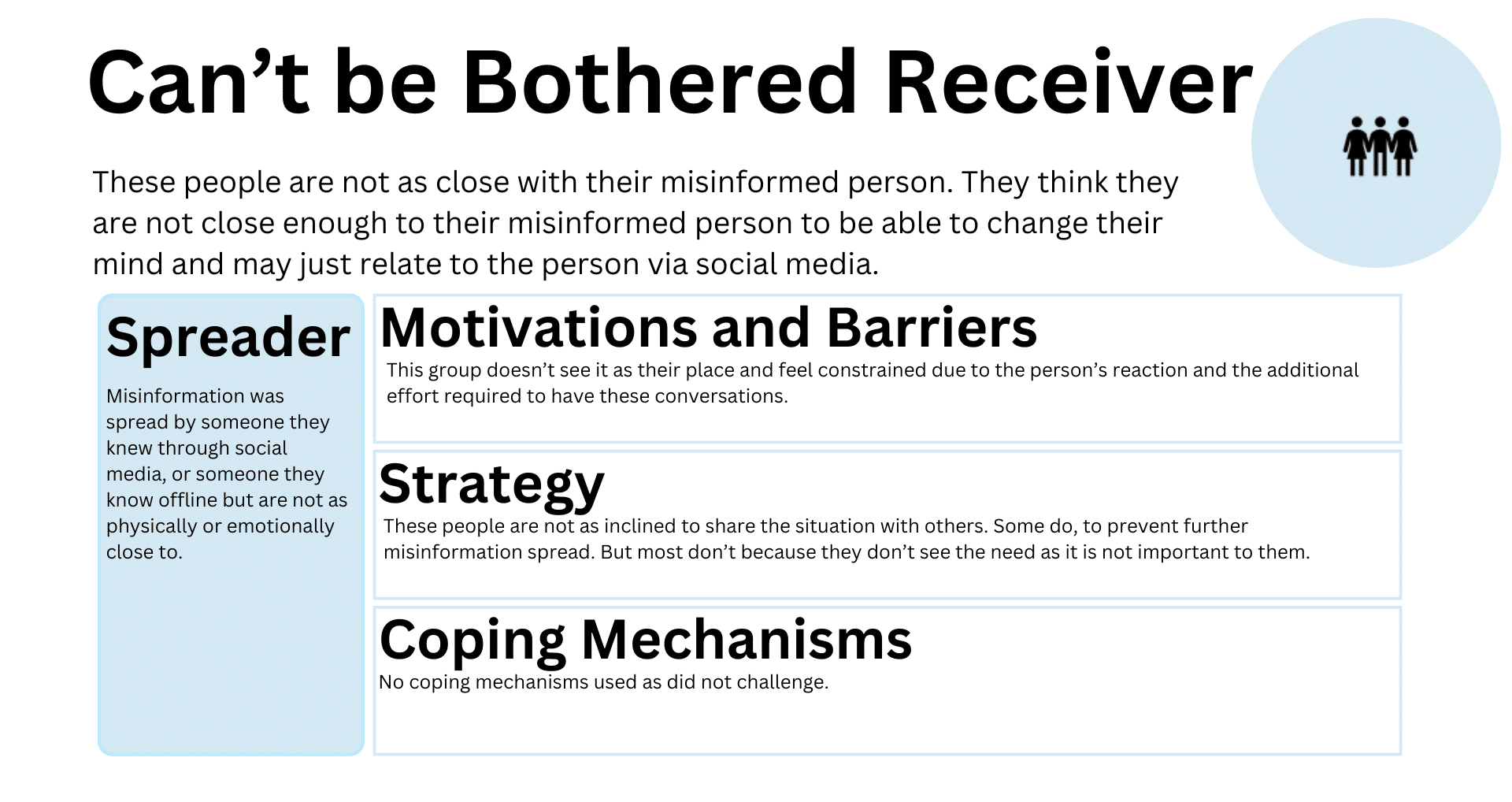
Finding 4: Can’t Be Bothered Receivers are not close to their spreader and do not see the challenges associated with misinformation correction worth it.
The Can’t be Bothered Receiver is a group of people who are characterized by their weak spreader-receiver relationship. In these cases, the spreader is typically someone they are aware of, either online or offline, but they are not emotionally or physically close to. The group finds both the risk of a negative response from the spreader and the effort required to challenge the misinformed views as barriers to challenging (Figure 4). They do not typically discuss the experience of being exposed to misinformation with others. However, where they perceive a potential risk to others, they discuss it to help reduce this risk. This determination of risk is what sets them apart from the Conflict Avoidant Receiver.
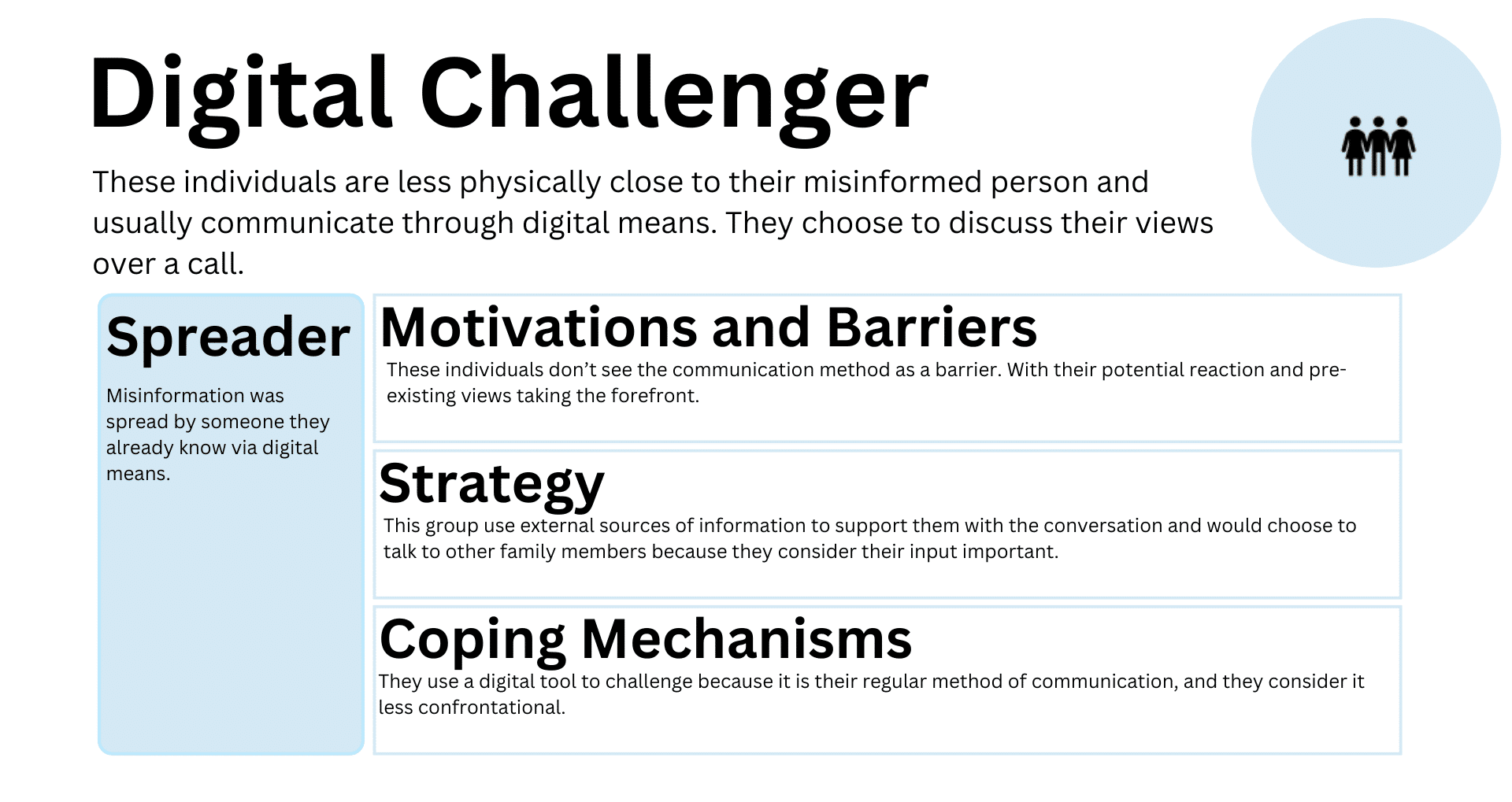
Finding 5: Digital Challengers are the only group primarily comfortable with challenging through digital platforms, as that is their main method of communication with the spreader.
The Digital Challenger, a small group, is those that are comfortable challenging misinformed beliefs online. As shown in Figure 5, they are not co-located with their spreader and usually communicate via digital platforms (i.e., typically communicate with people via these means, or challenge via these communication channels). This group utilize external sources of information (e.g., links to health organizations, groups they are in on social media, or news stories) to support them with the conversation. In addition, they would utilize other family members as a resource during these conversations.
Methods
To explore the context in which misinformation discussions occur, data was re-analysed from three prior studies with U.K. residents: an exploratory interview study (Scott, Coventry et al., 2023; n = 10), a survey on fictional experiences (Scott, Cecchinato et al., 2023; n = 100), and a survey based on participants’ own experiences (Scott, Cecchinato et al., 2025; n = 61).
Interviews
These were held with individuals who had been exposed to misinformation from their family members. They were asked about whether they chose to discuss the spreader’s views, how they chose to engage in this, whether they had any difficulties, and what tools or resources they used to support them. Participant demographics included age (18–24 = 3, 25–34 = 4, 35–44 = 1, 45–54 = 2). A full discussion of the results and interview design can be seen in Scott, Coventry et al., 2023.
Fictional survey
This survey explored how individuals would behave when exposed to misinformation from someone they were close to, and someone they considered less close, with the following scenario: “You find out that your [relation] believes some false information which could negatively impact their health. They have since started to share harmful articles and advice on social media.”
Closeness was measured using a combination of the Inclusion of Other Self scale (Aron et al., 1992), Relationship Closeness Index (Gächter et al., 2015), and the Subjective Closeness Index (Berscheid et al., 1989; Gächter et al., 2015), with participants being presented with their closest and least close relation. Questions asked about their immediate reaction when exposed to misinformation, barriers they would expect to experience, and coping mechanisms they would expect to use. Participant demographics included gender (Male = 43, Female = 54, Non-binary = 3), age (18–29 = 35, 30–39 = 33, 40–49 = 16, 50–59 = 9, 60+ = 7) and self-identified cultural background (Mono-cultural = 50, Multi-cultural = 50). A full discussion of the results and survey design can be seen in Scott, Cecchinato et al., 2023.
Individual experiences survey
This survey explored how individuals challenged misinformation in practice and the barriers that prevented them from doing so. Participants were asked to describe their own experience of misinformation exposure. Their actions, motivations, barriers, resources, and coping mechanisms were explored. This participant pool was recruited from individuals who completed the fictional survey. Participant demographics included gender (Male = 24, Female = 35, Non-binary = 2), age (18–29 = 23, 30–39 = 25, 40–49 = 6, 50–59 = 5, 60+ = 2) and self-identified cultural background (Mono-cultural = 26, Multi-cultural = 35). A full breakdown of the results and survey design can be seen in Scott, Cecchinato et al., 2023.
Following individual analyses, the authors created one larger dataset and analysed commonalities across all three studies from a behaviour change perspective, following steps outlined in Wendel (2020). We identified who challenged misinformation, how they challenged, and spreader-receiver relationship characteristics. We then reviewed where and how technology was used within the challenge, including whether it took place online or offline, before reviewing motivations and barriers to understand what might encourage or discourage people from challenging misinformation. These characteristics made up behavioural profiles, from which a set of behavioural archetypes was developed. Group sizes were included to indicate how common certain barriers, coping mechanisms, and motivations were across the sample. As the content/topic of misinformation was not explored during the data collection, it has not been utilized in the analysis.
[ad_2]
Source link
