
[ad_1]
It is almost impossible to imagine, but very, very soon, soldiers engaged in battle will be as outmoded as high button shoes, or gentlemen standing up when shaking hands with a lady. In fact there will be no more ground, air, or sea fighting by humans, no more intimate observations by war correspondents enlarging their own roles, no more pics of masculine swagger after a bloody victory.
And no, it is not that male tough guys have turned sensitive and no longer shoot first and ask questions later. It is very simple really: The male animal has been replaced by the machine, the latter being sexless, politically neutral, and ever so obedient.
My first reaction upon hearing about the future of warfare was to thank God. (I have four grandchildren.) My second was another thank you to the Almighty for having given us John Wayne. Future Hollywood war epics will need to be sci-fi flicks, which are already unwatchable. But there will be need for the Duke’s oldies, which are as watchable as Lily James and Keira Knightley. My only regret about the future of warfare is that we shall never see the likes of MacArthur, Patton, Guderian, Rommel, Manstein, Robert E. Lee, Stonewall Jackson, Ney, Murat, Blucher, not to mention Hannibal, Caesar, Themistocles, Miltiades, Alexander, and Leonidas. No more glorious returns after great victories, just some science wiz with glasses and greasy hair pushing some buttons in his computer in a darkened room and—boom. It makes one ashamed to say he’s serving his country.
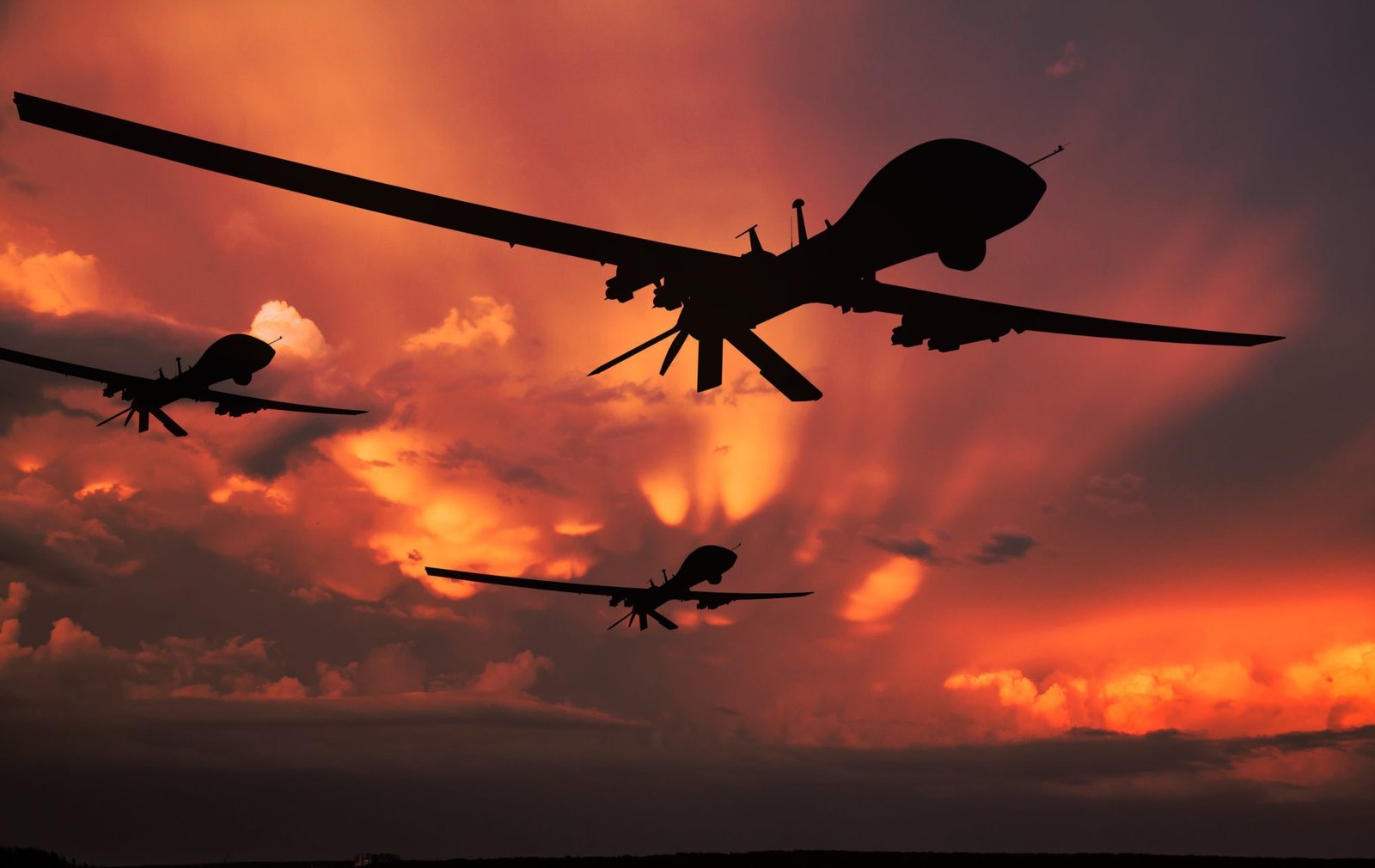
So, no more ground troops, no more grunts, no more tanks. Uncrewed missile barges in autonomous seabed warfare will keep the sailors sober and at home. Manned warships will act as motherships for surface and subsurface vessels. Sea drones with speeds up to 40 mph and a range of 1,000 miles explode upon contact against targets. Patriot air defense systems are unable to down ballistic missiles traveling at several times the speed of sound. Ukrainian drones flew for more than 12 hours recently before tilting their wings and smashing into oil refineries in Siberia. Fifteen-hundred miles is a hell of a journey, but this is modern warfare. Sheer distance from the front lines is no longer a factor. Nor does victory belong simply to the force with the most firepower or the thickest armor. It belongs to the one that can find and strike faster than its opponent.
It sounds like a sci-fi horrible, and perhaps it is. All it means is that now the folks back home will suffer in the same way gallant troops have until now. “Send not to know for whom the bell tolls.” It already has begun out east, where Crimea has been isolated by Ukraine drones with minimal human casualties. (Where, oh, where are the gallant 600 of the Light Brigade?) The Crimean peninsula is now an albatross around Putin’s neck. What the Russians hoped would be their cherished Black Sea Riviera is now uninhabitable. Drones are today’s Genghis Khans. Future warfare also presents a terrible dilemma for the neocons. Will it help them convince future American presidents to attack any enemy of Israel, or will it hinder them from persuading the White House that Israel under attack is one and the same as the U.S. of A.? Four-pizzas Podhoretz is losing his appetite over it.
Subscribe Today
Get daily emails in your inbox
Throughout history warfare has shaped societies. The irony of earlier warfare was that the ruling classes were up front, the great unwashed, if even there, all the way back. The Ancient Greeks followed their nobles, who followed their kings in battle. As did the Romans and others. Caesar, Hannibal, Alexander all led in battle. The feudal system of the Middle Ages saw land ownership and divine authority settling on the knights who safeguarded all by serving in the military. Knights, thus, became the linchpin of the feudal system. In the Battle of Agincourt in 1415 won by Henry V of England, much of the French nobility was wiped out.
What ended the medieval system was the invention of gunpowder. Knights became obsolete overnight, a bit like tanks today, when kings and popes decided to arm dumb peasants to do the fighting rather than give away profitable lands to knights. Peasants with firearms could do the job the knights once did but from a distance. Still, great generals led from the front all the way up to the First World War.
However fantastic all this may sound, even the adversaries can watch the conflict as audience rather than participants. The whole ghastly scene of war has now turned into something like a video game. The only good thing is that far fewer soldiers die in video games. The bad is that there will be multiple Dresdens. Stealth aviation and precision guided missiles are as bows and arrows once were. Whoever comes up with the next superweapon wins.
[ad_2]
Source link
