
[ad_1]
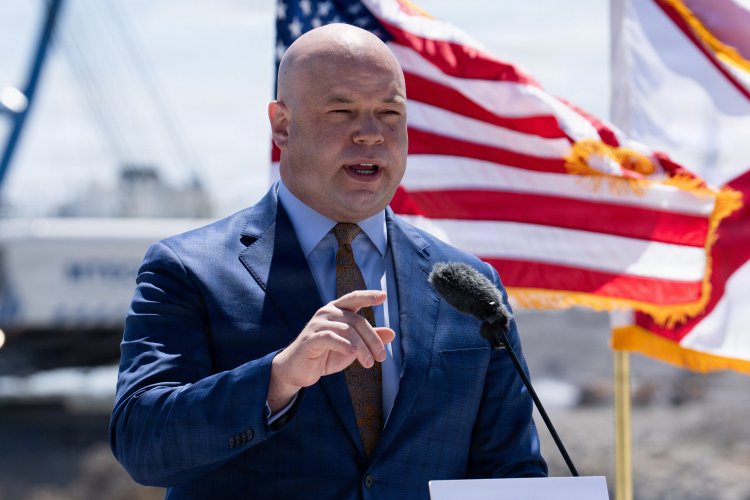
Adam Telle will take over as acting secretary of the Army after President Donald Trump announced Thursday that Telle will temporarily replace the recently departed Dan Driscoll.
Telle was already serving as assistant secretary of the Army for Civil Works, a Senate-confirmed position overseeing the Army Corps of Engineers’ civil works program. During Trump’s first term, he led the White House legislative affairs team responsible for the Senate, and he later served as chief of staff to Sen. Bill Hagerty, R-Tenn. Trump called him a “Great Patriot” in the post announcing the move.
For now, however, Telle is only serving in an acting capacity, and the White House has not announced who Trump will nominate to permanently lead the Army. Trump was able to install Telle immediately because he was already serving in a Senate-confirmed position, allowing him to temporarily take over without another confirmation vote. If Trump chooses Telle for the permanent job, however, he will still have to formally nominate him and win Senate confirmation.
That vacancy opened after Driscoll submitted his resignation following months of reported tension with War Secretary Pete Hegseth. Driscoll did not publicly give a reason for leaving and praised Trump and Hegseth in his farewell statement, but reports describe repeated clashes over personnel decisions, Army modernization, and readiness. Driscoll was particularly close to former Army Chief of Staff Gen. Randy George, whom Hegseth pushed out earlier this year, and reportedly went to the White House with concerns about Hegseth’s personnel moves.
Telle’s appointment buys Trump time as the White House weighs who should take over permanently. Several other candidates remain under consideration, though some could face significant obstacles during the confirmation process.
Sean Parnell
Parnell may have the strongest backing inside Hegseth’s orbit. He currently serves as the Pentagon’s chief spokesman, and CBS News reported this week that Hegseth has told people close to him that Parnell would be his top choice. Parnell is also an Army combat veteran who served in Afghanistan, where he was wounded and received a Purple Heart and Bronze Star for valor.
His close relationship with Hegseth could also become a liability. Hegseth would be getting an Army secretary he trusts after months of fighting with Driscoll, but senators who liked Driscoll or are already skeptical of Hegseth could view Parnell as an extension of the war secretary. Semafor reported that Parnell could face a difficult confirmation in part because of support for Driscoll among Republican defense hawks.
Parnell also carries baggage from his 2022 Pennsylvania Senate campaign, which could prove problematic in the confirmation hearing. During a contentious divorce and custody fight, his then-wife accused him of abuse, allegations he denied. A family court judge found her more credible, concluded Parnell had committed “some acts of abuse in the past,” and awarded her primary custody. Parnell suspended his Senate campaign after the ruling.
Mike Obadal
Obadal is the most obvious continuity candidate. He is already the undersecretary of the Army, the department’s No. 2 civilian official, and was confirmed by the Senate last year. Before joining the administration, Obadal spent 27 years in the Army as an attack helicopter pilot and special operations officer before working at defense technology company Anduril.
His recent military service would also be an obstacle, however. Federal law bars anyone from serving as Army secretary within seven years of leaving active duty as a commissioned officer in a regular component of the military. Obadal retired from the Army in 2023, putting him inside that window and requiring Congress to pass a waiver before he could take the job. Unlike his confirmation, which would require only a simple Senate majority, a contested waiver would generally need 60 votes to overcome a filibuster.
Trump’s newly announced nominee for Navy secretary, Hung Cao, faces the same problem. Cao retired from active duty in October 2021, meaning Congress would also have to approve an exception to the seven-year rule before he could permanently lead the Navy.
Derrick Anderson
Of the names under consideration, Anderson brings one of the most conventional backgrounds for the job: a former Green Beret and Army Ranger who served multiple deployments overseas before earning a law degree from Georgetown. He later ran for Congress in Virginia in 2024, narrowly losing to Democrat Eugene Vindman.
Anderson has also already held senior positions dealing directly with the Army and national security. Earlier in Trump’s second term, he served as acting assistant secretary of the Army for Manpower and Reserve Affairs and as director for counterterrorism at the National Security Council. He is now assistant secretary of defense for special operations and low-intensity conflict, where he oversees issues involving the organization, training and equipping of U.S. special operations forces.
Unlike Obadal, Anderson left active duty long enough ago that the seven-year restriction would not apply to him. After leaving active duty in 2016, Anderson joined the D.C. Army National Guard, which does not trigger the seven-year restriction on recent service in the regular Army.
Brian Mast
Mast chairs the House Foreign Affairs Committee and served more than 12 years in the Army. While working as a bomb disposal expert in Afghanistan in 2010, he stepped on an improvised explosive device and lost both legs.
His biggest obstacle would likely come from the Republican Party’s right flank. After leaving the Army, Mast volunteered in 2015 on an Israeli military base through Sar-El, a civilian program that places foreign volunteers in support roles with the Israel Defense Forces. Mast packed medical kits and moved supplies, and in 2023 he wore the IDF uniform from that volunteer stint to the Capitol as a show of support for Israel after the Oct. 7 attacks.
This history has already generated opposition from some “America First” voices as Mast’s name has circulated for Army secretary. Semafor reported that Mast’s strong public support for the Israeli government has made some in Trump’s base uneasy, meaning a nomination could draw criticism from influential voices outside the Senate.
[ad_2]
Source link
