
[ad_1]
By Shaddi Zeid, Hannah Gelder, Marla Bramble
This article was originally published by Truthout
Our campaign won a digital advertising revenue tax that may generate over $1.1 billion annually for the state’s budget.
On June 1, the Illinois legislature passed a tax on the digital advertising revenue of tech companies like Meta, Amazon, and Alphabet (parent company of Google). Big Tech resisted the measure and will likely challenge it in court. Nevertheless, several analyses show the tax may generate $800 million annually, a number that could increase with time as revenues from digital advertising are expected to grow. The number would represent a major increase in Illinois state’s budget, but still only a sliver of the mega-corporations’ runaway profits.
This breakout victory for movement organizations demonstrates how grassroots organizing can fight back against widening wealth gaps, cuts to essential services, ballooning corporate power, and growing authoritarianism. It shows us that long-haul alliances, bold agendas, and collaboration with progressive legislators can seize on a growing consensus that the most powerful corporations — especially Big Tech — have too much power and wealth and must pay their fair share.
How We Started
Our fight to make big corporations and the ultra-rich pay their fair share in Illinois began nearly two decades ago. In the wake of the 2008 financial crash, our three organizations — ONE Northside, Grassroots Collaborative, and The People’s Lobby, with support from national groups like People’s Action — all began to organize (alongside many others) to confront a growing crisis: Corporations and the wealthy were getting richer every year and regularly receiving new corporate tax breaks and bailouts, while budget cuts were devastating our communities.
From 2015 to 2017, our state went through three years of budget disasters triggered in the short term by right-wing billionaire Gov. Bruce Rauner but also made possible by a long history of bipartisan pro-corporate leadership in our state. Our organizations saw the need to respond to these disasters by taking up new campaigns to tax big corporations. We held a series of civil disobedience actions led by faith leaders targeting Governor Rauner’s top donors, occupied the state capitol as the Revenue Truth Squad, and led a 15-day, 200-mile march from Chicago to Springfield, until the state finally passed a budget that included $125 million in new revenue from closing corporate tax loopholes. By 2018, every Democratic candidate for governor made a graduated income tax a key part of their platform to address Illinois’s budget crisis. Gov. JB Pritzker won with a mandate to improve state funding for essential services by taxing the rich. The legislature then put a constitutional amendment on the 2020 ballot to make that possible. Our coalitions joined with other key allies, like the Illinois Coalition for Immigrant and Refugee Rights (ICIRR) and a broad array of labor unions, to support the Fair Tax ballot referendum. The votes fell short in a tough loss to a billionaire-funded counter-campaign, but legislators who worked closely with our movement like State Sen. Robert Peters then closed $655 million in corporate tax loopholes in 2021. Every year since, we have continued demanding and winning budgets that make big corporations pay more to fund essential services across the state.
What We Did Differently This Time
Our efforts from 2016 to 2025 together clawed back over $1 billion annually from major corporations. Still, this was short of meeting our communities’ needs or improving our standing as the state with the eighth-most regressive tax code. That revenue helped make possible stronger investments in public schools, health care, and human services after the Rauner budget impasse, but it still left major gaps in education, transit, housing, and care for seniors and people with disabilities. In 2024, our organizations helped launch the Illinois Revenue Alliance (ILRA) along with a core of collaborators from earlier fights and newly engaged groups who recognized the growing need to tax the rich.
In 2026, we knew we had to ramp up. The Trump regime attacked our state with Immigration and Customs Enforcement (ICE) violence in the streets and budgetary violence through massive cuts to Medicaid, environmental programs, the Supplemental Nutrition Assistance Program (or SNAP, formerly known as “food stamps”), and so much more, while giving huge tax cuts to mega-corporations and billionaires supporting the authoritarian agenda.
We were helped by a growing set of co-conspirators in elected office. Over the past 15 years, many groups launched 501(c)(4) organizations like The People’s Lobby, Grassroots Illinois Action, and ONE People’s Campaign to engage more in lobbying and elections. These organizations made progressive taxation a key factor in endorsements, challenging centrist Democrats and replacing them with candidates who wanted to tax the rich. As a result, our campaigns over the past few years have included an increasingly powerful team of legislative allies. Legislators like State Rep. Will Guzzardi, who used to sponsor our bills, such the Retailers’ Discount, are now key budget negotiators. This year, organizers-turned-state lawmakers convened an Affordability and Tax Justice Coalition — led by a number of legislators including State Senators Graciela Guzman and Karina Villa and State Representatives Lindsey LaPointe and Norma Hernandez — and organized with their colleagues to demand every budget makes strides towards transforming our state’s tax system. They helped ensure the digital ads tax was included in the final budget.
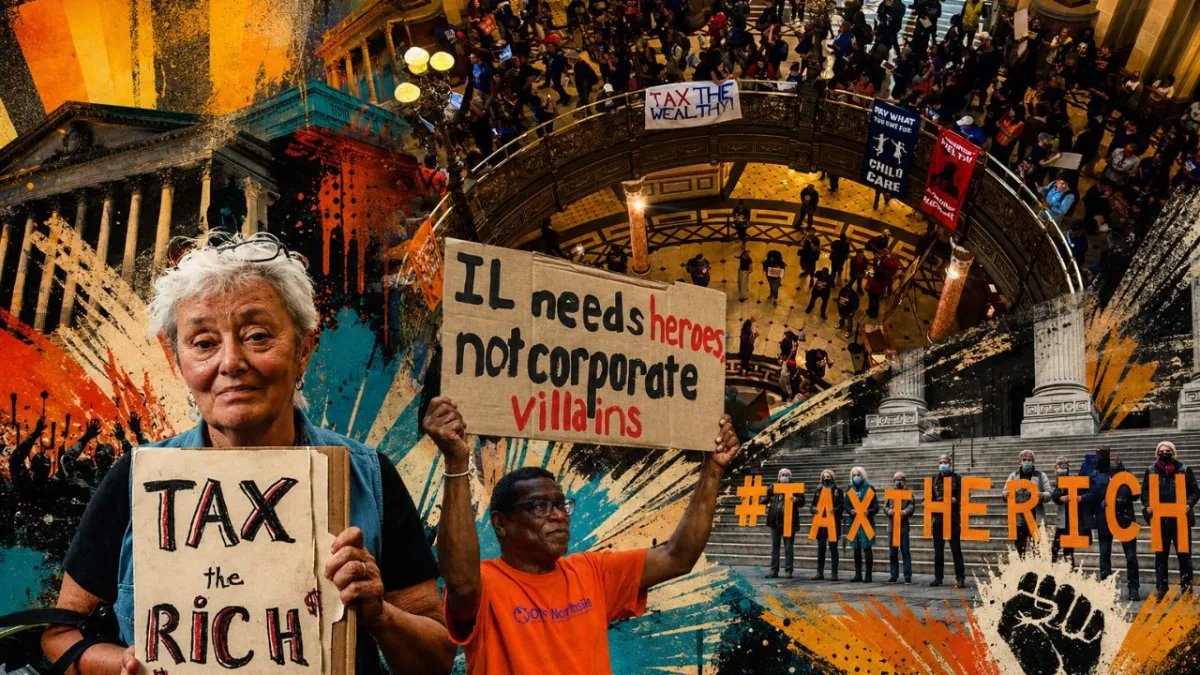
We knew we needed to move the broader public narrative, so we came back to the adage that actions are the lifeblood of organizing. Grassroots Collaborative and our national network, PowerSwitch Action, designed PowerUp, a campaign with our members, four other organizations, and two major local unions to train leaders and organizers, and engage in dramatic actions that would captivate public attention around a clear, moral question: Should mega-corporations and the ultra-wealthy pay more in taxes to fund critical public services? We aimed to take actions that could secure concrete victories and undercut the power of the wealthy at the state level, while highlighting their ties to the authoritarian apparatus at the federal level.
PowerUp held actions on Amazon, Meta, and Google to call attention to how these tech giants are powering and profiting off Donald Trump’s attacks on our communities: All three donated $1 million to Trump’s inauguration, while Amazon’s cloud division provides services used by the Department of Homeland Security and ICE. The People’s Lobby led a nonviolent civil disobedience action with PowerUp allies that shut down an Amazon warehouse for four hours. Twelve people were arrested disrupting blocking delivery trucks while demanding that Illinois tax corporations that benefit from Trump’s agenda and use the revenue to protect Medicaid, SNAP, schools, and other public services threatened by federal cuts. The action made this connection explicit by bringing Medicaid recipients, health care workers, and community members threatened by Trump’s tax cuts to Amazon’s warehouse, where they disrupted deliveries and demanded that Illinois protect essential services by taxing corporations like Amazon and rejecting Trump’s corporate tax agenda. More actions were held at corporate offices and, in the final weeks of the legislative session, tactics shifted to legislators, with visits and marches to their offices and banner drops around their home districts.
In parallel, ILRA organized massive days of action at the state capitol and grassroots lobbying of legislators. SEIU Healthcare, Chicago Teachers Union, ICIRR, Citizen Action Illinois, and other organizations like ours held lobby days, ran digital ads, and organized weekly phone banks patching constituents through to their lawmakers. Our organizations’ lobbying and government relations staff collaborated daily inside the capitol, working with legislative allies to make sure chamber leaders heard the demand for progressive revenue.
Through a coordinated and escalated campaign of nonviolent direct action and lobbying efforts, along with a strong “inside game” by bill sponsors and corporate tax champions State Sen. Robert Peters and State Rep. Norma Hernandez, we secured our biggest victory yet: the passage of the digital ads tax. This measure — proposed initially in 2021 by Action Center on Race and the Economy, which continued to play an important role throughout this effort — became a top ILRA priority starting in 2025. Estimates of how much revenue will be generated by the measure vary, with the Center for Tax and Budget Accountability estimating $800 million, and estimates based on projected revenue for U.S. digital advertising from major tech companies projecting $1.2 billion. These revenues would be gleaned from corporations like Google, Amazon, and Meta (as Facebook is now known) that make hundreds of billions of dollars in digital advertising revenue.
Taking on Authoritarian Forces and Realizing Concrete Wins for Our People
This breakthrough was possible now as it has become increasingly obvious to people that the same forces starving our state of resources are also core pillars of Trump’s authoritarian regime. People see the ultra-wealthy’s assets ballooning, news of trillion-dollar compensation packages for corporate executives, and new rounds of trillion-dollar tax breaks, all while corporate CEOs stand with Trump and masses of people struggle to afford housing and health care. Organizers must continue to connect the dots to show that we can tax extreme wealth and our governments can and must use that revenue to address the needs of the vast majority of Americans. Going on offense with a bigger vision for the kind of world we want to win, and who has the wealth to pay for it, is a key element in fighting authoritarianism.
At the core of our success has been coalitional work that is fueled by trust built over many campaign cycles. It can be tough and messy but is necessary to have any chance of winning. Not many foundations jump to fund campaigns to tax the rich. Our tables have often been unstaffed or understaffed, but our teams put in the hours and scraped together resources that partners could spare, trusting that the collective effort would add up. The breadth of our coalitions created greater collective power, but it left unresolved the question of what new revenue should be spent on. Coalitions should begin that discussion early enough to shape who is at the table and how the campaign speaks to the public, while keeping the initial agreement broad enough to hold diverse partners together. The key choice is whether to dedicate revenue to specific widely felt needs — such as education, public transit, health care, or housing, or leave it available for the general budget. In other states, ballot initiatives were successful when new funding was tied to specific needs like education and public transit. In states where ballot initiatives are available, we would encourage organizers to consider pairing taxes on concentrated wealth or corporate profits with specific, popular public investments.
To be clear, the budget passed by the Illinois General Assembly still did not meet the moment. It fell short on many issues: significant underfunding of public education, no badly needed raises for frontline workers who care for the elderly, and an inadequate safety net for thousands who will lose SNAP and Medicaid benefits due to federal cuts. It will take bolder actions, new alliances, and organizing to build public pressure on decision-makers.
Illinois legislators have become more proactive as a result of our campaigns. In addition to the digital ads tax, legislators passed other measures to bring in needed revenue, such as a social media platform fee, protecting Illinois from one of Trump’s federal tax giveaways, and a tax on cryptocurrency. More of them can see the widening gap in power and wealth and, now that we have called the question, are declaring with their votes that Big Tech corporations — instead of donating to ballrooms and inaugurations and accumulating profits and asset valuations — ought to contribute more to the well-being of Illinois families and to pay their fair share toward schools, health care, food, affordable housing, and all the public services our families deserve.
Our successful fight for the digital ads tax, along other legislative campaigns that fell short this year, taught us that combining forces and strategies; exposing and polarizing around oligarchic villains like Big Tech; drawing the connections between austerity’s legacy in Illinois, the affordability crisis, and Trump’s handouts to the ultra-wealthy; and putting this fight in public view, can disrupt “business as usual” and force lawmakers to take a side. We are doubling down on our efforts, and in order for them to win, more people need to join the fight.
This article was originally published by Truthout and is licensed under Creative Commons (CC BY-NC-ND 4.0). Please maintain all links and credits in accordance with our republishing guidelines.
Shaddi Zeid is the Political Director at The People’s Lobby. A veteran of both the 2016 Bernie Sanders and Hillary Clinton presidential campaigns, Shaddi has spent more than a decade at the intersection of electoral politics, grassroots organizing, public policy, and governance. His experience spans presidential and local campaigns, city government, criminal justice reform, state budget battles, and progressive revenue initiatives. Before joining The People’s Lobby, he served in the New York City Mayor’s Office and worked on campaigns across the country.
Hannah Gelder has organized with ONE Northside since 2008 and currently serves as its Director of Organizing. Over the years, she has trained hundreds of community leaders, built statewide coalitions, and helped secure victories on healthcare access, affordable housing, and progressive tax policy. Hannah is deeply committed to ensuring every community has the resources it needs to thrive.
Marla Bramble joined Grassroots Collaborative as Deputy Director in 2024, bringing more than two decades of organizing experience. As a disabled woman, Marla is guided by a vision of a society where everyone’s humanity is valued and everyone has the resources to flourish. Her work organizing alongside Black, Brown, Jewish, and working-class communities has helped win major victories on affordable housing, police accountability, immigration, and economic justice throughout Chicago and Illinois.
Editor’s Note: At a moment when the once vaunted model of responsible journalism is overwhelmingly the play thing of self-serving billionaires and their corporate scribes, alternatives of integrity are desperately needed, and ScheerPost is one of them. Please support our independent journalism by contributing to our online donation platform, Network for Good, or send a check to our new PO Box. We can’t thank you enough, and promise to keep bringing you this kind of vital news.
You can also make a donation to our PayPal or subscribe to our Patreon.
Please share this story and help us grow our network!
[ad_2]
Source link
