
[ad_1]
Joshua Scheer
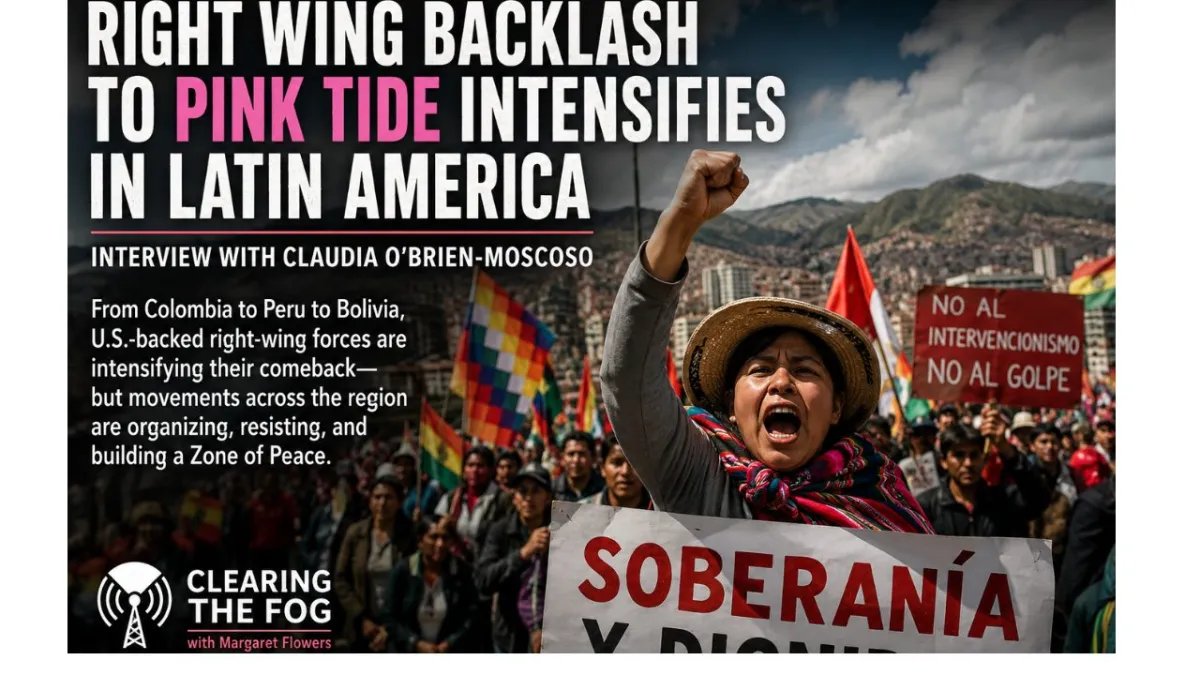
As right-wing governments regain ground across Latin America, grassroots movements are warning that the region is entering a new phase of political confrontation. Following years of progressive victories known as the “Pink Tide,” conservative forces—often backed by economic pressure, foreign intervention, and elite political networks—are reclaiming power in countries such as Colombia and Peru. Yet across the region, labor unions, Indigenous communities, anti-imperialist organizations, and popular movements continue to organize in defense of sovereignty, democracy, and social justice.
On this week’s Clearing the FOG, host Margaret Flowers speaks with Claudia O’Brien-Moscoso of the Black Alliance for Peace Haiti/Americas Team about the growing right-wing backlash sweeping Latin America. They examine recent elections, allegations of foreign interference, escalating U.S. military and economic pressure, and the broader struggle between imperial power and popular movements. The conversation also explores the campaign to build a Zone of Peace in Our Americas—an effort to strengthen solidarity across the hemisphere in the face of increasing militarization and political instability.
Whether discussing Colombia, Peru, Venezuela, Bolivia, or the wider region, this interview argues that today’s political battles are part of a much larger struggle over who will shape Latin America’s future—and what role the United States will continue to play in it.
As elections reshape the political landscape from Colombia to Peru and Bolivia, many activists warn that the region is witnessing more than ordinary political change. They see a coordinated effort to roll back years of progressive gains through economic pressure, foreign influence, and expanding militarization. In this interview, Claudia O’Brien-Moscoso explores why many organizers view today’s struggles as part of a broader battle over Latin America’s future—and why solidarity across the Americas has become more important than ever.
Claudia “Clau” O’Brien-Moscoso is a journalist, organizer, and co-coordinator of the Black Alliance for Peace Haiti/Americas Team. Originally from Barrios Altos, Lima, she grew up in New Jersey before dividing her time between the United States and Peru.
As Claudia O’Brien-Moscoso argues throughout this discussion, the struggle unfolding across Latin America is about far more than the outcome of individual elections. It is a contest over political sovereignty, economic independence, and who will control the region’s future. Whether in Bolivia, Colombia, Peru, or Venezuela, social movements continue to organize despite electoral defeats, economic pressure, and political repression. The interview suggests that while the recent resurgence of the right marks a significant setback for the region’s progressive movements, it has also strengthened calls for greater coordination, solidarity, and grassroots organizing across the Americas.
For audiences in the United States, the conversation raises broader questions about the relationship between U.S. foreign policy and political developments throughout the hemisphere. O’Brien-Moscoso emphasizes that solidarity begins with understanding the experiences of those directly affected and supporting independent reporting and cross-border organizing efforts such as the Black Alliance for Peace’s Zone of Peace campaign. Whether or not one agrees with every analysis presented, the discussion offers an opportunity to examine how Latin America’s political future is being shaped by both internal struggles and international forces—and why those developments continue to have implications far beyond the region itself.
Perhaps the most important takeaway from this conversation is that political change is measured not only by elections, but by the strength of the organizations that survive them. O’Brien-Moscoso repeatedly returns to the importance of unions, Indigenous communities, neighborhood organizations, and popular movements that continue organizing regardless of who occupies the presidential palace. In her view, governments may rise and fall, but durable political power is built over years of education, local organizing, and solidarity.
The interview ultimately asks listeners to look beyond headlines about victories and defeats. Across Latin America, movements continue to defend sovereignty, challenge foreign intervention, and organize for economic justice even in moments of political setback. Whether those efforts succeed or fail, the conversation offers an important reminder that democracy is not simply something exercised at the ballot box—it is something built and defended every day by ordinary people.
The show is a reminder of the enduring strength of grassroots movements across Latin America. For those who believe—as some policymakers in Washington appear to—that military force, sanctions, kidnappings, or bombings can erase decades of organizing, this conversation offers a different perspective. Again and again, O’Brien-Moscoso points to the resilience of communities that continue to organize, resist, and rebuild despite immense external pressure.
What emerges throughout the discussion is a deeper question: Who controls a nation’s resources? Who makes the economic decisions that shape people’s lives? And can communities determine their own future free from outside intervention? As new governments take office and political tensions continue to rise, one message comes through clearly: the struggle over Latin America’s future is far from over, and the movements on the ground remain committed to fighting for the vision of sovereignty, democracy, and social justice they believe their countries deserve.
Further reading and viewing: Evo Morales on Bolivia’s Political Crisis, Popular Resistance and the Fight for Sovereignty
In a two-part exclusive interview for Black Agenda Report, journalist Claudia O’Brien-Moscoso speaks with former Bolivian President Evo Morales about the country’s deepening political and economic crisis following the election of President Rodrigo Paz. Morales argues that Bolivia’s weeks-long general strike is not simply a response to rising prices and fuel shortages but a broader rejection of what he describes as a return to neoliberal economic policies, privatization, and foreign intervention.
Morales contends that the government’s agreements with the International Monetary Fund, the removal of subsidies, tax changes affecting small producers, and plans involving Bolivia’s lithium resources have fueled widespread demonstrations led by workers, Indigenous communities, and peasant organizations. He characterizes the unrest as both an economic revolt and a struggle to defend Bolivia’s sovereignty, natural resources, and Indigenous political gains achieved during the Movimiento al Socialismo (MAS) era.
Throughout the interviews, Morales also discusses what he views as growing U.S. involvement in Bolivia. He points to statements by U.S. officials supporting the current government, alleges increased military and security cooperation, and argues that Bolivia’s vast lithium reserves have become a central geopolitical target. According to Morales, the country’s current conflict cannot be separated from broader international competition over strategic resources and political influence in Latin America.
The second installment focuses on internal divisions within Bolivia’s left. Morales reflects on his relationship with former President Luis Arce, acknowledging mistakes made during his own administration while arguing that subsequent governments abandoned the economic model that he says expanded public investment and reduced poverty. He also discusses the formation of his new political movement, Evo Pueblo, and claims that legal obstacles prevented him from participating in the 2026 presidential election.
Looking beyond Bolivia, Morales connects the country’s political crisis to wider developments across Latin America. He discusses events in Venezuela, Cuba, and the growing influence of the BRICS nations, arguing that the region is experiencing renewed pressure from the United States even as new multipolar alliances emerge. Throughout both interviews, Morales presents Bolivia’s ongoing protests as part of a larger struggle over democracy, Indigenous political participation, economic sovereignty, and resistance to foreign intervention.
Editor’s Note: At a moment when the once vaunted model of responsible journalism is overwhelmingly the play thing of self-serving billionaires and their corporate scribes, alternatives of integrity are desperately needed, and ScheerPost is one of them. Please support our independent journalism by contributing to our online donation platform, Network for Good, or send a check to our new PO Box. We can’t thank you enough, and promise to keep bringing you this kind of vital news.
You can also make a donation to our PayPal or subscribe to our Patreon.
Please share this story and help us grow our network!
[ad_2]
Source link
