
I came across a few news items that I could possibly write about today and couldn’t decide which to cover, so I will write about all of them, since they all relate to renewable energy. The first is a new study comparing direct air capture (DAC) to installing new wind and solar. This is a direct comparison between these two options, to see which provides the most bang for the buck.
DAC involves taking CO2 directly out of the atmosphere in order to mitigate carbon release through burning fossil fuels. If this technology were sufficiently efficient it could be hugely useful in reducing future climate change. This is the only approach that can potentially have a negative carbon footprint, actually reducing the amount of CO2 in the atmosphere. Other technologies simply reduce the amount released. This negative carbon factor is highly attractive since it could theoretically zero out our carbon release and even take us back in time to an atmosphere with less CO2. Right now, it should be noted, we are not only continuing to release massive amounts of CO2 into the atmosphere, the amount continues to increase. In 2025 the world emitted 38.1 billion tonnes, of carbon, a 1.1% increase over 2024.
But there are problems with DAC – it is currently not very efficient and is not scalable enough to have enough of an impact. Also, the efficiency of DAC depends heavily on how you power it – if you connect it to the grid and there is some fossil fuel energy on that grid, you may actually increase CO2 rather than decreasing it. Ideally DAC would be powered entirely by low carbon energy sources. This is why critics of DAC argue that it simply makes no sense to deploy this technology before we have decarbonized the energy sector, which we should do first.
In the current study they ask a critical question – if we directly compare DAC to deploying wind and solar, which provides the greater reduction in energy pollution per dollar spent. They also considered both the environmental and health impacts. They further considered three scenarios – current DAC technology, significant advances in DAC technology, and a massive breakthrough in technology. They also did their analysis for the entire US and for different regions. What they found was that deploying renewable energy was more cost effective for every region of the country under the current technology and significant advances scenarios. In the massive breakthrough scenario the results were mixed by regions, with a slight net advantage country-wide to DAC.
In my opinion this just adds to the conclusion that we should first decarbonize the grid with a combination of low carbon energy sources, including maximizing wind and solar while maintaining or even expanding our nuclear infrastructure, and only then invest in significant DAC. We can continue to research DAC in the meantime, and then deploy only when it gets significantly more efficient, in order to offset industries that are difficult to decarbonize.
There are a couple of solar power updates worth discussing as well. The first is that we are getting very close to commercializing tandem silicon and perovskite solar cells. Silicon is the current standard, with most commercial panels at 22-23% efficiency, with high-end panels at about 26%. This is pushing up against the theoretical limit for silicon (32%), and many experts think we will not get much closer to this theoretical limit because of some unavoidable sources of energy loss. This is where perovskite comes in – this is widely considered to be the next material to replace silicon in high efficiency solar cells. But even better, silicon and perovskite absorb light at different frequencies, so when you combine them in tandem you get even higher efficiencies. The current record is produce by LONGi (a Chinese solar panel company), with a commercial tandem panel with verified 34.6% efficiency. They plan to make these panels available in 2027-2028. Also, the theoretical upper limit of efficiency of this tandem design is 43%.
However, perovskite still has a longevity problem. For these tandem panels the silicon component lasts 20-25 years with minimal efficiency loss. The perovskite, however, only lasts 10-12 years. This is insufficient for residential use, but still useful for grid-scale projects. With large projects it is cost effective to pay for the higher end panels, and replacing them with even better panels in 10 years is not a bad investment anyway. But home owners don’t want to do this. However, there is a great deal of research into extending the lifespan of perovskite panels (for example). Another Chinese company, GLC, has announced a tandem solar cell with a 25 year warranty, and with an efficiency of 26%. We are quickly heading for panels with both efficiencies in the mid 30s and a lifespan of 25 years.
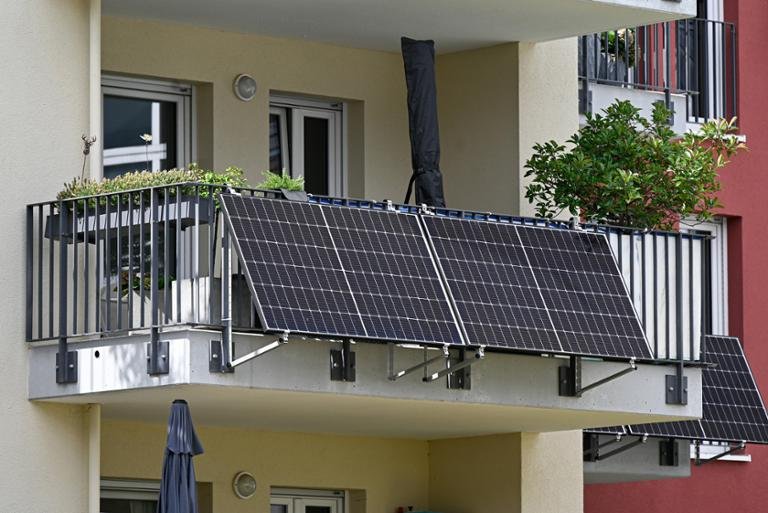
The availability of relatively cheap and highly efficient solar panels has also given rise to a new industry – plug-in solar (also called balcony solar). These are stand-alone panels you simply plug into a regular outlet, which can both accept and deliver energy. That’s really it. You have to mount it somewhere, but most people do not put it on their roof but rather on a stand or attached to their balcony or similar structure. This is useful for renters, apartments, mobile homes, remote locations like cabins, or even to supplement existing rooftop installations. In general you will recoup the cost of the panel in reduced energy bills in seven years, while the panel itself should last for 30 years. These are already very popular in Germany where they have been used for a decade without any safety issues.
Utilities companies in the US have been trying to slow their adoption, arguing that they present safety issues. For example, if they are sending current to the grid they could endanger utility workers. However, this is likely a diversionary tactic to slow the adoption of a competing technology. Units are already designed not to send energy to the grid when there is a power outage. The safety record in Germany is pretty solid evidence that they can be used safely. For most users plug-in solar would not power their entire home, but would shave money off their energy bill and reduce their carbon footprint.
The great thing about plug-in solar is that there are no issues with grid stability since most users will be simply reducing their baseload demand, not producing excess energy that has to go to the grid. But because they can be widely distributed, these small reductions in grid energy demand can be significant. This could be a useful supplement to grid-scale and rooftop solar. And of course they can be especially useful when paired with home battery backup, or even just an EV.
With recent events in the Mideast, including national average gas prices at $4.45 per gallon and electricity costs up 7.4% over last year, it seems like a good time to push for energy technologies that are not reliant on a vulnerable infrastructure partly in unstable parts of the world. These events also highlight that we can never achieve true energy independence simply by producing more oil, as oil prices are set as a global commodity. Solar, however, can be true energy independence, harvested right where it is used. Of course, this raises an entirely different discussion about maintaining domestic renewable energy technology and raw material supply chains. This is why invested in the technology of tomorrow rather than doubling down on fossil fuels is so critical.
