
[ad_1]
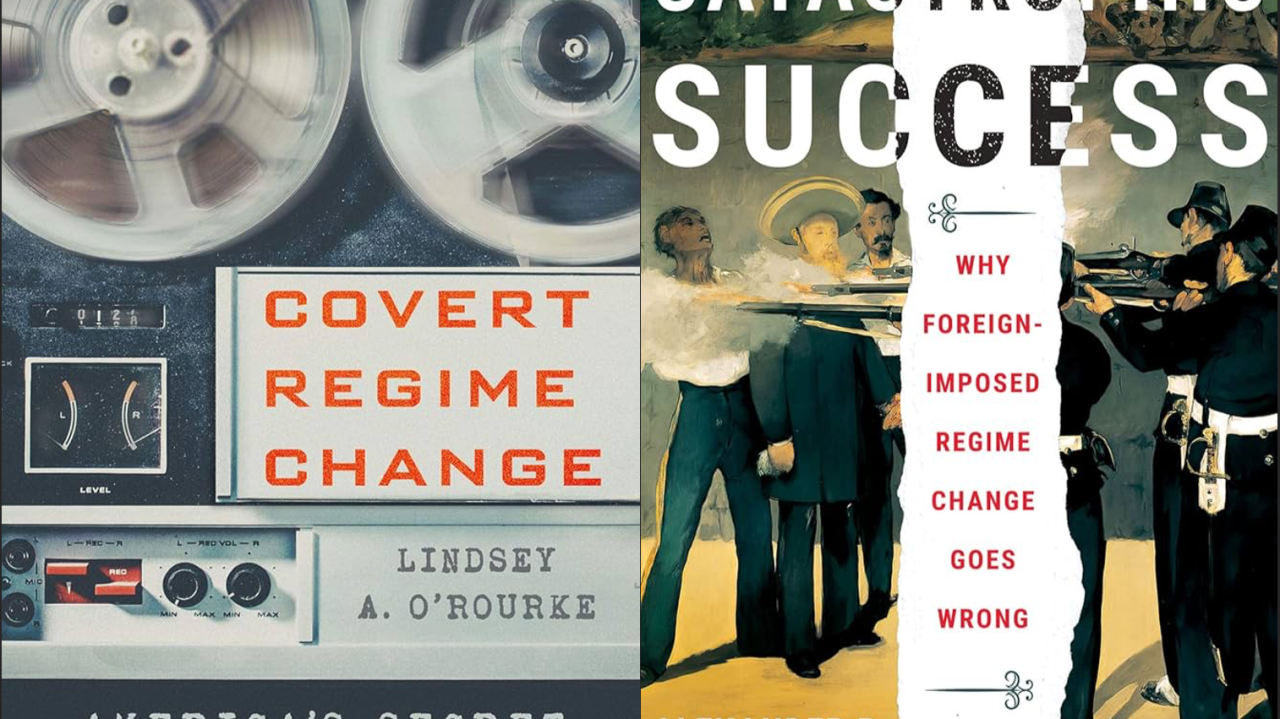
The modern international order rests on a contradiction rarely examined in full daylight. Western states present themselves as guardians of international rules, democracy, and self-determination, yet the historical record of their behavior abroad tells a different story — one written not in treaties or speeches, but in classified cables, deniable operations, and shattered political systems. Covert Regime Change, first published in 2018, matters because it documents, with unusual rigor, how this contradiction became a governing method. Lindsey A. O’Rourke, Associate Professor at Boston College, does not ask whether covert intervention occasionally went wrong. She demonstrates that it became a routine instrument of statecraft, one whose predictable consequences were political collapse, mass violence, and long-term instability.
The book’s starting point is empirical, not rhetorical. O’Rourke assembles the most comprehensive dataset to date of U.S.-backed regime change attempts during the Cold War, identifying seventy cases between 1947 and 1989. Sixty-four were covert. Only six were overt. This imbalance is not incidental. It reveals a strategic preference for secrecy as a means of exercising power without democratic constraint. Covert regime change allowed policymakers to intervene repeatedly while insulating themselves from public accountability.
O’Rourke also dismantles the notion that covert regime change primarily served democratic ends. Statistically, covert interventions overwhelmingly produced authoritarian outcomes. Where democratic transitions occurred – and they are hard to find – , they were more often associated with overt interventions, where public scrutiny imposed limits. Secrecy correlated with repression, not reform. O’Rourke’s findings dispel the myth that the US fought for democracy during the Cold War: “The United States supported authoritarian forces in forty-four out of sixty-four covert regime changes, including at least six operations that sought to replace liberal democratic governments with illiberal authoritarian regimes. Yet, Washington’s proclivity for installing authoritarian regimes was also not absolute. In one-eighth of its covert missions and one-half of its overt interventions, Washington encouraged a democratic transformation in an authoritarian state.” In other words: Washington supported whatever regime or rebel group served its interests — and showed little concern for democracy.
What makes the book so unsettling is that it refuses to stop at the moment of intervention. O’Rourke tracks what followed. Using comparative statistical analysis, she shows that states targeted by covert regime change were significantly more likely to experience civil war and mass killings. Her statistical analysis shows that “states targeted for covert regime change were 6.7 times more likely to experience a Militarized Interstate Dispute with the United States in the ten years following intervention.” US regime change operations also steeply increased episodes of mass killing: “States targeted in successful operations were 2.8 times more likely to experience an episode of mass killing, whereas states targeted in failed covert missions were 3.7 times more likely.”
Vietnam demonstrates how covert regime change could deepen rather than prevent war. Before large-scale U.S. troop deployments, Washington pursued covert efforts to shape South Vietnam’s leadership. O’Rourke reconstructs the U.S. role in facilitating the 1963 coup against President Ngo Dinh Diem. Rather than stabilizing the regime, the coup fragmented power and intensified dependence on U.S. military support. What began as covert political manipulation ended in a war that killed millions of Vietnamese and devastated the region.
In the Western Hemisphere, the United States utilized hegemonic operations to enforce a brutal regional conformity, often at the direct expense of democratic institutions. The CIA-backed overthrow of Jacobo Árbenz in 1954 destroyed Guatemala’s young democracy. Guatemala’s subsequent trajectory: decades of military rule, a civil war lasting more than thirty years, and the killing of roughly 200,000 people, the majority civilians. Indigenous communities were systematically targeted.
The case of the Dominican Republic illustrates the cold transition from secret meddling to open violence. The US first backed Rafael Trujillo’s dictatorship. Following the 1961 assassination of Trujillo — an operation in which the CIA provided the weapons — the country attempted a fragile democratic opening. When the reformist Juan Bosch won the presidency in 1962, his refusal to launch a McCarthyite purge of domestic leftists led Washington to view him as a “weak link” in the regional defense against communism. After Bosch was ousted in a military coup, a popular uprising in 1965 sought to restore the democratic constitution. Fearing a “second Cuba,” the Johnson administration launched a massive overt invasion to crush the rebellion and install a more compliant regime. The empirical record here is clear: for American planners, the survival of a pro-Washington hierarchy was far more important than the survival of a Caribbean democracy.
One of the book’s most analytically important findings concerns repetition. States subjected to one covert regime change attempt were far more likely to experience subsequent interventions. Covert action did not resolve instability; it institutionalized it. Political systems weakened by external manipulation became perpetual sites of interference.
The moral failure documented in Covert Regime Change is therefore not accidental. It is structural. Secrecy enabled policymakers to externalize violence, displace responsibility, and treat foreign societies as experimental terrain. Civil wars prolonged, civilians killed, and political futures destroyed were foreseeable consequences of deliberate choices.
Proxy Wars and Moral Evasion
One of the most revealing dimensions of Covert Regime Change is the attention it pays to proxy warfare. Covert intervention rarely meant the United States acted alone. It meant empowering others to act violently on its behalf, often with full awareness of who those actors were and what they represented.
The rollback operations in Eastern Europe during the early Cold War provide one of the clearest illustrations. O’Rourke documents U.S.-backed covert efforts to destabilize Soviet-aligned regimes in countries such as Albania, Romania and Ukraine through the infiltration of exile groups and paramilitary networks. These operations were conceived as low-risk alternatives to direct confrontation with the Soviet Union. In practice, they relied heavily on émigré militias whose ideological and historical backgrounds were deeply compromised.
Many of these groups included former collaborators with Nazi Germany and fascists, implicated in wartime atrocities. This was not incidental. They were selected precisely because of their militant anti-communism and organizational cohesion. O’Rourke shows that U.S. officials were aware of these backgrounds and proceeded regardless. The operations themselves were militarily ineffective. Infiltrators were frequently captured or killed soon after insertion. What they did achieve was the reinforcement of authoritarian control. The existence of covert Western-backed networks confirmed Soviet narratives of external subversion and justified intensified repression across Eastern Europe.
Afghanistan represents the most consequential case of proxy warfare in the book. During the Soviet occupation, the United States conducted one of its largest and most expensive covert operations, channeling billions of dollars in weapons and support to Afghan resistance fighters. These forces were often described in sanitized terms, but O’Rourke is clear about their ideological character. Most were brutal Islamist extremists, organized around rigidly authoritarian visions of society.
The objective of the operation was narrowly defined: bleed the Soviet Union and force its withdrawal. On those terms, it succeeded. What followed, however, was political collapse. After the Soviets left, U.S. engagement rapidly diminished. Afghanistan descended into civil war as rival militias turned their weapons on one another and on civilians. Out of this chaos emerged the Taliban, followed by transnational jihadist networks whose violence would reverberate globally. The intervention did not merely fail to build a viable state; it actively contributed to the conditions under which one of the most repressive regimes of the late twentieth century took power.
Western publics rarely saw the consequences of policies carried out in their name. Violence was outsourced to proxies. Responsibility was fragmented across agencies and allies. Failure could be reframed as complexity or local pathology. What Covert Regime Change ultimately makes impossible is the claim that these outcomes were unfortunate side effects of well-intentioned policies. The evidence shows that policymakers repeatedly chose secrecy over accountability, power politics over democracy, and short-term advantage over human cost. The victims were not abstractions. They were civilians caught between armed factions, dissidents silenced, and societies denied the chance to determine their own futures.
Power Without Reckoning
By the end of Covert Regime Change, the accumulation of evidence leaves little room for comforting interpretation. It documents a system of intervention that functioned as intended — discreet, flexible, and largely insulated from domestic scrutiny — while producing outcomes that were consistently destructive for the societies it targeted. Failure abroad rarely translated into accountability at home. The result was a cycle in which intervention became easier precisely because its consequences were borne elsewhere.
The statistical findings reinforce this interpretation with striking consistency. States subjected to covert regime change were more likely to experience adverse regime transitions — coups followed by coups, fragile governments replaced by more repressive ones. Civil wars in these countries lasted longer and were harder to resolve. These were not marginal increases. They were structural shifts in political trajectory, affecting millions of lives over decades.
O’Rourke’s insistence on evidentiary discipline gives these conclusions their force. She shows how similar mechanisms produced similar outcomes under varying conditions. Whether in Latin America, Africa, Europe, or Asia, covert regime change followed a recognizable script: identify a political outcome deemed unacceptable, undermine it quietly, empower local actors willing to use force, and withdraw once immediate objectives were met. What followed — repression, civil war, or long-term instability — was treated as local failure rather than external design.
Covert Regime Change challenges the reader to reconsider how international responsibility is assigned. Violence that is indirect is no less real. Harm that is delayed is no less consequential. Political destruction carried out through intermediaries is no less deliberate.
As a work of scholarship, the book is meticulous and restrained. As a historical record, it is devastating. It reveals an era in which power was exercised without witness and accountability. The world that emerged from those decisions — fractured, militarized, and distrustful — is their legacy. The enduring lesson of Covert Regime Change is that secrecy does not merely hide violence; it makes it sustainable, allowing great powers to destroy other societies while preserving the illusion of innocence at home.
Michael Holmes is a German-American freelance journalist specializing in global conflicts and modern history. His work has appeared in Neue Zürcher Zeitung – the Swiss newspaper of record – Responsible Statecraft, Psychologie Heute, taz, Welt, and other outlets. He regularly conducts interviews for NachDenkSeiten. He has reported on and traveled to over 70 countries, including Iraq, Iran, Palestine, Lebanon, Ukraine, Kashmir, Hong Kong, Mexico, and Uganda. He is based in Potsdam, Germany.
[ad_2]
Source link
