
[ad_1]
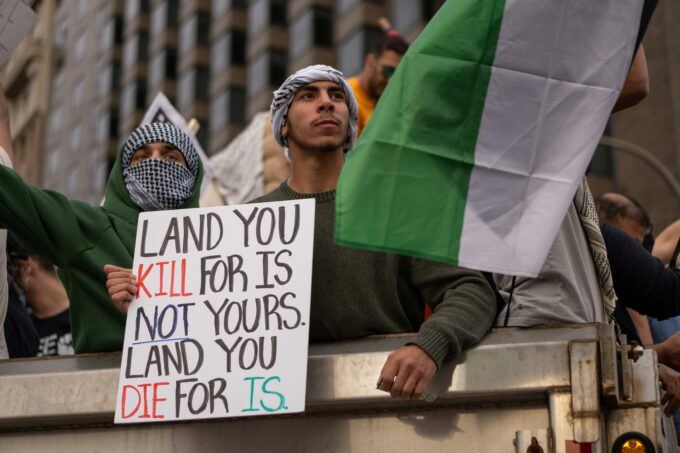
Image by Ian Hutchinson.
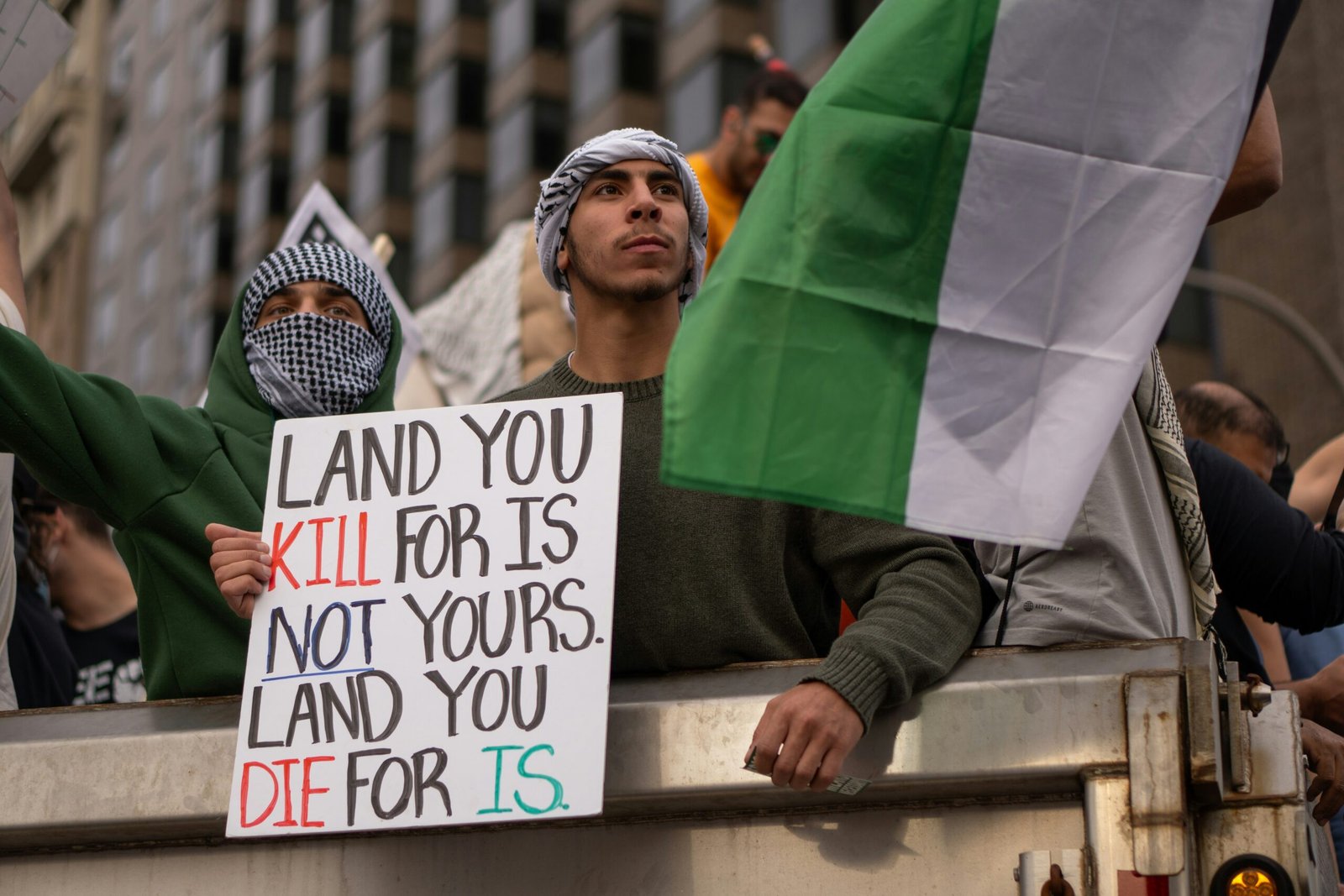
The power of the most important protest movement of our time, the Palestine Solidarity movement, lies in how it shaped a new political consciousness, especially among younger generations on campuses. The movement itself was brutally repressed, particularly in Western countries. In the Middle East and Maghreb, the pro-Palestinian protests that continue on a smaller scale are often cautiously tolerated by the regimes, in light of the vast, popular support of the Palestinians in the region.
The astonishing international sweep of student encampments in the Spring of 2024 helped to unmask western “democracies,” the self-proclaimed heirs of ancient Greek and enlightenment ideals, and to generate a fundamental shift in popular sentiment, the world over, against the US and Israeli imperialist war machines. Above all, it transformed a new generation, who developed, by their encampments and protests, alternative practices of freedom and democracy. How this critical consciousness and transformative socio-political experiment might again take historic form in the future we shall see.
The Palestine solidary encampments succeeded in forging small yet powerful spaces of democracy, particularly in the few cases that did not meet with repression. What happened when these solidarity encampments evolved on the students’ own terms? We cannot fully know in the case of most of the over 300 encampments that spread in waves worldwide during the Spring of 2024, inspired by the Columbia student protests against the Israeli genocide in Gaza. Most university administrations followed Columbia’s lead in their near-immediate repression of students’ peaceful protests, whereby they invited the police to storm the universities, assault and arrest students and faculty, and confiscate and demolish the encampments’ material culture.
One of the rare encampments allowed to progress was at Bard College. In May of 2024, I visited my son, a student at Bard, who was part of the Palestine Solidary encampment. What I discovered during my visit stunned me: the students developed novel forms of collective life, political practice, educational programs, solidarity and resistance, from local to national. Their protest focused on the genocide in Gaza and Palestinian liberation, but also integrated other large and ostensibly small causes, as represented in their list of demands. The students presented, on a level plane, as related and worthy, demands concerning campus worker rights; a demand to challenge Executive Order 157; a demand for the creation of an intercampus board of students, staff, and faculty to oversee future investments; the creation of scholarships and relief funds for Palestinian survivors of the Israeli genocide; and a demand for year-around housing and jobs for displaced students present and future, particularly for the significant number of Afghan refugee students that the Bard administration, in an impressive act of solidarity, had admitted with financial support.
Students for Justice in Palestine (SJP), which at first included a modest number students, grew almost overnight to over 50 members, with 150 daytime participants (out of just under 2500 students). Bards’ Palestine solidarity encampment in fact included a curiously motley group, growing in number by the day, who formed a “Popular University for Gaza,” as well as a new social and political order that the longer duration of their encampment afforded them. Like the monster solidarity demonstrations for Gaza simultaneously taking place London and Paris, that drew in every kind of person, the majority of participants in the Bard encampment were in fact not Palestinian, Arab, or Jewish. The second largest group was Jewish, and the smallest component was Palestinian and Arab, and some students were a mix of all of these and more, like one student leader who is of Jewish American and Singaporean Chinese parentage. Ben, a student participant, told me that the encampment was not at all “cliquish,” and he was surprised to watch a significant number of conventional students he hardly knew inexplicably join in, who had previously, he esteemed, “had nothing to do with anything,” let alone with Israel, Palestine, or politics generally.
The Bard administration tolerated their student encampment, and negotiated and accepted student demands, while most other university administrations in the US capitulated to the US government’s pressure to take measures so repressive as to go down in history. Why did Bard not follow suit? Arguably, Bard could more easily accommodate student demands, as it did not have many investments yet (but the endowment has since significantly increased). But this does not explain enough. More telling is the administration’s exceptional program, founded in 2009, offering dual degrees with Al-Quds University in East Jerusalem, which is Palestinian. This is an inconceivable project for any other university in the United States or Europe.
Bard College’s support of freedom of expression, non-conformity, and ingenuity, held up in this volatile context and international upheaval, judging by how the encampment was allowed to progress unharmed. The Bard encampment lasted longer than most in the US, and was able to draw on the college’s imaginative educational environment and traditions, as well as the richness of the unconventional backgrounds and experiences of many of the student participants themselves. The surprising result was that they created a commune that arguably falls within the tradition of the Paris Commune of 1871, which has wide-spread and diverse afterlives, as Kristin Ross demonstrates in Communal Luxury. The Paris Commune was short-lived and met with gruesome state repression, but its influence and reproductions (often unintentional) powerfully persist–even unto the idyllic Hudson River Valley, in this case.
The administration did not at first take student demands seriously, dragging along negotiations with the SJP student leaders, up until the moment when the students occupied the main administration building three days before graduation, barricading themselves inside with the diplomas. The only “repression” borne later was that several students were convoked for an internal hearing, with the presence of professors, for their responsibility for their unnamed comrades who had occupied the administrative building, and who ate over 200 dollars-worth of chocolates off the administrative assistants’ desks—which offended them and made them feel trespassed. Students succeeded in getting their demands met, negotiated and modified according to what was functionally possible, and with compromises. Student negotiators had to study up on finance and investment to be able to negotiate, thus gaining additional competences and respect.
I wanted to learn more about how these students decided to join this SJP adventure, what they thought they were doing, and from their own perspectives. I wanted also to understand how their “Free University for Gaza” and tent hamlet grew into an actual commune, even if on a small scale. In a series of conversations with student activists during and following my visit to Bard, I learned about what it was like for them to barely sleep, create art, recite poetry, deliver speeches and news updates from Gaza, Palestine, swap zines, write, teach, read, research, listen, sing together in several languages, depart in learning delegations to other campuses, hold meetings, workshops, regular Shabbat dinners, attend a feast, with evening music and reveries, offered by Afghani refugee students, receive solidarity meals and visitors, original speakers, and to manage disagreement, trash, and to collectively strategize, negotiate, meditate, and find community far and wide. I learned to what extent they developed their Palestine Solidarity commune deliberately, in the Thoreauvian sense of living reflectively and purposefully, relinquishing routine convention and starting anew.
Students not directly involved arrived bearing gifts: a group of art students devoted class time to creating artworks for the encampment, to adorn and instruct, and others were inspired to lend a hand, often in tiny ways, from behind the scenes. Mark’s roommate had laundered his clothes and set them folded neatly on his bed, ready to be taken back to the encampment. The going ethos of this encampment and commune was solidarity, hands on, and many students, professors, and visitors came by, often with their children, to exchange and offer help. Several encampment students were also members of a student committee that had previously joined the campus workers union to help negotiate better conditions and wages. The campus workers, in turn, helped the encampment, often with little prior knowledge of Palestine or Israel.
The student protesters’ venture was at once improvised and deliberate. In organizing the daily life and purpose of the encampment, students were inspired to flatten the requirements of hierarchy and specialization. All participated in intellectual activities and labor, skill training, decision-making by consensus, lectures, debates, workshops (on how to archive, for example), sharing knowledge and know-how with each other, as well as with students from other campuses. Former activists from Act-Up, a family from the Lenape people arrived by car from far away, all came to share and exchange with the students. They received a lecturer and former Bard student who conjured up an earlier natural world that surrounds them, extending through the northeast corridor, before European settlers invaded, depicting rich food forests, diverse flora and fauna very different from what we have today.
All the student protesters I interviewed declared that they had never learned so much and so intensely in all their lives than they had in the three weeks of the Palestine Solidarity encampment. I asked, “But from what or whom? “From each other,” came the answer. Their professors were largely lenient with deadlines and absences, telling them that nothing they can learn from them or in class could ever compare with what they are living. And a very large number of student protesters, now well-trained and disciplined, passionate, discerning, and high-performing, earned straight A’s that semester, despite being exhausted to the bone.
Perhaps unintentionally, in the organization of daily life and the astonishing ambition of their work and national reach, the Students for Justice in Palestine were closely following the teachings of Jacques Rancière in Le maître Ignorant (The Ignorant Teacher) and other writings. He demonstrated the universal accessibility, necessity, and complementarity of physical and intellectual labor practiced at once, whereby anyone can discover and learn organically, not through instruction but practice—overriding the debilitating hierarchy, in his view, of experts and pupils.
In connecting specific injustices surrounding them, students at Bard decided that protesting Israel’s genocide needed reinforcement, that they needed to create, on their modest scale, but with a demonstrably wide influence, a social and political world based on alternative practices and ways of being. They felt compelled to relate causes, casting a generous net.
The students practiced living respectfully of one another, integrating the environment and communities. Shorter-lived encampments nationwide created nascent communes in just a few days, and their approaches were strikingly similar, passed on between campuses but also inspired by their will to transform the social and political orders of their time. The immediacy of Israel’s genocide in Gaza, as well as western powers’ participation in this genocide, the pervasive silence and normalcy surrounding them, profoundly shocked them, as well as increasing numbers of students the world over—an entire generation of students, we could argue—collapsing the world as they thought they understood it. And they seemed to have stepped through to the other side, in a sense: not to dream up new political and social relations but to discover them by the kinds of thoughtful, experimental, collective work and solidarity that can generate such newness and transformation.
The students I interviewed are fascinating, extraordinary, always sustaining a healthy sense of auto-derision. “Palestine will not be liberated from Annandale-on-the-Hudson” students wryly remarked to one another. Yet it is the proliferation of such ambitious protests and experiments like that of Bard’s Palestine Solidarity encampment that have turned the tide against Israel, and reinforced resistance to predatory capitalism that is openly degrading populations and environments, producing the highest wealth concentrations in history. Students did not merely condemn society and the political order, but rather created a model and an alternative.
True, they could not directly set back, by a Palestine Solidarity encampment at Bard College, the powers that abet this central crime of our era. But collectively with wider movements, and in time, they might. What undeniably and directly changed were the participants themselves, who were transformed utterly by the experience of their encampment. Through student channels, a generation of young people influenced one another, over vast geographical expanses. Despite their detractors and anti-establishment politics, they are now passionate and impressive, and will undoubtedly, for one thing, land the best jobs in their fields (as demonstrated in a 5-year study of the Yale graduate student leaders, who faced severe institutional repression in the union strike of the 90s). And this new generation of politicized students will likely continue, in their social and political lives, to be effectual against injustice.
This unexpected movement against Israel’s genocide in Gaza provoked a shift in the tide which may not only eventually impede Israel’s colonial aggression, but reinforce resistance to a dominant social and political order. This order today, brashly defended by ruling elites, a tiny minority of humans, openly backed by brute force, overrides ecological health and human dignity for unprecedented financial gain.
And Bard student protesters were not free to “play revolutionaries,” as detractors trolled on social media, because they were part of a repressed yet powerful global movement. Regardless of how elite the campus, the possibility of violence loomed. As the Bard encampment progressed, the students were not so sure they would escape repression, particularly when they occupied the main administration building. They renamed the building Shaima’s Hall, in honor of the daughter of martyred Palestinian poet Refaat Al-Areer, and hung his famous poem “If I must die” on the front. The Israelis soon also killed Shaima, with her husband and infant daughter, by an airstrike on the headquarters of the Red Crescent International in the Al-Rimal neighborhood, where the family had sought shelter.
Only a few hours in advance, student leaders informed selected protesters who would take over the main administrative building at Bard. The students chosen to occupy it were identified as having the least to lose in case of arrest, so non-immigrant American citizens. They carefully followed the zine “How to Occupy a Building,” passed onto them by Columbia protesters, who themselves retrieved, from Columbia’s archives, the how-to report left by 1969 anti-war student protesters who had first over took Hamilton Hall. They followed their instructions to the T. Indeed, the forms taken of all the student protests were both organically conceived through practice and collaboration, and yet have deep roots.
The Bard students had increasingly felt frustrated by what they experienced as a deliberate bureaucratic “run-around,” or bad faith negotiations. Even with this tension and escalation, one student protestor reasoned that “Bard would not be Bard if they call in the police.” That same student said that when at 4 am he grabbed a crowbar, and was about to put on his ski mask, ready to force the door of the building they then occupied, he suddenly felt queasy, realizing that he could find himself, that very night, in the back of a police van.
Violent attacks against students would seem unlikely, on the face of it. Bard College, set on an inspiring waterfront of the Hudson River, is glorious, with rolling green fields, noble trees, woods, a rushing stream and waterfall for summer pleasures, banquets of art and music everywhere, and fine architecture, historic to contemporary. But it is also a wide-open campus, potentially vulnerable to the kind of attack that took place at UCLA, where a large number of masked, pro-Israel thugs invaded campus and beat student protesters bloody for hours on end while campus security stood by watching and LA police did not intervene. As such violence and willful state violation of student rights was unthinkable to this generation, Bard students were very aware of the possibility of this kind of attack, as certainly were students in all Palestine solidarity encampments internationally. Several of the student protesters, in a “sleep-deprived bout of nocturnal paranoia,” as one of the student leaders humorously described it, surrounded their encampment with cinderblocks in case attack vehicles barrel through in the middle of the night.
In one incident, tension rose between union members and the students when they replaced an American flag with a Palestinian one. The campus workers took it down, and the student leaders negotiated an exchange of flags. Mark noted that many students, especially ones raised in left-leaning or non-conformist households, do not necessarily have an idea what it is like to grow up pledging allegiance to the flag every morning in school, and to have learned to cherish it. He watched a YouTube video to teach himself how to fold a flag. When he ceremoniously handed it back to members of the workers’ union, whom he knows well, he assured them that it had not touched the ground.
This solidarity and growing community were foundational to this Bard Palestine Solidarity commune and the functioning of daily life. The arrival of Bard students new to politics parallels the fresh wave of student protesters at Columbia University who, shaken by the first wave of arrests of their classmates, and the police destruction of the solidarity encampment, moved to reoccupy the same central lawn and help rebuild the encampment. They asked politicized students to “give us language” and instruct them on how to proceed. Like at Columbia, at Bard, people from beyond campus arrived in solidarity, delivering whole meals to the encampment. Amalia, a student leader responsible for food arrangements, managed allergies and restrictions, saying “no pork please” many times a day to the people who offered meals prepared in local restaurants or their homes.
Amalia also ran the encampments’ nightly general assemblies, holding them down to a single hour, giving each person one minute to make a point (encouraging them to prepare their interventions), and decisions were made by consensus. News of this efficiency drew the interest of Palestine activists at Vassar and Yale, who sent delegations to Bard to workshop meeting organization. Amalia worked so hard, as did they all, that her comrades had to search for her, more than once, in the fields surrounding the encampment where she was given to spontaneously drop onto the grass in deep slumber.
I asked student protesters what they will remember years from now from their encampment lives. Cara expressed her daily, early morning astonishment, blinking in disbelief, when she found the encampment still there, saying to herself that this is really happening. Ben says that for once he got to class on time every time, given he was sleeping in tents just next to his classrooms. He volunteered to take-on long night security shifts, and developed a study discipline during the wee hours of near solitude. He declared that he never did so much reading and research on a subject as he did on Palestine, which he did not know much about beforehand, as well as on many subjects encountered during those weeks in the encampments’ university within the university. What Ben said he will remember is how the world of the encampment, his new world, transformed him on a psycho-emotional level, giving him a “complete feeling.” This feeling he felt once before during a middle school trip that took him from Western Massachusetts, where he was raised by his two mothers, to Uganda, where he learned to play traditional drums and percussion instruments, and lived in warmth and comradery with local musicians running the workshop for children.
Amalia said she will remember her feeling of utter joy as she carefully watched, standing in an open field, the backs of the SJP student leaders as they negotiated with Bard bureaucrats. Their backs were visible through large windows, illuminated by a glistening sun, and at one moment she could tell, by a sudden repose of their bodies, a slight but perceptible drop in their shoulders, that they made it, that their demands were successfully negotiated and accepted.
Our near-undivided focus on the proclamations and deeds of powerful autocratic leaders, however alarming and damaging they are, accords them more power, as RFI journalist Melissa Chemam reminds us, taking our attention away from the other ninety percent of the world where we might find needed inspiration. Bard’s Palestine solidarity encampment educated me in the importance of focusing on small, ostensibly marginal places and peoples that in fact can offer very different and collective forms of political and social life.
The surprise wave of Palestine solidarity encampments affords us forms of resistance not only to the US-Israeli genocide in Gaza and Israelis frenzied land-grab and pogroms all over the Palestinian lands it occupies, but to repressive forms of power generally. Left relatively free to gain a measure of self-rule, Bard students weaved together a seemingly unrelated collection of struggles. But their movement coalesced, producing a full experience and narrative that can be grasped and actively interpreted. This full experience and narrative counters social media’s demoralizing fragments, sound-bites, cropped videos, and partial citations that both magnetize and neutralize us.
The Palestine Solidarity encampments the world over have undeniably helped change the nature of resistance to dominant, repressive forms of political and social life. The fruits of their efforts may take a historical duration to take effect, but it is this massive, international protest that galvanized a new generation, transforming political practice in our time.
[ad_2]
Source link
